Driving Out Experimental Variability
Increasingly, industry is recognizing the importance of maintaining correctly aligned load frames and insisting on tighter alignment requirements. To supply material testing data to the aerospace or defense industries, laboratories must now ensure their load frames are aligned on at least an annual basis. Aircraft manufacturers such as Boeing and Airbus, and government agencies such as NASA and the U.S. Air Force, are now auditing their suppliers for compliance with existing alignment standards.
The primary reason for this increased emphasis on load frame alignment is the critical need to drive experimental variability out of the material testing equation. When developing a new material, it is important to look at the property variation in the material, not the property variation from the test machine. Ensuring correct alignment removes one unknown in the characterization of such materials.
Engine components
The Mechanical Behavior and Life Prediction Group at Wright Patterson AFB conducts a number of material testing projects to improve life prediction methodologies for gas turbine engine components.
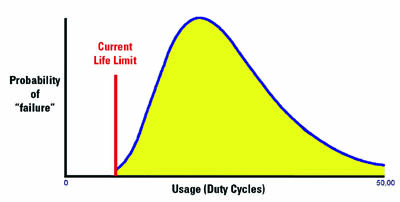
U.S. Air Force turbine engines are designed and life-managed according to the Engine Structural Integrity Program (ENSIP) guidance. This guidance is based on a "safe life" operation approach; fracture critical components are retired when one in 1,000 is predicted to have initiated a crack, as well as a fracture mechanics-based "damage tolerance" approach where the components are inspected for damage before any crack can grow to a critical size and cause failure.
Both approaches are critically dependant on material test data-mainly fatigue and fatigue crack growth. Because of the safe life design practice, all components are removed from service when they reach their life limit. The components that statistically should not have a crack, which represent the majority of the components, are removed from service with substantial remaining life.
If the variability in fatigue life is driven by experimental considerations rather than the inherent variability of a given material product, the usable life of a component could be greatly under-predicted. Load frame misalignment is one of the main experimental variables that can be eliminated today with correct experimental procedure.
Looking forward, driving load frame variability from material testing will only increase in importance. In the future, gas turbine engine parts will be made from advanced materials that can be very
brittle-high-temperature intermetallics, ceramic matrix composites and even some monolithic ceramics. When testing low-ductility materials, correct load frame alignment is even more critical.
Source: MTS Systems Corp.
Experimental variability
Experimental variability is more pervasive than one might assume. Load frame misalignment is inevitable, and even correctly calibrated load frames will deliver incorrect and unreliable data if they are unaligned or misaligned. Systems can drift out of alignment due to a number of factors, including the initiation of new test programs, or changes in fixturing and accessories. Such misalignment is indicated by particular telltale patterns in the way specimens fail. When conducting crack growth experiments, for example, the cracks will not run straight in specimens if a load frame is not correctly aligned. In fatigue testing, where failure initiation sites should be relatively random, repeated failures on one side of the specimen or the other are indications that a load frame is likely out of alignment.
Test variability driven by experimental considerations also is costly. Gaining meaningful data from misaligned systems requires the testing of far greater numbers of specimens, extending the duration of test programs. The number of mechanical property tests that must be conducted to qualify an aerospace material is driven by the measured variability in the test results. Therefore, if the variability is induced by the experimental procedures, the number of tests that must be conducted is increased.
Likewise, misaligned test systems can drive up costs significantly by requiring the stocking of large quantities of spare parts to accommodate unanticipated maintenance actions. The aerospace industry, for example, is likely paying a huge cost for experimentally induced material variability. Because of the stringent design requirements for all critical aerospace systems, any variability in data that does not represent a true material limitation will increase system weight, resulting in increased fuel consumption by flying with components that are structurally more capable than necessary for safe operation. Flawed life prediction methodologies for gas turbine engine components could result in higher frequencies of unscheduled engine removals, greatly raising fleet maintenance costs and negatively affecting Air Force readiness.
Whether conducting quality control testing or new materials research, it is critically important to drive the experimental variability out of the material testing equation through the routine measuring and alignment of load frames. Achieving this in a consistent, cost-effective manner, however, can prove problematic, particularly for a large test lab with several load frames.
The Mechanical Behavior and Life Prediction Laboratory in the Air Force Research Laboratory Materials & Manufacturing Directorate at Wright Patterson AFB has more than 26 servohydraulic load frames. With a demand for great flexibility from these test machines, it is necessary to perform alignment checks every time the grips, crossheads and fixturing are changed, or to switch to a new or different length specimen.
To facilitate such frequent alignment checks, each test machine is equipped with a dedicated alignment system. Comprised of an alignment fixture and measurement utility, these easy-to-use systems deliver the necessary software, networking, data acquisition and conditioning functionality needed to maintain correct alignment on all of the lab's test systems. This ensures that all of the lab's test systems comply with industry regulations and standards for material testing accuracy without compromising tight test schedules or the test lab budget.
The advanced materials now being developed for the aerospace industry will be affected by test technique. This is why standards organizations such as ASTM, ISO, SAE and ASME are reviewing their individual standards to ensure tests represent the material's capability and variability, not that of the test system.
Design methodologies in both the aerospace and automotive industries are moving toward probabilistic methods. The calibration of these models will require data with an unprecedented level of quality in terms of material pedigree and test accuracy. Without a reduction in the experimentally induced variability in mechanical property tests, these material and design advances will not be able to meet their intended goals. It is critical to drive the load frame variability out of the materials test equation. Q
Andrew Rosenberger, Ph.D., is a senior materials research engineer at Wright-Patterson Air Force Base. He can be reached at (937) 255-3304 or [email protected]. Paul Lehman is a marketing communications specialist for MTS Systems Corp. (Eden Prairie, MN). He can be reached at (952) 937-4781 or [email protected].
Looking for a reprint of this article?
From high-res PDFs to custom plaques, order your copy today!