Quality Measurement: Use Air to Improve Measurements

Many machinists count on conventional mechanical gages to perform straightforward and adequate inspection. However, many others have been turning to air gages because their benefits are clear: Noncontact inspection, higher resolution, ease of use, purging of contamination and resistance to fouling are the name of the game for today's air gage technology.
A tried-and-true technology that was developed in France before World War II, air-gaging employs the use of air-flow volumes and air pressure to measure part dimensions. It represents Edmunds Gages' (Farmington, CT) core measurement technologies because of the many advantages it brings to the manufacturing process. As a noncontact means of precise comparative dimensional measurement, air gaging is particularly useful for checking soft, highly polished, thin-walled and other delicate materials. It is ideal for measuring dimensions with tolerances smaller than 0.005 inch, and when gaging tight tolerances, a resolution as small as 0.000002 inch or more can be achieved.
Air gages are easy to use even by unskilled operators. Operation is as simple as presenting a tool to a work piece and observing a reading. It also is fast, allowing a row of multiple column amplifiers, for example, to be scanned in one glance thus reducing time and operator fatigue. Most air-gage systems operate at air pressures that can purge work pieces of contaminants such as abrasive particles and coolant at the measurement point, eliminating the need for separate cleaning in most operations. Also, because air gage tooling contains no moving parts, it is virtually immune to fouling.
While air gaging has and will continue to serve as a relatively simple and cost-effective shop-floor metrology solution, the technology does face its share of challenges and continues to improve to meet customer needs.
Contrary to claims that air gaging reached its peak years ago, providers are seeing an increasing demand for a technology that remains among the most flexible of inspection methods-capable of measuring a wide range of dimensional and geometry characteristics, as well as deep bores, blind holes and counterbores. Depending on the application, air gage providers continue to build on this method, meeting new requirements for air conservation, improved repeatability, data acquisition and more.

Air gages improve
"For all the benefits of air gages, as with every gage, the technology does have some shortcomings, one of which is the cost of using compressed air," says Dick Mierzejewski, vice president of sales for Edmunds Gages. "Unless performing 100% inspection, often the operator will set down the gage on a bench where it sits and blows air. Even with a shut-off valve, you're still relying on the operator to use it. With rising utility costs, many manufacturers have been seeking ways to conserve on this air."
A recent survey by the U.S. Department of Energy shows that the generation of compressed air at many industrial facilities is among the most expensive sources of energy, accounting for 10% to 30% or more of electricity consumed. "A typical cost for compressed air is about $0.25 per 1,000 cubic feet," Mierzejewski says. "That number can vary substantially depending on the efficiency and age of the compressor and distribution system."
To help combat this, Edmunds Gages has developed an automatic air-sensing package to toggle the air flow from a minimal cost-savings rate to the normal flow rate used for gaging. This sensing capability automatically occurs on the manual application of the air tool. The "Auto-Air" system normally allows a low-pressure, small-volume flow of air to pass through the column to the air tool.
On application of the air tool to a part or master, the column senses a backpressure build-up and automatically switches the air flow for normal gaging use. This regulated pressure stays active for a predetermined amount of time-five, 10 or 15 seconds-after the tool is removed from the part or master. The active time period is selectable through the use of an enter button on the face of the column amplifier. This "ease of use" forgoes the need to use a PC to download the time delay. Also, the system's design contains no shut-off valve that would require the operator to manually open and close the valve.
Chris Koehn, president of Stotz Gaging Co. (Freeport, IL), a provider of air-gaging technology, says another challenge is meeting the operator's need to address increasingly tight tolerances on the shop floor. "We have been working with our customers, particularly in the automotive industry, to measure increasingly smaller tolerances. We have been meeting requirements to measure parts with tolerances as small as 0.000080 inch while still guaranteeing a gage repeatability and reproducibility of 10%. Still, we are finding customers who want us to cut that number in half, which is a challenge because, traditionally, air gaging repeats in the neighborhood of only 0.000040 inch."
Koehn attributes much of Stotz Gaging's product line success to its use of electronic sensor technology that accomplishes repeatability within a few seconds with no lag time. "Using electronic sensors is by no means conventional, but the benefit is it requires very little time to stabilize the numbers. Our air gages also contain no moving parts so there's no wear on the gage," Koehn says.
"Dynamic measurement is another requirement we've been increasingly seeing," he adds. "Rather than take a static measurement in which the air gage is inserted and takes only one measurement, we have seen a need to move the part being measured or the gage itself using a linear drive. With this, if you have a 500-pound part, you can move the gage itself. For smaller parts, you can move the part. Computer technology allows the operator to obtain the information from the contours of the part and draw those contours. Again, in this area, we continue to work with our customers to refine the linear drive to become more accurate."

Maintaining integrity
Air Gage Co. (Livonia, MI) also understands the need to design and manufacture air gaging systems and accessories to meet increasing critical part inspection requirements. "One area of need is in full statistical analysis of process capability," Air Gage Vice President Barney Isaacson says. "As customers become more computer-literate, they want more control over their data. Particularly in the area of software, we felt it necessary to develop a platform across all products that also gives our customers complete access to writing and updating their own programs."
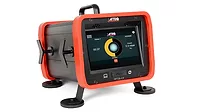
Air Gage's industrial computer system allows part measurement characteristics to be entered and saved for an unlimited number of gages. Easy-to-use software menus help to guide the operator through a series of lists that specify details for gage calibration, operating instructions and measurement calculations.
"One application involves a valve body. We met a customer's requirement to be able to measure all of the land diameters in a valve bore and, by using the instructions on the screen, the operator can reposition as necessary," Isaacson says. "By the time the operator has moved through each of those positions, all diameters on the valve bore will have been captured quickly and accurately using full support data accomplished by an open-air spindle."
When it comes to air gages, "we're seeing an increasing need to offer customers a low-priced solution that still maintains the integrity of what they are accustomed to using this technology," Isaacson says. Q
Tech tips
• As a noncontact means of precise comparative dimensional measurement, air gaging is useful for checking soft, polished, thin-walled and other delicate materials, and it can measure dimensions with tolerances smaller than 0.005 inch.
• Most air-gage systems operate at air pressures that can purge work pieces of contaminants such as abrasive particles and coolant at the measurement point, eliminating the need for separate cleaning in most operations.
• Providers are seeing a demand for
a technology that remains among
the most flexible of inspection
methods-capable of measuring a wide range of dimensional and
Looking for a reprint of this article?
From high-res PDFs to custom plaques, order your copy today!