Quality Magazine logo
search
cart
facebook twitter linkedin youtube
  • Sign In
  • Create Account
  • Sign Out
  • My Account
Quality Magazine logo
  • NEWS
  • PRODUCTS
    • FEATURED PRODUCTS
    • SUBMIT YOUR PRODUCT
  • CHANNELS
    • AUTOMATION
    • MANAGEMENT
    • MEASUREMENT
    • NDT
    • QUALITY 101
    • SOFTWARE
    • TEST & INSPECTION
    • VISION & SENSORS
  • MARKETS
    • AEROSPACE
    • AUTOMOTIVE
    • ENERGY
    • GREEN MANUFACTURING
    • MEDICAL
  • MEDIA
    • A WORD ON QUALITY PUZZLE
    • EBOOK
    • PODCASTS
    • VIDEOS
    • WEBINARS
  • EVENTS
    • EVENT CALENDAR
    • IMTS
  • DIRECTORIES
    • BUYERS GUIDE >
      • Supplier Insights
    • NDT SOURCEBOOK
    • VISION & SENSORS
    • TAKE A TOUR
  • INFOCENTERS
    • Digital Quality Management Systems
    • NEXT GENERATION SPC & QUALITY ANALYTICS
  • AWARDS
    • ROOKIE OF THE YEAR
    • PLANT OF THE YEAR
    • PROFESSIONAL OF THE YEAR
  • MORE
    • Expert Columns
    • NEWSLETTERS
    • QUALITY STORE
    • INDUSTRY LINKS
    • SPONSOR INSIGHTS
  • EMAG
    • eMAGAZINE
    • ARCHIVES
    • CONTACT
    • ADVERTISE
  • SIGN UP!

Ensure the Suitability of Optical Shaft Gaging
By BNP Media Staff
February 27, 2009
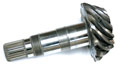
Pinion shafts from the pilot series as evidence of the test equipment and test process suitability. Source: Hommel-Etamic America


As workpieces become more complex and manufacturers are expected to provide fully inspected, documented parts, there is increasing interest in noncontact gaging, specifically optical gaging.

Shafts, often including features such as gears, multiple diameters, notches and grooves, are key, functional parts in a range of products, from aerospace and powertrain to fuel management, bearings, hydraulic and other industrial assemblies. Measurements of shaft features-diameters to surface finish and form-must be accomplished to microns in a single pass with detailed documentation.

To ensure quick, noncontact measurement of shaft geometry, optical shaft measuring systems are increasingly being used in series production situations because of their flexibility in measuring a broad range of part sizes and features.

Optical shaft metrology enables rotational-symmetrical workpieces to be measured quickly and flexibly during the production process. When testing dimensions that are key to overall functionality, in addition to having strict tolerances, accuracy and repetitive precision become primary considerations.
Ensuring Measurement Reliability

When manufacturing shafts for engine, powertrain and transmission components, such as those used in automotive and aerospace industries, it is extremely important to adhere to the strict tolerance limits for diameter dimensions along with the envelope requirements used to ensure assembly functionality.

To ensure that the process is well suited to the task, a measurement uncertainty budget should be established to bring clarity and transparency to the situation.

After a target measurement uncertainty for any tolerance of interest is established, it must be adhered to. It is key to using this measuring method to one’s advantage when measuring characteristics that are vital to functionality. By using a measuring uncertainty budget, a manufacturer can ensure that an optical shaft measuring system is suitable for the task in question. This budget can be determined based on regulations as seen in Figures 1 through 4. It is important for both the manufacturer and the end user of any optical measuring system to be aware of both the standard and extended measuring uncertainty of the process.

First, even before the series production begins, the operator must procure a suitable measuring system. This way its suitability for measuring characteristics key to functionality can be ensured, and quality management standards’ requirements can be met and the risk of false test decisions reduced.

The measuring system manufacturer must prove the suitability of the test equipment for the actual measurements to the user. A measuring uncertainty budget offers security for customer commitments and provides notes on minimizing measurement deviations. That is why this process is important to optical gaging.
Two Ways to Suitability

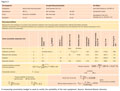
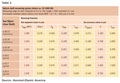
If, for example, the shaft measuring system is used to measure the bearing diameter D of a gear shaft (tolerance field location js7), the standard uncertainty, Udm, of the measuring system is established first from its maximum permissible deviation limits MPE= (2 + D/100) µm, with D in millimeters as seen in Table 1. In a test, the proof was obtained using three hard turned and three ground pinion shafts.

Assuming that the rectangular distribution measurement deviations (coefficient b=0.58) of the measuring system are within these “device error limits,” the results for Udm (MPE) shown in Table 1 are obtained.

Key measuring conditions are the monitoring of the calibration state using built-in, fine-tuned standards (calibration disks) as references. It also is essential to be able to automatically correct measurement deviations due to fluctuations in environmental temperature and in the workpieces from the reference temperature of 20 C.

The metrological properties of the measuring system can quickly become clear. The combined standard uncertainty (Udm) of the test equipment, based on the directly active uncertainty characteristics, is determined through repeat measurements on calibrated step standards.

The following are included in the measuring uncertainty budget for the test optical gage for shaft diameter 38.12 js7:
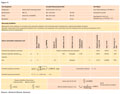
  • The calibration uncertainty with which the step standard was calibrated. In this case, Ucal = 0.3 µm + 0.8 x 10⁻⁶ x D, with D in millimeters. It is specified as the extended measuring uncertainty in the calibration certificate and is reduced using the factor k = 2 (P = 95%) to a standard uncertainty of 165 nanometers (nm).

  • The measured value resolution 0.1 µm, comparable with the graduation. With the limit value a = 0.5 x resolution and assumed triangular distribution (b = 0.41), there is an estimated type B standard uncertainty of 20.5 nm.

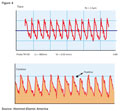
  • The repeatability of the measurement was determined by taking 50 measurements on the standard. The calculated standard deviation sg of 59.1 nm entered in the measuring uncertainty budget for the test equipment as type A standard uncertainty.

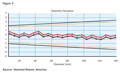
  • The systematic measurement deviation (bias) of the measuring system, throughout the partial measuring range under observation, was determined as the difference of the average Pg of the measurements on the standard to determine the repetitive precision to the calibrated diameter xm of the level standard. The measurement error determined in this way is considered a limit value and is transformed under the assumption of a standard distribution (b = 0.33) to a standard uncertainty of 9.11 nm. The course of the systematic measurement deviations of the measuring system within the permissible limit values was determined by the certified standard (see Figure 3).


  • Measuring Uncertainty Budget

    The measuring uncertainty budget illustrates that significant parts of the comparatively low combined standard uncertainty of 198 nm for the shaft measuring system used results from the calibration uncertainty of the standard (69%) and the systematic measurement deviation of the measuring system (21%).

    The comparison of the standard uncertainty of the test equipment with the diameter tolerance indicates that the optical gage is suitable for the measuring task at hand. With comparable measuring conditions, the smallest testable diameter tolerance in the nominal dimension range with this shaft measuring system is 2.978 micrometers.

    The high measuring accuracy and the repetitive precision of the measuring system during automated diameter measurements for relatively small tolerance classes also is verified by the other shaft fits that were tested as seen in Table 1.

    Based on the fact that the triple standard uncertainty of the test equipment should only equal a maximum of 20% of the measuring tolerance (if T≤IT7), then the smallest testable diameter tolerances Tmin in the nominal dimensions range are the basis for the test plan.
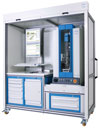
    To ensure quick, noncontact measurement of shaft geometry, optical shaft measuring systems are increasingly being used in series production situations because of their flexibility in measuring a broad range of part sizes and features. Source: Hommel-Etamic America

    Advanced Measuring Uncertainty

    To ensure that correct test decisions are made at the tolerance limits, the advanced measuring uncertainty of the test process must be known. The usual variables that influence the length measurements-operation and temperature-can be almost totally ignored because the measurement is automated and the temperature differences resulting from the measurement deviations are largely compensated for, depending on operating conditions.

    Workpiece conditions that can cause measuring uncertainty during series measurements, such as the geometric surface structure, form deviations and contamination, can lead to inner part control that equals the standard uncertainty of the object, uObject.

    The influence of form deviations and surface roughness when determining the diameter over the cylinder envelope lines also is largely reduced by the choice of the evaluation process. The diameter of the hard-turned bearing seats can, for example, be determined via the peakline of the surface profile and is recorded by the CCD line of the optical gage in high resolution.
    To determine the object dispersion, 50 measurements were taken from the bearing cylinder under repetitional conditions. The standard deviation, sn, is calculated with these measurements and is included in the measuring uncertainty budget as the standard deviation, uObject (Type A).

    The standard uncertainty of the test equipment uPM = 198 nm and the object uObjekt = 473 nm as well as an estimated value of 500 nm for the unknown systematic measuring uncertainty are used to determine the additional measurement program related measuring uncertainty test process U for the shaft diameter 38.12 js7. The measuring uncertainty represents an interval within which the unknown “true” measurement result can be determined with the defined probability (P = 95%, k = 2).

    The suitability of the test process can be determined by looking at the ratio of the extended measuring uncertainty to the characteristic tolerance. With a shaft diameter of 38.12 js7, for example, and a diameter tolerance T of 24 µm, the ratio equals U:T = 0.049.

    The extended measuring uncertainty of the diameter measurement for the measurement task therefore equals 4.9% of the tolerance. This proves the suitability of the test process for this characteristic. Q

    This information is based on work by Dr. Christian Beck, manager of the production metrology and research department at the Institute for Management and Production Metrology of the TEQ GmbH (Chemnitz, Germany), and Dr. Uwe Siefke, application specialist for optical metrology at the Hommel-Etamic GmbH plant (Jena, Germany).

    Quality Online

    For more information on noncontact gaging, visit www.qualitymag.com to read these articles:

  • “Optical Gaging Expedites Product Development”
  • “The Many Faces of Automatic Gaging”


  • Tech Tips

  • Measurements of shaft features must be accomplished to microns in a single pass with detailed documentation.

  • Optical shaft measuring systems are increasingly being used in series production situations because of their flexibility in measuring a broad range of part sizes and features.

  • To ensure that the process is well suited to the task, a measurement uncertainty budget should be established to bring clarity and transparency to the situation.

  • Share This Story

    Looking for a reprint of this article?
    From high-res PDFs to custom plaques, order your copy today!

    Recommended Content

    JOIN TODAY
    to unlock your recommendations.

    Already have an account? Sign In

    • 2024 Quality Rookie of the Year Justin Wise 1440x750px banner with "Quality Rookie of the Year" logo inset

      Meet the 2024 Quality Rookie of the Year: Justin Wise

      Justin Wise is an exceptional individual who has been...
      Aerospace
      By: Michelle Bangert
    • Man with umbrella and coat stands outside while it rains at night looking at a building.

      Nondestructive Testing: Is there an ethics problem?

      I was a whistleblower who exposed fraudulent activities...
      NDT
      By: Dale Norwood
    • Unraveling Deflategate: Football stadium with closeup of football on field

      Unraveling the Tom Brady Deflategate

      The Deflategate scandal erupted following the 2014 AFC...
      Measurement
      By: Greg Cenker and Henry Zumbrun
    Manage My Account
    • eMagazine Subscriptions
    • Newsletters
    • Online Registration
    • Subscription Customer Service
    • Manage My Preferences

    More Videos

    Sponsored Content

    Sponsored Content is a special paid section where industry companies provide high quality, objective, non-commercial content around topics of interest to the Quality audience. All Sponsored Content is supplied by the advertising company and any opinions expressed in this article are those of the author and not necessarily reflect the views of Quality or its parent company, BNP Media. Interested in participating in our Sponsored Content section? Contact your local rep!

    close
    • This image shows a person seated next to a Bobcat T66 compact track loader.
      Sponsored byPolyWorks by InnovMetric

      Supercharging Digital Gauging at Bobcat North America

    • Dorsey Calibration Lab photo by Tom LaBarbera Picture this Studios
      Sponsored byDorsey Metrology International

      Ensuring Product Quality in a Competitive Manufacturing Landscape

    • This image displays a Eddyfi Technologies Cypher portable inspection instrument alongside a scanner for non-destructive testing (NDT).
      Sponsored byEddyfi Technologies

      A Safer, Smarter Approach to Weld Inspection: Why Advanced Ultrasonic Testing Is Redefining Industry Standards

    Popular Stories

    Mukesh headshot

    Building Quality Systems for Complex, Regulated Environments

    MicroRidge MobileCollect wireless measurement system

    Before AI Can Help, the Data Has to Be Ready

    a titanium diaphragm speaker driver

    The One Thing Elon Gets Right Is Designed to Scare You

    2026 Quality Professional of the Year!

    Events

    June 4, 2026

    Scaling Manufacturing Quality with Automation for Greater ROI

    If you need to do more with the same resources or build a new tech foundation, this session shows where to start and how to create a more efficient, scalable, cost-conscious quality process.

    June 9, 2026

    Future-Proof your Quality Processes with Advanced 3D Optical CMM Technology

    Discover how to effortlessly capture complex data, leverage true multi-sensor automation, and ensure continuous operation without creating inspection delays.

    View All Submit An Event

    Products

    Lean Manufacturing and Service Fundamentals, Applications, and Case Studies

    Lean Manufacturing and Service Fundamentals, Applications, and Case Studies

    See More Products
    Quality Podcast Channel Custom Content

    Related Articles

    • Shaft Gaging

      Flexibility is the Name of the Game in Shaft Gaging

      See More
    • calibrated light source

      Optical Shaft Metrology: A New Generation of Measuring Systems Provides Cutting-Edge Precision, Accuracy

      See More
    • Optical Shaft Measurement System

      See More

    Related Products

    See More Products
    • Measurement and Gaging DVD

    • ZEuCDwAAQBAJ.jpg

      Lean Six Sigma In The Age Of Artificial Intelligence: Harnessing The Power Of The Fourth Industrial Revolution

    • Gaging and Inspection Tool Design DVD

    See More Products

    Events

    View AllSubmit An Event
    • August 12, 2025

      Enhancing Shop Floor Metrology: The Case for 3D Optical Gauges in Quality Management

      On Demand This webinar will discuss how 3D optical gauges can help you qualify and quantify your inspection callouts, defects, geometries of interest, and surface finish in seconds – right on the shop floor.
    View AllSubmit An Event
    ×

    Stay in the know with Quality’s comprehensive coverage of
    the manufacturing and metrology industries.

    Newsletters | Website | eMagazine

    JOIN TODAY!
    • RESOURCES
      • Advertise
      • Contact Us
      • Directories
      • Manufacturing Division
      • Store
      • Want More
    • SIGN UP TODAY
      • Create Account
      • eMagazine
      • Newsletters
      • Customer Service
      • Manage Preferences
    • SERVICES
      • Marketing Services
      • Market Research
      • Reprints
      • List Rental
      • Survey/Respondent Access
    • STAY CONNECTED
      • LinkedIn
      • Facebook
      • YouTube
      • X (Twitter)
    • PRIVACY
      • PRIVACY POLICY
      • TERMS & CONDITIONS
      • DO NOT SELL MY PERSONAL INFORMATION
      • PRIVACY REQUEST
      • ACCESSIBILITY

    Copyright ©2026. All Rights Reserved BNP Media, Inc. and BNP Media II, LLC.

    Design, CMS, Hosting & Web Development :: ePublishing