Robots Inspect It All

Robots are repeatable, reliable and flexible, leading many to adopt this technology for their application. Laser gaging with servo positioning of sensors is seen here. Source: Cincinnati Automation
One million robots can’t be wrong. The Robotic Industries Association (RIA, Ann Arbor, MI) estimates that more than one million robots are being used worldwide, with more than 186,000 robots now used in the United States.
Robots have become a familiar presence on the factory floor, with increasingly sophisticated robots contributing to this growth. Robots are repeatable, reliable and flexible, leading many to adopt this technology for their application.
Robots have come a long way since the word was introduced by Czech writer Karel Čapek in 1921-not only are robots on factory floors, but some, including Honda’s 4-foot, 3-inch humanoid ASIMO, have fan Web sites.
The appeal of robotic inspection lies in its flexibility, as well as improvements in product quality and productivity. Having the ability to change product mix rapidly is a selling point, as is the reduction in scrap and rework.
Though they have not displaced human inspectors, robots are used for many different applications, says Ernie Kenneway, general manager of Dunkley International (Kalamazoo, MI). “I think you’re going to see more and more robots on the factory floor. They’re repeatable, reliable, they show up for work every day,” Kenneway says. “If something can be done with a robot, it makes sense to use one.”

A robot-mounted vision system and lighting package are able to look at a variety of parts at infinite angles. Source: Dunkley International
Robotic Inspection Applications
Robots are used in today’s applications for a number of tasks. Dunkley uses robots and vision in two ways: robot finishing and robot final inspection.In the first scenario, the robot takes the part to a number of finishing tools. Occasionally the tool will break, leaving the tool in the part or not completing the part. Robots solve this problem by presenting the part to a vision system, which can determine if all operations are completed to specifications. If not, the vision system will have the robot put the part in a reject area.
Robots also can aid final inspection on large and heavy parts. The part can be a different part number with different options each time.
But in both approaches, whether the robot travels to the part or brings the part to an inspection station, the system saves the image information. After the parts are inspected, those images are stored on a server so the customer now has a record of what happened on that part. This gives both the company and the customer a way to track what was shipped, Kenneway says.
If the application involves a very large assembly, it is best to use the robot as the vision movement system. It depends on the physical size of the part to inspect-the larger the object, the easier it is to put the camera on the robot and inspect it.
Implementing robotic inspection systems is not a plug-and-play task, however.
Phillip Smith, president of Cincinnati Automation (Erlanger, KY), says that robots cannot be plucked off the shelf and put straight onto the factory floor. As with so many products available today, there is no one-size-fits-all solution in robotics. Smith points out that even if two companies are both inspecting the same part and would like to use robots, they tend to want to inspect parts differently.
“Robots allow us the flexibility to provide inspection and gaging solutions to meet a customer’s specific requirements,” Smith says.
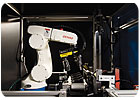
Vision guided robotic systems have become a familiar presence on the factory floor, with increasingly sophisticated robots contributing to this growth. Source: Cincinnati Automation
“If there’s a large range of parts-that would cause people to need to have to move sensors and cameras into positions to inspect or gage parts-and the number one way to do that is robots,” Smith says.
Just like their human counterparts, robots come in different shapes and sizes. Articulated arm robots provide flexible robotic inspection. “Robots help us to develop solutions that become flexible and can work over a range of part sizes,” Smith says. For example, if a manufacturer only has one type of pin to inspect, it could use a feed system and inspect it without any trouble. But if the company has other sizes or components, it would need a more flexible system in order to inspect all of the parts.
This is where robots shine. The machines provide ease of changeover, allowing inspection of different parts. Before people started using servos, they perhaps would have had two-position manual locators and moved sensors from one position to another, Smith says. Plenty of people have had two or more cameras to accommodate the range of part sizes.
Robotic inspection systems thus offer productivity improvement because they do not require changeover. Operators simply select a part number on the human machine interface (HMI) to inspect the selected parts.

A robot mounted vision system completes final assembly inspection. Source: Dunkley International
Robot Installation
Dunkley handles all aspects of a vision project, “from A to Z, soup to nuts,” Kenneway says. When a customer approaches Dunkley about an application, they typically go onsite to see the production environment. The company will determine if it has the capability to help the customer and determine if a robot is a good fit. If it is, they do a proof of concept, trying the solution on a small scale to take some of the risk out of it, both to satisfy the customers as well as themselves.To ensure their products match the application, Cincinnati Automation discusses the project with customers in detail before proposing a solution. Sometimes they look at an application and the solution is obvious, Smith says, such as needing an articulated arm. From there they drill down the checklist: What kind of reach do you need? What sort of payload are you looking at? How fast do you want to do this task?
They will keep moving up in robot size to match the customer requirement, making sure that the solution is as simple as possible so it is easier to install, support and keep in operation. If needed, the customer can move up in robot size from there.
No matter what the application, robots are not a product someone buys and has working the next day. All told, a typical robotic inspection system would take Cincinnati Automation approximately 15 weeks from start to finish, Smith says.

A robot cleans and deburrs parts then presents the part to the vision system for final inspection. Source: Dunkley International
Trends in Robotics
Though robotics, like other capital equipment, has taken a hit this year, Jeffrey Burnstein, executive vice president of the RIA, says the organization is positive about the future. “Long term, we certainly see growth for robotics in a lot of industries,” Burnstein says, including solar panel manufacturing and alternative energy areas.“Overall reduction in manufacturing costs is often a key driver,” he says. “If you can drive the costs of production down, it allows you to stay competitive, and robotics allows you to play a role in that.”
Cost is not the only issue, however-quality also is important. Burnstein recalls an automotive manufacturer aiming for high quality in windshield sealant, a difficult job to do correctly. The robot is much more accurate at this than humans, meaning that far fewer people come back for repairs. Thus it is much less expensive to have a robot do the job than even the cheapest of manual labor.
Along with the robots themselves, the reasons for using robotics also have changed, Burnstein says. In the beginning, robots were used to remove people from dull or dangerous work, tasks that were easy to automate. Over time, robots began to be used for more-improving quality and productivity, getting products to market faster and competing globally.
To keep up with these changing times, robots have advanced in recent years, with robots today certified to work in different environments including clean rooms and wash downs. Burnstein predicts robots will continue to be used in a wider variety of industries. Driven in large part by global competition, manufacturers will need to implement robotics in order to be competitive, a positive long-term trend for the industry. Developments in safety systems also will allow robots to work closer with humans, without a fence around the robots, allowing for more applications.

Driven by global competition, manufacturers will need to implement robotics in order to be competitive. This flexible gaging system operates using precision servos. Source: Cincinnati Automation
Robotics Today
With all the advantages robots can provide, how prevalent are they on today’s factory floor?“If they’re a smaller manufacturing company, this could be their first implementation of robots,” Smith says. “If they’re a mid-range or larger company, they have been exposed to it before.”
Though robots as we know them today have been around for a couple of decades, Smith says the novelty has not worn off: “People still see them as new and a way to have a current technology solution for whatever they’re implementing in their process.”
When suppliers can demonstrate that they are on the front lines in terms of inspection and robotic technology, that tends to give them more credibility with the customer, Smith says.
“For example, one of our robotic inspection systems provides better than 10 micron gaging accuracy at multiple programmed positions around the test parts,” Smith says, “and this is something very positive for the customers.”
While industry has been using robotics for years, improvements continue. Positional accuracy gets better with each release of new controllers, Smith says.
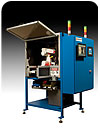
Robotic inspection systems offer productivity improvement because they do not require changeover. Source: Cincinnati Automation
“I think what probably has not been utilized yet is the ability to have very large assemblies inspected,” Kenneway says. Instead of someone trying to physically look up the part number, it is far easier for the computer to have that retained. When the camera grabs the image information, the robot will know if it passed that image, and go to the next location.
“I think a lot of people have not taken full advantage of all the process control available today,” Kenneway says. “There’s an awful lot you can do now between process controllers operating assembly lines, intermediate inspection and vision tied to the robot.”
So no matter what the application, manufacturers would do well to see if robots would be a good fit. And while the ASIMO is not available for purchase, many other robots are available for a range of applications. The machines may not all be able to run 3.7 mph, but they can help applications run better. Q
For more information on the organizations mentioned in this article, visit:
Quality Online
For more information on robots, visit www.qualitymag.com to read the following:“Seven Questions to Selecting a Measurement System”
“The Future of NDT: Radiography Meets Robotics”
Case Studies: “Testing a Soft-Body Robot”
Tech Tips
Looking for a reprint of this article?
From high-res PDFs to custom plaques, order your copy today!