Quality Magazine logo
search
cart
facebook twitter linkedin youtube
  • Sign In
  • Create Account
  • Sign Out
  • My Account
Quality Magazine logo
  • NEWS
  • PRODUCTS
    • FEATURED PRODUCTS
    • SUBMIT YOUR PRODUCT
  • CHANNELS
    • AUTOMATION
    • MANAGEMENT
    • MEASUREMENT
    • NDT
    • QUALITY 101
    • SOFTWARE
    • TEST & INSPECTION
    • VISION & SENSORS
  • MARKETS
    • AEROSPACE
    • AUTOMOTIVE
    • ENERGY
    • GREEN MANUFACTURING
    • MEDICAL
  • MEDIA
    • A WORD ON QUALITY PUZZLE
    • EBOOK
    • PODCASTS
    • VIDEOS
    • WEBINARS
  • EVENTS
    • EVENT CALENDAR
    • IMTS
  • DIRECTORIES
    • BUYERS GUIDE >
      • Supplier Insights
    • NDT SOURCEBOOK
    • VISION & SENSORS
    • TAKE A TOUR
  • INFOCENTERS
    • Digital Quality Management Systems
    • NEXT GENERATION SPC & QUALITY ANALYTICS
  • AWARDS
    • ROOKIE OF THE YEAR
    • PLANT OF THE YEAR
    • PROFESSIONAL OF THE YEAR
  • MORE
    • Expert Columns
    • NEWSLETTERS
    • QUALITY STORE
    • INDUSTRY LINKS
    • SPONSOR INSIGHTS
  • EMAG
    • eMAGAZINE
    • ARCHIVES
    • CONTACT
    • ADVERTISE
  • SIGN UP!

Improve Productivity with Phased Array
By Dane Hackenberger
May 1, 2010
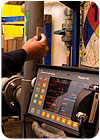
The inspection process that used to take three, four or five different probes can now be done with one phased array probe. Source: GE Sensing & Inspection Technologies


Imagine shining a light down a dark hallway. The light source transmits the light and your eyes receive the light. Even if you were able to bounce the light off the walls, it would be difficult to see everything in that hallway with a single beam of light. But, if you bring a few friends that also have lights, together you would be able to illuminate and view the entire hall.

This is how phased array works. It makes use of multiple sensors angled at varying degrees in order to obtain greater coverage. In doing this, it electronically directs a sound beam to every corner of the hall, providing complete inspection coverage and better probability that operators will detect the object or defect they are seeking.

The Beginning

Phased array technology was first introduced in the early 1970s into the medical field using ultrasounds. Although the idea of phased array has been around since the 1800s, the industry was not able to harness this technology for inspection means until more than 100 years later. This advanced method of inspection has now expanded from the medical field into the industrial arena, proving to enhance results, speed inspections and provide productivity.

In the industrial environment, the traditional means of inspection have changed drastically during the past few decades. Early inspections were restricted to the application of the probe. The probe itself would have been a single-element transducer, containing one operating element. This element would have been transmitting and receiving a single ultrasonic pulse. Multiple probes with various focusing, apertures and angles often were needed to perform every inspection.

The data also was simplistic for these single-element transducers in the form of an A-scan, essentially an oscilloscope trace with a time and amplitude component. Inspections were time-consuming and tedious.
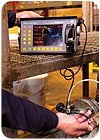
Phased array decreases total inspection time, improves the inspection results and increases the confidence in the inspector’s decision-making. Source: GE Sensing & Inspection Technologies

Probes Expand Functionality

The introduction of angle beam and dual-element probes greatly expanded the functionality of ultrasonic inspection. Defects could not only be detected, but also measured. The inspection data also evolved from simplistic A-scans to B-scans and C-scans. Even with this development, multiple probes often were necessary to fully inspect a part that needed inspections from multiple angles. The task of changing probes, recalibrating and re-measuring still proved to be tedious.

Conventional probes are composed of a single crystal, or element. An element is the active component in the probe that vibrates to generate ultrasonic energy. In order to change the sound angle, an inspector changes the angulation of the probe relative to the inspection surface by either changing probes or changing the ultrasonic wedge fixture attached to the probe.

For phased arrays, the crystal is cut into many parts. Each of these elements is individually driven by a pulser that is capable of delivering the excitation pulses to each element with minute time-shifts.

Many elements can be pulsed together at once to mimic the acoustic output of a single probe, or they can be pulsed as a group with each element receiving its pulse time-shifted from its neighbors. A specific set of time-shifted pulses is referred to as focal law, or phasing sequence.

These focal laws allow one multi-element array to produce many different sound angles within a test piece and can be changed electronically and very rapidly. In other words, one array does the job of many single-element transducers.

Advances Continue

Advances in electronics and computerization have helped the advances in inspection methods and results. Today, data is processed, displayed, analyzed and stored all within the same instrument. The instrument also can transmit data to remote locations for further analysis, reporting or archiving.

The phased arrays also are advancing; today there are dialogue probes that are preprogrammed with setup information to assist the inspector in setup and hasten the calibration process. Phased arrays also are available in many configurations to optimize the acoustic and mechanical performance to provide the best solution for an inspection application.

There are many advantages to phased array, but speed is probably the most prevalent. The inspection process that used to take three, four or five different probes can now be done with one phased array probe. The need to change probes, recalibrate and re-inspect is eliminated with phased array. Quicker inspections equate to less downtime, which in turn equates to real savings for the customer.

The second largest advantage is the quality of the inspection results. As mentioned earlier, the probability of detection is higher because of the complete coverage of the part with the phased array. Also, the results are presented as an image instead of an A-scan, which offers more information to the inspector and is much more intuitive. This allows inspectors to make more confident decisions and enables the improved probability of detection and inspection speed. The more an inspector can see and understand about the component, the more confident he can be about the quality of his inspection.

Phased array decreases total inspection time, improves the inspection results and increases the confidence in the inspector’s decision-making. Phased array also helps to eliminate the need to purchase multiple probes for the inspection of one part. This means more standardization since there are fewer parts to purchase and maintain.

As phased array technology improves and the inspector becomes more accustomed to the technology, it will soon become a standard in the inspection world. Traditional inspection means will not necessarily go away, but the power and impact of phased array in industry will be more important. Q

Tech Tips

  • There are many advantages to phased array, but speed is probably the most prevalent.

  • The inspection process that used to take three, four or five different probes can now be done with one phased array probe.

  • The need to change probes, recalibrate and re-inspect is eliminated with phased array.


  • Quality Online

    For more information on phased array, click on the following:
  • Q-Cast Podcast: How Can Phased Array Help You
  • Unconventional NDT
  • No ‘Flaws’ in NDT Approach
  • Share This Story

    Looking for a reprint of this article?
    From high-res PDFs to custom plaques, order your copy today!

    Dane Hackenberger is a product manager for GE Sensing & Inspection Technologies (Billerica, MA). For more information, call (866) 243-2638, e-mail [email protected]or visit www.geinspectiontechnologies.com.

    Recommended Content

    JOIN TODAY
    to unlock your recommendations.

    Already have an account? Sign In

    • 2024 Quality Rookie of the Year Justin Wise 1440x750px banner with "Quality Rookie of the Year" logo inset

      Meet the 2024 Quality Rookie of the Year: Justin Wise

      Justin Wise is an exceptional individual who has been...
      Aerospace
      By: Michelle Bangert
    • Man with umbrella and coat stands outside while it rains at night looking at a building.

      Nondestructive Testing: Is there an ethics problem?

      I was a whistleblower who exposed fraudulent activities...
      NDT
      By: Dale Norwood
    • Unraveling Deflategate: Football stadium with closeup of football on field

      Unraveling the Tom Brady Deflategate

      The Deflategate scandal erupted following the 2014 AFC...
      Measurement
      By: Greg Cenker and Henry Zumbrun
    Manage My Account
    • eMagazine Subscriptions
    • Newsletters
    • Online Registration
    • Subscription Customer Service
    • Manage My Preferences

    More Videos

    Sponsored Content

    Sponsored Content is a special paid section where industry companies provide high quality, objective, non-commercial content around topics of interest to the Quality audience. All Sponsored Content is supplied by the advertising company and any opinions expressed in this article are those of the author and not necessarily reflect the views of Quality or its parent company, BNP Media. Interested in participating in our Sponsored Content section? Contact your local rep!

    close
    • Key Takeaways for Quality Leaders
      Sponsored byComplianceQuest

      Key Takeaways for Quality Leaders from the 2026 Gartner Magic Quadrant™ for QMS

    • This image shows a person seated next to a Bobcat T66 compact track loader.
      Sponsored byPolyWorks by InnovMetric

      Supercharging Digital Gauging at Bobcat North America

    • Dorsey Calibration Lab photo by Tom LaBarbera Picture this Studios
      Sponsored byDorsey Metrology International

      Ensuring Product Quality in a Competitive Manufacturing Landscape

    Popular Stories

    a titanium diaphragm speaker driver

    The One Thing Elon Gets Right Is Designed to Scare You

    This image shows a person seated next to a Bobcat T66 compact track loader.

    Supercharging Digital Gauging at Bobcat North America

    Dorsey Calibration Lab photo by Tom LaBarbera Picture this Studios

    Ensuring Product Quality in a Competitive Manufacturing Landscape

    2026 Quality Professional of the Year!

    Events

    June 9, 2026

    Future-Proof your Quality Processes with Advanced 3D Optical CMM Technology

    Discover how to effortlessly capture complex data, leverage true multi-sensor automation, and ensure continuous operation without creating inspection delays.

    June 22, 2026

    Automate 2026

    Automate is North America's largest robotics and automation event — and the best place to take your ideas from insight to impact.
     
    Our show floor features the world’s leading automation solutions, from AI and robotics to motion control, vision systems, and more. Plus, our educational conference is second to none, led by the brightest minds in automation today.
     
    Ready to transform the way you work? Take the next step at Automate.
    View All Submit An Event

    Products

    Lean Manufacturing and Service Fundamentals, Applications, and Case Studies

    Lean Manufacturing and Service Fundamentals, Applications, and Case Studies

    See More Products
    Quality Podcast Channel Custom Content

    Related Articles

    • Looking Below the Surface with Ultrasonic Phased Array

      See More
    • ALS-RAPA-Pipe-Upon-Supports.jpg

      Monitoring Assets with Restricted Access Phased Array

      See More
    • Improve Productivity with Hardness Testing

      See More

    Related Products

    See More Products
    • Factory Physics for Managers: How Leaders Improve Performance in a Post-Lean Six Sigma World

    • leanss.jpg

      Lean Six Sigma for Engineers and Managers With Applied Case Studies

    • Green Lean: Achieving Outstanding Environmental Performance with Lean DVD

    See More Products

    Related Directories

    • TEST NDT LLC

      TEST NDT in Southern California is a privately-owned NDT training facility. We offer Level I, II, and III Non-Destructive Testing Training Courses in UT, RT, CR, ET, MT, PT, and VT, in addition to Phased Array and Eddy Current Array training and Phased Array Inspection of Composites in accordance with SNT-TC-1A/NAS-410, special seminars and on-site training.
    ×

    Stay in the know with Quality’s comprehensive coverage of
    the manufacturing and metrology industries.

    Newsletters | Website | eMagazine

    JOIN TODAY!
    • RESOURCES
      • Advertise
      • Contact Us
      • Directories
      • Manufacturing Division
      • Store
      • Want More
    • SIGN UP TODAY
      • Create Account
      • eMagazine
      • Newsletters
      • Customer Service
      • Manage Preferences
    • SERVICES
      • Marketing Services
      • Market Research
      • Reprints
      • List Rental
      • Survey/Respondent Access
    • STAY CONNECTED
      • LinkedIn
      • Facebook
      • YouTube
      • X (Twitter)
    • PRIVACY
      • PRIVACY POLICY
      • TERMS & CONDITIONS
      • DO NOT SELL MY PERSONAL INFORMATION
      • PRIVACY REQUEST
      • ACCESSIBILITY

    Copyright ©2026. All Rights Reserved BNP Media, Inc. and BNP Media II, LLC.

    Design, CMS, Hosting & Web Development :: ePublishing