Quality 101: Force Measurement Explained
Regardless of the technology employed, the desired result of force measurement is the same-measure the force applied to capture a reading for validation or further analysis.

Force measurement is used in many differing types of applications and may be accomplished with devices utilizing differing technologies. Typical applications include measurements of tension and/or compression and are directed at capturing properties such as strength of a material, component or a bond. The technologies include mechanical measurements utilizing calibrated springs or electronic measurements using strain gages that employ the piezoelectric effect to capture the effect of force on a load cell or strain gage. Regardless of the technology employed, the desired result is the same-measure the force applied to capture a reading for validation or further analysis.
Tension measurements are typically used when there is a desire to obtain information on the behavior of a product or material when it is pulled apart. This is a useful measurement for understanding how strong an adhesive bond is, which is relevant, for example, when a handle will support the weight of what is contained in a case, or if a child can break off a small part of a toy.
Compression measurements are typically used to obtain information on the behavior of a product or material when it is pushed together or crushed. This type of measurement is useful in understanding how much force it will take to open a door, to compact a box and open a blister-package.
Measurements may be done in validating samples of a product such as testing a button or joint. These types of measurements are most often simple procedures performed in the production environment. Researchers and design engineers also require such measurements as they work through product development or selecting materials and parts for use in manufacturing. The goal would be to have proper materials used in a product or package, or for the components to behave in a certain way. These measurements are typically performed in a lab or even may be done by a specialized testing company.
The testing that is performed may be done to reach a certain value based on the criteria established by engineering, scientists or a governing agency such as the American Society for Testing and Materials (ASTM). The acceptable result could be a value of tension or compression and may involve ensuring that there is no damage. This is called nondestructive testing (NDT). In some cases, the test is done to cause a failure: this is destructive testing. Both would fall under the broad term of force measurement.
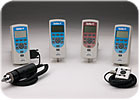
Mechanical instruments are typically used for lower accuracy measurements or measurements in conditions that are hazardous or detrimental to electronic instruments. These instruments are usually rugged and use calibrated springs and gearing to gage and display force readings. Applications such as flight line testing, product validation on the production floor and muscle strength evaluations may use a mechanical device for force measurement.
Electronic instruments are used more often for higher accuracy measurements. Electrical instruments typically offer more flexibility for the operator in that they may have communications capability for data transfer, changeable load cells for different measuring ranges, remote load cells for testing in limited spaces and incorporated functions such as statistical analyses. However, electrical instruments may not be designed for some environmental conditions and are more susceptible to damage from the elements. Some applications such as tearing force of a cloth, sampling of raw materials, plastics testing and puncture force may use an electronic instrument for force measurement.
In any case or application, one key thing to remember is that the device is only a part of the test. Many applications require repeated tests or may have to be performed several times at a specified interval. For consistency, the sample needs to be tested in a specific manner. If it is not, then the data or result becomes questionable.
There are many methods available to ensure a proper and consistent test result. A basic requirement is to ensure proper calibration of the device. Even within the calibration cycle, if the device has been over-ranged, it should be calibrated. The other requirements are wrapped into test setup and performance.
Using such devices as test stands, travel limits, load (force) limits and programmable systems are tools that are used to ensure consistency in the test setup. Performance consistency may involve such items as specific fixtures or tips for the device, using the same operator and applying the force to a specified location on the sample. All of these factors play a part in ensuring that the results are repeatable and are valid for the test that is being performed.
There are many variables to consider and the selection is most often based on the need for compliance to a standard and/or a design criterion and the type of test being performed. In all cases, consistency is the key to capturing good data and readings and will always play a large part in obtaining valid and useable results.
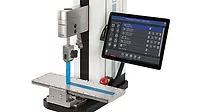
Electronic instruments are used more often for higher accuracy measurements. Source: Ametek
Force measurement is used in many differing types of applications and may be accomplished with devices utilizing differing technologies. Typical applications include measurements of tension and/or compression and are directed at capturing properties such as strength of a material, component or a bond. The technologies include mechanical measurements utilizing calibrated springs or electronic measurements using strain gages that employ the piezoelectric effect to capture the effect of force on a load cell or strain gage. Regardless of the technology employed, the desired result is the same-measure the force applied to capture a reading for validation or further analysis.
Tension measurements are typically used when there is a desire to obtain information on the behavior of a product or material when it is pulled apart. This is a useful measurement for understanding how strong an adhesive bond is, which is relevant, for example, when a handle will support the weight of what is contained in a case, or if a child can break off a small part of a toy.
Compression measurements are typically used to obtain information on the behavior of a product or material when it is pushed together or crushed. This type of measurement is useful in understanding how much force it will take to open a door, to compact a box and open a blister-package.
Compression measurements are typically used to obtain information on the behavior of a product or material when it is pushed together or crushed. Source: Ametek
Validation, Testing and Research
These measurements can be used for validation, testing and research. One particular group of measurements is even used to test and evaluate muscle strength.Measurements may be done in validating samples of a product such as testing a button or joint. These types of measurements are most often simple procedures performed in the production environment. Researchers and design engineers also require such measurements as they work through product development or selecting materials and parts for use in manufacturing. The goal would be to have proper materials used in a product or package, or for the components to behave in a certain way. These measurements are typically performed in a lab or even may be done by a specialized testing company.
The testing that is performed may be done to reach a certain value based on the criteria established by engineering, scientists or a governing agency such as the American Society for Testing and Materials (ASTM). The acceptable result could be a value of tension or compression and may involve ensuring that there is no damage. This is called nondestructive testing (NDT). In some cases, the test is done to cause a failure: this is destructive testing. Both would fall under the broad term of force measurement.
Mechanical instruments are typically used for lower accuracy measurements or measurements in conditions that are hazardous or detrimental to electronic instruments. These instruments are usually rugged and use calibrated springs and gearing to gage and display force readings. Applications such as flight line testing, product validation on the production floor and muscle strength evaluations may use a mechanical device for force measurement.
Electronic instruments are used more often for higher accuracy measurements. Electrical instruments typically offer more flexibility for the operator in that they may have communications capability for data transfer, changeable load cells for different measuring ranges, remote load cells for testing in limited spaces and incorporated functions such as statistical analyses. However, electrical instruments may not be designed for some environmental conditions and are more susceptible to damage from the elements. Some applications such as tearing force of a cloth, sampling of raw materials, plastics testing and puncture force may use an electronic instrument for force measurement.
In any case or application, one key thing to remember is that the device is only a part of the test. Many applications require repeated tests or may have to be performed several times at a specified interval. For consistency, the sample needs to be tested in a specific manner. If it is not, then the data or result becomes questionable.
There are many methods available to ensure a proper and consistent test result. A basic requirement is to ensure proper calibration of the device. Even within the calibration cycle, if the device has been over-ranged, it should be calibrated. The other requirements are wrapped into test setup and performance.
Using such devices as test stands, travel limits, load (force) limits and programmable systems are tools that are used to ensure consistency in the test setup. Performance consistency may involve such items as specific fixtures or tips for the device, using the same operator and applying the force to a specified location on the sample. All of these factors play a part in ensuring that the results are repeatable and are valid for the test that is being performed.
Consistency is Key
The selection of the device and peripheral set-up options are a function of the requirement to perform the test. If the test is being used for quality verification and has a go/no-go result, the test setup may be very simple and use a basic device to capture the results at the end of production. If the test is being used to gage the acceptability of raw materials for use in producing an end item, the test may be much more complex and require a higher level of accuracy and repeatability so a test stand, digital gage and data capture may be in order.There are many variables to consider and the selection is most often based on the need for compliance to a standard and/or a design criterion and the type of test being performed. In all cases, consistency is the key to capturing good data and readings and will always play a large part in obtaining valid and useable results.
Looking for a reprint of this article?
From high-res PDFs to custom plaques, order your copy today!