Quality Magazine logo
search
cart
facebook twitter linkedin youtube
  • Sign In
  • Create Account
  • Sign Out
  • My Account
Quality Magazine logo
  • NEWS
  • PRODUCTS
    • FEATURED PRODUCTS
    • SUBMIT YOUR PRODUCT
  • CHANNELS
    • AUTOMATION
    • MANAGEMENT
    • MEASUREMENT
    • NDT
    • QUALITY 101
    • SOFTWARE
    • TEST & INSPECTION
    • VISION & SENSORS
  • MARKETS
    • AEROSPACE
    • AUTOMOTIVE
    • ENERGY
    • GREEN MANUFACTURING
    • MEDICAL
  • MEDIA
    • A WORD ON QUALITY PUZZLE
    • EBOOK
    • PODCASTS
    • VIDEOS
    • WEBINARS
  • EVENTS
    • EVENT CALENDAR
    • IMTS
  • DIRECTORIES
    • BUYERS GUIDE >
      • Supplier Insights
    • NDT SOURCEBOOK
    • VISION & SENSORS
    • TAKE A TOUR
  • INFOCENTERS
    • Digital Quality Management Systems
    • NEXT GENERATION SPC & QUALITY ANALYTICS
  • AWARDS
    • ROOKIE OF THE YEAR
    • PLANT OF THE YEAR
    • PROFESSIONAL OF THE YEAR
  • MORE
    • Expert Columns
    • NEWSLETTERS
    • QUALITY STORE
    • INDUSTRY LINKS
    • SPONSOR INSIGHTS
  • EMAG
    • eMAGAZINE
    • ARCHIVES
    • CONTACT
    • ADVERTISE
  • SIGN UP!
Vision & Sensors

Smart Cameras Go Mobile

By Ben Dawson
January 3, 2011
A smart camera combines a digital camera, processing, software and communications in a small package. Source: Dalsa Corp.


Smart cameras combine a digital camera, processing, software and communications in a small package. They are an excellent choice for a machine vision system to do tasks such as gaging or visually detecting part defects. Currently, there are several types of machine vision systems that are commonly used for quality control.

Three Types of Machine Vision Systems

A vision sensor is appropriate for simple vision tasks, such as detecting when a part is present. Vendors such as Banner, Omron and Keyence offer a variety of sensors that measure things such as International Commission on Illumination (CIE) color or depth at a point on an object. Sensors make one type of measurements at one or a few points. They require little or no programming so are easy to setup.

Most machine vision tasks require multiple measurements on two- or three-dimensional images and so require significantly more intelligence than a simple sensor. These tasks are typically solved by a combination of vision processing functions and therefore require some programming.

Machine vision tasks that are difficult, fast or require significant computational power are best done by a PC-based machine vision system. An example of a difficult task is detecting low-contrast defects such as scratches, bubbles, discolorations, burn marks or contamination. These types of defects are poorly defined so extensive computation is required to detect them.

Smart cameras are appropriate for the many machine vision tasks that require two- or three-dimensional imaging and have moderate computation and speed requirements. Dimensional gaging, verifying a part’s outline, barcode or optical character recognition (OCR), defect detection and locating parts (perhaps to guide a robot), are examples of tasks that can be done quickly and inexpensively by a smart camera.

Some vendors call their smart cameras “sensors” perhaps to emphasize that they have limited programmability and thus should be easy-to-use. An example of a smart camera often called a sensor is a dedicated barcode reader.


PC-based machine vision systems and smart cameras require programming because they are general-purpose tools. Source: Dalsa Corp.

Riding the Mobile Computing Curve

Most smart cameras use a digital signal processor (DSP) for their intelligence. Some smart cameras also use processing elements similar to that in advanced cell phones or other mobile computing devices. These processing elements include a standard central processing unit (CPU), hardware image processors and a capable DSP.

A smart camera that uses mobile computing technology has a number of advantages. First, the demand for smarter mobile devices with ever-better features drives increases in processor performance. The smart camera can ride the mobile computing performance curve for increased speed or to take on more demanding vision applications.

Second, the inclusion of a standard CPU means familiar operating systems and machine vision software can be used. If more performance is needed, it is easy to migrate to a PC-based system running the same machine vision software.

Third, mobile computing devices are very low power and fit into small packages.

Some smart phone applications have a machine vision component. For example, one can get an appplication for a smart phone that reads a bar code which connects to reviews of that product. Also, some cell phone cameras locate faces in an image to set the color balance and exposure. However, industrial machine vision requires hardware and software not found in a smart phone. Besides, who would want to wash-down their smart phone?


It's the Software

PC-based machine vision systems and smart cameras require programming because they are general-purpose tools. If the programming takes too much time, the need and money for a machine vision project evaporates. Easy-to-use software is therefore required for rapid and successful development of a machine vision application.

Modern machine vision software allows you to program your vision application graphically-point-and-click to select a tool, such as a caliper, and then position that tool on the part to be measured. There is no programming in the usual sense. Vision operations are presented in familiar terms, rather than the terms of machine vision algorithms. For example, the caliper tool is presented as if it was a mechanical gage so there is no need to understand sub-pixel edge detection algorithms.

New smart cameras are designed to be servers on an Ethernet network and have no way to display images themselves. Instead, images are sent over the Ethernet to a client PC. Here a technician can set up and program the smart camera from the client PC and then log off of the smart camera and let it run independently. Results are reported over Ethernet using standard industrial protocols or via digital input/output lines from the camera. One client PC can manage many smart cameras.


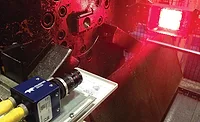
Parts from a vibratory bowl go into an index wheel that rotates to show the part to the smart camera for dimensioning. Note the protective enclosure around the smart camera's lens. Source: Prime Engineering

A Working Example

Prime Engineered Components (Watertown, CT) manufactures 800,000 precision-turned parts per week for automotive, aerospace and other industries. Defective parts cause expensive returns and hurt customer relations. Using smart cameras, Prime is doing 100% quality inspection with nearly zero part defect escapes.

One Prime facility manufactures mostly screw machined parts-parts with grooved patterns such as threaded anchor bolts. Critical dimensions for these parts include the minimum and maximum dimensions of the threads.

To measure these dimensions, the parts are fed by a vibratory feeder into slots on an index wheel. The wheel turns to position the part in front of the smart camera and a caliper tool measures the thread dimensions.

Defective parts are manually removed from the product stream. It might seem odd to have automated the handling and visual inspection of the parts but not defect sorting, but the defect rate is low and Prime examines defective parts to correct the production process. Once again, easy-to-use software for the smart camera was the key to getting this inspection task built.

The convergence of smart mobile devices and machine vision allows small, fast and inexpensive machine vision systems that are perfect for many machine vision tasks. How about having the smart camera e-mail or tweet your smart phone when there is a problem?

Tech Tips

  • Smart cameras are appropriate for the many machine vision tasks that require two- or three-dimensional imaging and have moderate computation and speed requirements.

  • Easy-to-use software is required for rapid and successful development of a machine vision application.

  • The convergence of smart mobile devices and machine vision allows small, fast and inexpensive machine vision systems that are perfect for many machine vision tasks.

  • Share This Story

    Looking for a reprint of this article?
    From high-res PDFs to custom plaques, order your copy today!

    Ben Dawson is Director of strategic development for Teledyne DALSA Industrial Products Inc. [email protected].

    Recommended Content

    JOIN TODAY
    to unlock your recommendations.

    Already have an account? Sign In

    • 2024 Quality Rookie of the Year Justin Wise 1440x750px banner with "Quality Rookie of the Year" logo inset

      Meet the 2024 Quality Rookie of the Year: Justin Wise

      Justin Wise is an exceptional individual who has been...
      Aerospace
      By: Michelle Bangert
    • Man with umbrella and coat stands outside while it rains at night looking at a building.

      Nondestructive Testing: Is there an ethics problem?

      I was a whistleblower who exposed fraudulent activities...
      NDT
      By: Dale Norwood
    • Unraveling Deflategate: Football stadium with closeup of football on field

      Unraveling the Tom Brady Deflategate

      The Deflategate scandal erupted following the 2014 AFC...
      Measurement
      By: Greg Cenker and Henry Zumbrun
    Manage My Account
    • eMagazine Subscriptions
    • Newsletters
    • Online Registration
    • Subscription Customer Service
    • Manage My Preferences

    More Videos

    Sponsored Content

    Sponsored Content is a special paid section where industry companies provide high quality, objective, non-commercial content around topics of interest to the Quality audience. All Sponsored Content is supplied by the advertising company and any opinions expressed in this article are those of the author and not necessarily reflect the views of Quality or its parent company, BNP Media. Interested in participating in our Sponsored Content section? Contact your local rep!

    close
    • This image shows a person seated next to a Bobcat T66 compact track loader.
      Sponsored byPolyWorks by InnovMetric

      Supercharging Digital Gauging at Bobcat North America

    • Dorsey Calibration Lab photo by Tom LaBarbera Picture this Studios
      Sponsored byDorsey Metrology International

      Ensuring Product Quality in a Competitive Manufacturing Landscape

    • This image displays a Eddyfi Technologies Cypher portable inspection instrument alongside a scanner for non-destructive testing (NDT).
      Sponsored byEddyfi Technologies

      A Safer, Smarter Approach to Weld Inspection: Why Advanced Ultrasonic Testing Is Redefining Industry Standards

    Popular Stories

    a titanium diaphragm speaker driver

    The One Thing Elon Gets Right Is Designed to Scare You

    This image shows a person seated next to a Bobcat T66 compact track loader.

    Supercharging Digital Gauging at Bobcat North America

    Dorsey Calibration Lab photo by Tom LaBarbera Picture this Studios

    Ensuring Product Quality in a Competitive Manufacturing Landscape

    2026 Quality Professional of the Year!

    Events

    June 9, 2026

    Future-Proof your Quality Processes with Advanced 3D Optical CMM Technology

    Discover how to effortlessly capture complex data, leverage true multi-sensor automation, and ensure continuous operation without creating inspection delays.

    June 22, 2026

    Automate 2026

    Automate is North America's largest robotics and automation event — and the best place to take your ideas from insight to impact.
     
    Our show floor features the world’s leading automation solutions, from AI and robotics to motion control, vision systems, and more. Plus, our educational conference is second to none, led by the brightest minds in automation today.
     
    Ready to transform the way you work? Take the next step at Automate.
    View All Submit An Event

    Products

    Lean Manufacturing and Service Fundamentals, Applications, and Case Studies

    Lean Manufacturing and Service Fundamentals, Applications, and Case Studies

    See More Products
    Quality Podcast Channel Custom Content

    Related Articles

    • Smart Cameras: Yesterday, Today and Tomorrow

      See More
    • Smart cameras inspecting parts

      Smart Cameras in a Manufacturing Environment: Today and in the Future

      See More
    • smart camera

      Why Smart Cameras are the Ideal Solution for Traceability

      See More

    Related Products

    See More Products
    • smart manu.jpg

      Smart Manufacturing Factory Artificial-Intelligence-Driven Customized Manufacturing

    • Streamlined Process Improvement

    See More Products

    Related Directories

    • Smart Vision Lights

      Smart Vision Lights is a leading designer and manufacturer of high-brightness LED lights for industrial applications, including machine vision. Smart Vision Lights products come with universal internal current-control drivers, offering constant or strobed operation, reduced wiring requirements, and easy installation.
    ×

    Stay in the know with Quality’s comprehensive coverage of
    the manufacturing and metrology industries.

    Newsletters | Website | eMagazine

    JOIN TODAY!
    • RESOURCES
      • Advertise
      • Contact Us
      • Directories
      • Manufacturing Division
      • Store
      • Want More
    • SIGN UP TODAY
      • Create Account
      • eMagazine
      • Newsletters
      • Customer Service
      • Manage Preferences
    • SERVICES
      • Marketing Services
      • Market Research
      • Reprints
      • List Rental
      • Survey/Respondent Access
    • STAY CONNECTED
      • LinkedIn
      • Facebook
      • YouTube
      • X (Twitter)
    • PRIVACY
      • PRIVACY POLICY
      • TERMS & CONDITIONS
      • DO NOT SELL MY PERSONAL INFORMATION
      • PRIVACY REQUEST
      • ACCESSIBILITY

    Copyright ©2026. All Rights Reserved BNP Media, Inc. and BNP Media II, LLC.

    Design, CMS, Hosting & Web Development :: ePublishing