Quality Magazine logo
search
cart
facebook twitter linkedin youtube
  • Sign In
  • Create Account
  • Sign Out
  • My Account
Quality Magazine logo
  • NEWS
  • PRODUCTS
    • FEATURED PRODUCTS
    • SUBMIT YOUR PRODUCT
  • CHANNELS
    • AUTOMATION
    • MANAGEMENT
    • MEASUREMENT
    • NDT
    • QUALITY 101
    • SOFTWARE
    • TEST & INSPECTION
    • VISION & SENSORS
  • MARKETS
    • AEROSPACE
    • AUTOMOTIVE
    • ENERGY
    • GREEN MANUFACTURING
    • MEDICAL
  • MEDIA
    • A WORD ON QUALITY PUZZLE
    • EBOOK
    • PODCASTS
    • VIDEOS
    • WEBINARS
  • EVENTS
    • EVENT CALENDAR
    • IMTS
  • DIRECTORIES
    • BUYERS GUIDE >
      • Supplier Insights
    • NDT SOURCEBOOK
    • VISION & SENSORS
    • TAKE A TOUR
  • INFOCENTERS
    • Digital Quality Management Systems
    • NEXT GENERATION SPC & QUALITY ANALYTICS
  • AWARDS
    • ROOKIE OF THE YEAR
    • PLANT OF THE YEAR
    • PROFESSIONAL OF THE YEAR
  • MORE
    • Expert Columns
    • NEWSLETTERS
    • QUALITY STORE
    • INDUSTRY LINKS
    • SPONSOR INSIGHTS
  • EMAG
    • eMAGAZINE
    • ARCHIVES
    • CONTACT
    • ADVERTISE
  • SIGN UP!
NDT

Back to Basics: Create a Good Pipe Radiograph for Wall Thickness Measurements
By Steven A. Mango
June 13, 2011
Figure 1. Source: Carestream Health


Figure 2. Source: Carestream Health

A common application of computed radiography for nondestructive examinations is profile shots for the in-service inspection of piping for erosion and corrosion. This involves a side view of the pipe with one or both outside walls visible, allowing the inspector to visualize and measure the wall thickness to characterize deterioration from erosion or corrosion, or a buildup of scale and deposits.

Because of the nature and location of in-service piping, such shots are commonly done with portable gamma sources, favored in field-radiography applications because of their mobility, portability and self-contained nature. Furthermore, the high energy of gamma sources often is required to penetrate the path length along the tangent to the inner pipe wall, especially with increasing pipe diameters. Although not as common, X-ray sources also are used, particularly in applications involving smaller diameters and thinner walls.

To facilitate reliable measurements, the radiograph must accurately record the locations of the outside and inside walls of the pipe. While image quality requirements are not particularly demanding for wall thickness measurements, the exposure must be controlled such that there is sufficient penetration to image the inside wall, but not so much that the background of the image is saturated, compromising the location of the outside wall by “undercut.”

Normally, this is not an issue when using gamma sources because the absorption of storage phosphor imaging plates is relatively inefficient at such high energies, and it is difficult to saturate the background. On the other hand, the imaging plates are very efficient at absorbing lower (X-ray) energy, and the background can easily be saturated.

A good rule of thumb for the background is not to exceed about 80% of the available dynamic range (maximum intensity) of the image. Let’s consider the two most common imaging modes.
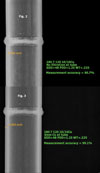


Figure 3. Carestream Health

For a 16-bit linear image with a maximum pixel value of 65,535, the background should not be more than about 52,000. That’s easy: 80% of 65,535 is about 52,000.

For a 12-bit log image with a maximum pixel value of 4,095, the background should not be more than about 4,000. How and why 4,000 is 80% of 4095 is not obvious to those who do not “think” in logarithms.

There are two basic ways in which an inspector measures wall thicknesses on a pipe radiograph. In the most rudimentary method, the viewing software allows the inspector to calibrate a ruler to a known reference in the image, then use that ruler to make measurements based on visual observations and determinations of the inside and outside wall boundaries. This requires not only an accurate radiograph, but also an accurate display on the monitor. Any errors in the window (contrast) and level (brightness) adjustments could easily result in misperceptions of where the wall boundary actually is, and hence erroneous measurements.

Fortunately, most viewing software also features more sophisticated measurement options whereby the measurement tool is performing the analysis on the underlying data, and not dependent on the display or the inspector’s ability to locate the wall boundaries.

In either case, though, the radiograph must accurately capture the precise locations of the pipe’s inner and outer walls to facilitate accurate measurements.

Now, let’s follow a couple of examples showing a gamma shot, a poor X-ray shot and a simple technique to produce a nice X-ray shot suitable for measurements.

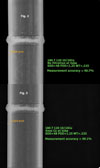
First, let’s look at a baseline image. Figure 1 shows a gamma shot with good overall exposure, good delineation of wall boundaries and a background intensity well below saturation. Properly calibrated for length, a wall thickness measurement tool yields a result with about 98.5% accuracy on this image.

Figure 2 is an X-ray shot, made with a typical combination of copper screens of 10-mil, front and back, inside the cassette, but no tube filtration. While the image appears suitable, note that the background is saturated, with a pixel value of 4,095. In this case, the saturated background compromises the outside wall boundary, resulting in a measurement accuracy of only 90.7%. While this may be considered accurate enough for some applications, it can certainly be improved.

If using X-ray as the source for profile shots, how does one limit the background intensity and make the image look more like a gamma shot? The answer is not really a secret, and in fact is a simple technique familiar to many radiographers: pre-filtration at the tube.

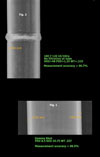
A few millimeters of copper at the tube will filter out the low energy portion of the X-ray spectrum, effectively “hardening” the beam. This leaves the higher energy portion of the beam to effectively penetrate the specimen, but eliminates the low energy portion that would easily be absorbed by the imaging plate, resulting in background saturation. The result is shown in Figure 3, in which 4 millimeters of copper at the tube reduced the background to well under saturation and yields a measurement accuracy of 99.1%. Note that the extra copper filtration even cleans up the inside wall boundary, so accuracy is improved all around.

Whether it is gamma or X-ray, profile shots can be optimized for accurate wall thickness measurements. All it takes is a little common sense and a few millimeters of copper.


Share This Story

Looking for a reprint of this article?
From high-res PDFs to custom plaques, order your copy today!

Steve Mango is the worldwide technical manager, NDT Solutions at Carestream Health Inc. (Rochester, NY). For more information, call (585) 627-6523, e-mail [email protected] or visit www.carestream.com .

Recommended Content

JOIN TODAY
to unlock your recommendations.

Already have an account? Sign In

  • 2024 Quality Rookie of the Year Justin Wise 1440x750px banner with "Quality Rookie of the Year" logo inset

    Meet the 2024 Quality Rookie of the Year: Justin Wise

    Justin Wise is an exceptional individual who has been...
    Aerospace
    By: Michelle Bangert
  • Man with umbrella and coat stands outside while it rains at night looking at a building.

    Nondestructive Testing: Is there an ethics problem?

    I was a whistleblower who exposed fraudulent activities...
    NDT
    By: Dale Norwood
  • Unraveling Deflategate: Football stadium with closeup of football on field

    Unraveling the Tom Brady Deflategate

    The Deflategate scandal erupted following the 2014 AFC...
    Measurement
    By: Greg Cenker and Henry Zumbrun
Manage My Account
  • eMagazine Subscriptions
  • Newsletters
  • Online Registration
  • Subscription Customer Service
  • Manage My Preferences

More Videos

Sponsored Content

Sponsored Content is a special paid section where industry companies provide high quality, objective, non-commercial content around topics of interest to the Quality audience. All Sponsored Content is supplied by the advertising company and any opinions expressed in this article are those of the author and not necessarily reflect the views of Quality or its parent company, BNP Media. Interested in participating in our Sponsored Content section? Contact your local rep!

close
  • This image shows a person seated next to a Bobcat T66 compact track loader.
    Sponsored byPolyWorks by InnovMetric

    Supercharging Digital Gauging at Bobcat North America

  • Dorsey Calibration Lab photo by Tom LaBarbera Picture this Studios
    Sponsored byDorsey Metrology International

    Ensuring Product Quality in a Competitive Manufacturing Landscape

  • This image displays a Eddyfi Technologies Cypher portable inspection instrument alongside a scanner for non-destructive testing (NDT).
    Sponsored byEddyfi Technologies

    A Safer, Smarter Approach to Weld Inspection: Why Advanced Ultrasonic Testing Is Redefining Industry Standards

Popular Stories

a titanium diaphragm speaker driver

The One Thing Elon Gets Right Is Designed to Scare You

This image shows a person seated next to a Bobcat T66 compact track loader.

Supercharging Digital Gauging at Bobcat North America

Dorsey Calibration Lab photo by Tom LaBarbera Picture this Studios

Ensuring Product Quality in a Competitive Manufacturing Landscape

2026 Quality Professional of the Year!

Events

June 9, 2026

Future-Proof your Quality Processes with Advanced 3D Optical CMM Technology

Discover how to effortlessly capture complex data, leverage true multi-sensor automation, and ensure continuous operation without creating inspection delays.

June 22, 2026

Automate 2026

Automate is North America's largest robotics and automation event — and the best place to take your ideas from insight to impact.
 
Our show floor features the world’s leading automation solutions, from AI and robotics to motion control, vision systems, and more. Plus, our educational conference is second to none, led by the brightest minds in automation today.
 
Ready to transform the way you work? Take the next step at Automate.
View All Submit An Event

Products

Lean Manufacturing and Service Fundamentals, Applications, and Case Studies

Lean Manufacturing and Service Fundamentals, Applications, and Case Studies

See More Products
Quality Podcast Channel Custom Content

Related Articles

  • A smart camera and vision system

    A back-to-basics look at LED illumination for machine vision applications

    See More
  • Shimadzu tensile testing

    Back to Basics: Tensile Testing for Rigid Plastics

    See More
  • compressive testing with Shimadzu

    Back to Basics: Compressive Testing for Rigid Plastics

    See More

Related Products

See More Products
  • 118877.jpg

    How to Audit ISO 9001 2015 A Handbook for Auditors

  • The Process Improvement Handbook: A Blueprint for Managing Change and Increasing Organizational Performance

See More Products

Related Directories

  • DeFelsko Corp.

    DeFelsko, a leading U.S. manufacturer of inspection instruments, proudly manufactures the PosiTector, PosiTest and PosiPen brand of instruments including the PosiTector series of interchangeable probes for measuring coating thickness, surface profile, environmental conditions, salt contamination, hardness, wall thickness, gloss, and concrete moisture.
×

Stay in the know with Quality’s comprehensive coverage of
the manufacturing and metrology industries.

Newsletters | Website | eMagazine

JOIN TODAY!
  • RESOURCES
    • Advertise
    • Contact Us
    • Directories
    • Manufacturing Division
    • Store
    • Want More
  • SIGN UP TODAY
    • Create Account
    • eMagazine
    • Newsletters
    • Customer Service
    • Manage Preferences
  • SERVICES
    • Marketing Services
    • Market Research
    • Reprints
    • List Rental
    • Survey/Respondent Access
  • STAY CONNECTED
    • LinkedIn
    • Facebook
    • YouTube
    • X (Twitter)
  • PRIVACY
    • PRIVACY POLICY
    • TERMS & CONDITIONS
    • DO NOT SELL MY PERSONAL INFORMATION
    • PRIVACY REQUEST
    • ACCESSIBILITY

Copyright ©2026. All Rights Reserved BNP Media, Inc. and BNP Media II, LLC.

Design, CMS, Hosting & Web Development :: ePublishing