Quality Magazine logo
search
cart
facebook twitter linkedin youtube
  • Sign In
  • Create Account
  • Sign Out
  • My Account
Quality Magazine logo
  • NEWS
  • PRODUCTS
    • FEATURED PRODUCTS
    • SUBMIT YOUR PRODUCT
  • CHANNELS
    • AUTOMATION
    • MANAGEMENT
    • MEASUREMENT
    • NDT
    • QUALITY 101
    • SOFTWARE
    • TEST & INSPECTION
    • VISION & SENSORS
  • MARKETS
    • AEROSPACE
    • AUTOMOTIVE
    • ENERGY
    • GREEN MANUFACTURING
    • MEDICAL
  • MEDIA
    • A WORD ON QUALITY PUZZLE
    • EBOOK
    • PODCASTS
    • VIDEOS
    • WEBINARS
  • EVENTS
    • EVENT CALENDAR
    • IMTS
  • DIRECTORIES
    • BUYERS GUIDE >
      • Supplier Insights
    • NDT SOURCEBOOK
    • VISION & SENSORS
    • TAKE A TOUR
  • INFOCENTERS
    • Digital Quality Management Systems
    • NEXT GENERATION SPC & QUALITY ANALYTICS
  • AWARDS
    • ROOKIE OF THE YEAR
    • PLANT OF THE YEAR
    • PROFESSIONAL OF THE YEAR
  • MORE
    • Expert Columns
    • NEWSLETTERS
    • QUALITY STORE
    • INDUSTRY LINKS
    • SPONSOR INSIGHTS
  • EMAG
    • eMAGAZINE
    • ARCHIVES
    • CONTACT
    • ADVERTISE
  • SIGN UP!
Test & Inspection

Back to Basics: Compressive Testing for Rigid Plastics

An expert discuses compressive test methods and ASTM D695.
By Edward McMenamin
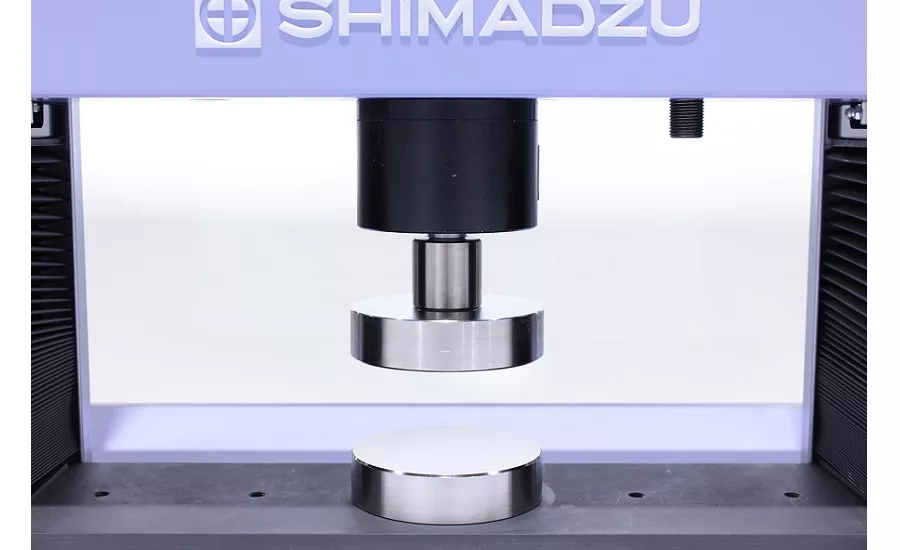
compressive testing with Shimadzu

The specimen’s deformation is measured by a strain gage, or a compressometer, that measures the distance between two fixed points on the test specimen during the test, recording the change in distance caused by the load exerted on the specimen.

May 1, 2018

Pick up a material analysis data sheet and you’ll always find tensile testing, and probably flexural testing as well. But depending on the application, don’t hold your breath looking for compressive testing.

“Compressive testing is just a slower test,” explains Steve Driscoll, professor, department of plastics engineering, University of Massachusetts Lowell. “Instead of testing at 0.2 inches per minute and up to 20 inches per minute, it’s a very slow test at 0.05 inches per minute. It just takes longer.”

Of course, there are rigid plastic parts that will undergo compressive forces during their product life cycle. So measuring for modulus of elasticity, yield stress, deformation beyond yield point, and compressive strength is as important as any other common materials test when the application calls for it.

Resin makers, design engineers and manufacturers rely on these materials tests to ensure their processes are stable and consistent, and that the right material is used for the right application. It’s imperative for quality.

Standards

ASTM and other international organizations provide standards for compressive testing, but the focus here will be ASTM D695, the standard for compressive testing rigid plastics. Like all ASTM standards, it’s reviewed every five years to address questions posed by recent advancements in materials or technologies.

“ASTM D695 is not quite as old as ASTM D638 for tensile properties, but it predates flexural, which is D790,” Driscoll says. “But if you look at a compressive tests, there’s almost a dozen compression tests for plastics and elastomers, all sorts of cellular products, flooring applications, plastics and lumber applications.”

In compressive testing rigid plastics, a small specimen—usually a prism of 0.5 by 0.5 by 1 inch, or a cylinder with a diameter of 0.5 inch and a length of 1 inch—is placed between two hardened blocks, or plates, in a universal testing machine. Rather than pulling it apart like in a tensile test, the two blocks slowly compress the specimen until the point of fracture or distortion.

ASTM requires that test specimens are conditioned to the appropriate standard before testing, and that the test should take place in a room at the same temperature and humidity as the room used in conditioning. The standard also requires that with isotropic materials, at least five specimens are tested. For anisotropic materials, the standard requires at least 10 specimens, with five tested normally and five tested parallel with the principal axis of anisotropy.

ASTM notes that “materials possessing a low order of ductility may not exhibit a yield point. In the case of a material that fails in compression by a shattering fracture, the compressive strength has a very definite value. In the case of a material that does not fail in compression by a shattering fracture, the compressive strength is an arbitrary one depending upon the degree of distortion that is regarded as indicating complete failure of the material.

“Many plastic materials will continue to deform in compression until a flat disk is produced, the compressive stress (nominal) rising steadily in the process, without any well-defined fracture occurring,” ASTM continues. “Compressive strength can have no real meaning in such cases.”

The specimen’s deformation is measured by a strain gage, or a compressometer, that measures the distance between two fixed points on the test specimen during the test, recording the change in distance caused by the load exerted on the specimen.

Industry Specific

Driscoll notes that compressive testing is more routinely performed in the civil engineering department down the hall from his plastics engineering classroom. There, tests check the strength of concrete columns, steel beams, flooring and other construction materials that will be subjected to regular compressive forces. Construction is now the second largest market for plastic materials, he adds. And other common, every-day materials like packing foam, cushioning and shipping pallets are also regularly tested for their compressive properties.

“It’s very application- and industry-specific,” he says. “When you put 1,000 pounds of steel on a shipping pallet, or you put 1,000 pounds of resin on a shipping pallet, that’s a compressive test. Compressive testing is still very, very critical, just not as popular as tensile testing or flexural testing.

Compressive testing is also essential in checking the strength of materials with a “sandwich” construction, created by techniques such as elastic reservoir molding (ERM). Its proposed use in the ‘70s still hovers in the imaginations of design engineers thanks to the DeLorean DMC-12, the eccentric sports car made famous again years later as the time-traveling vehicle in Back to the Future. One of the key design characteristics that most intrigued investors during the car’s prototype stage was the proposed use of an unproven manufacturing technology known as elastic reservoir molding.

The ERM process used two outer fibrous glass layers to sandwich resin-impregnated inner foam, which was compressed to impregnate and then cured, according to Driscoll. This hidden sub-structure of the body panels was then to be bonded to the stainless steel outer skins. Unlike the more popular compression molded sheet molding compound (SMC), or hand-lay-up fibrous glass impregnated with unsaturated polyester resin used to manufacture the Corvette and Avanti body components, ERM did not achieve wide-spread economical and functional success.

KEYWORDS: compression testing manufacturing materials analysis plastics analysis tensile testing

Share This Story

Looking for a reprint of this article?
From high-res PDFs to custom plaques, order your copy today!

Ed McMenamin is a former editor of Quality Magazine.

Recommended Content

JOIN TODAY
to unlock your recommendations.

Already have an account? Sign In

  • 2024 Quality Rookie of the Year Justin Wise 1440x750px banner with "Quality Rookie of the Year" logo inset

    Meet the 2024 Quality Rookie of the Year: Justin Wise

    Justin Wise is an exceptional individual who has been...
    Aerospace
    By: Michelle Bangert
  • Man with umbrella and coat stands outside while it rains at night looking at a building.

    Nondestructive Testing: Is there an ethics problem?

    I was a whistleblower who exposed fraudulent activities...
    NDT
    By: Dale Norwood
  • Unraveling Deflategate: Football stadium with closeup of football on field

    Unraveling the Tom Brady Deflategate

    The Deflategate scandal erupted following the 2014 AFC...
    Measurement
    By: Greg Cenker and Henry Zumbrun
Manage My Account
  • eMagazine Subscriptions
  • Newsletters
  • Online Registration
  • Subscription Customer Service
  • Manage My Preferences

More Videos

Sponsored Content

Sponsored Content is a special paid section where industry companies provide high quality, objective, non-commercial content around topics of interest to the Quality audience. All Sponsored Content is supplied by the advertising company and any opinions expressed in this article are those of the author and not necessarily reflect the views of Quality or its parent company, BNP Media. Interested in participating in our Sponsored Content section? Contact your local rep!

close
  • This image shows a person seated next to a Bobcat T66 compact track loader.
    Sponsored byPolyWorks by InnovMetric

    Supercharging Digital Gauging at Bobcat North America

  • Dorsey Calibration Lab photo by Tom LaBarbera Picture this Studios
    Sponsored byDorsey Metrology International

    Ensuring Product Quality in a Competitive Manufacturing Landscape

  • This image displays a Eddyfi Technologies Cypher portable inspection instrument alongside a scanner for non-destructive testing (NDT).
    Sponsored byEddyfi Technologies

    A Safer, Smarter Approach to Weld Inspection: Why Advanced Ultrasonic Testing Is Redefining Industry Standards

Popular Stories

MicroRidge MobileCollect wireless measurement system

Before AI Can Help, the Data Has to Be Ready

a titanium diaphragm speaker driver

The One Thing Elon Gets Right Is Designed to Scare You

This image shows a person seated next to a Bobcat T66 compact track loader.

Supercharging Digital Gauging at Bobcat North America

2026 Quality Professional of the Year!

Events

June 4, 2026

Scaling Manufacturing Quality with Automation for Greater ROI

If you need to do more with the same resources or build a new tech foundation, this session shows where to start and how to create a more efficient, scalable, cost-conscious quality process.

June 9, 2026

Future-Proof your Quality Processes with Advanced 3D Optical CMM Technology

Discover how to effortlessly capture complex data, leverage true multi-sensor automation, and ensure continuous operation without creating inspection delays.

View All Submit An Event

Products

Lean Manufacturing and Service Fundamentals, Applications, and Case Studies

Lean Manufacturing and Service Fundamentals, Applications, and Case Studies

See More Products
Quality Podcast Channel Custom Content

Related Articles

  • Shimadzu tensile testing

    Back to Basics: Tensile Testing for Rigid Plastics

    See More
  • Flexural Testing

    Back to Basics: Flexural Testing for Plastics

    See More
  • Back to Basics: Material Testing Carbon Fiber Reinforced Plastics

    Back to Basics: Material Testing Carbon Fiber Reinforced Plastics

    See More

Related Products

See More Products
  • 118877.jpg

    How to Audit ISO 9001 2015 A Handbook for Auditors

See More Products

Related Directories

  • ForTest Italia Srl

    ForTest designs and manufactures leak testing and flow testing equipment. Always with an eye on innovation, since 2012 the company has been based in Modena in the former Maserati factories and boasts clients in Italy and around the world, working in many sectors, such as automotive, agriculture, oil hydraulic, irrigation, mechanical, electronics, biomedical and packaging.
  • American Society for Nondestructive Testing (ASNT)

    ASNT is the association for nondestructive testing (NDT) professionals committed to making the world a safer place. NDT professionals detect irregularities, flaws, and defects in materials, components, and structures that could compromise the safety, reliability, or functionality of an object or structure. Established in 1941, ASNT supports members with certifications, professional development, industry insights, advocacy, events, publications, and networking opportunities and is focused on fostering the growth of future generations of NDT professionals through the ASNT Foundation. Serving more than 22 000 members and certificate holders worldwide, ASNT is the largest technical society for NDT professionals. ASNT is based in Columbus, Ohio, with offices in Houston, Texas, and Chennai, India.
×

Stay in the know with Quality’s comprehensive coverage of
the manufacturing and metrology industries.

Newsletters | Website | eMagazine

JOIN TODAY!
  • RESOURCES
    • Advertise
    • Contact Us
    • Directories
    • Manufacturing Division
    • Store
    • Want More
  • SIGN UP TODAY
    • Create Account
    • eMagazine
    • Newsletters
    • Customer Service
    • Manage Preferences
  • SERVICES
    • Marketing Services
    • Market Research
    • Reprints
    • List Rental
    • Survey/Respondent Access
  • STAY CONNECTED
    • LinkedIn
    • Facebook
    • YouTube
    • X (Twitter)
  • PRIVACY
    • PRIVACY POLICY
    • TERMS & CONDITIONS
    • DO NOT SELL MY PERSONAL INFORMATION
    • PRIVACY REQUEST
    • ACCESSIBILITY

Copyright ©2026. All Rights Reserved BNP Media, Inc. and BNP Media II, LLC.

Design, CMS, Hosting & Web Development :: ePublishing