Vision & Sensors - Vision Technology
Code Quality
In-line vision-based technology reduces downtime.
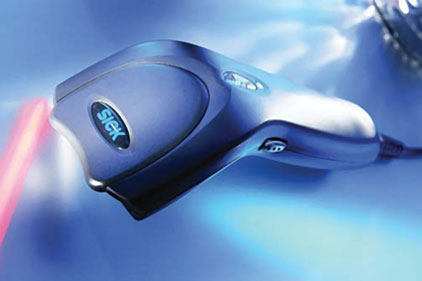 Source: SICK |
In today’s world of bar code tracking and highly automated processes, it is becoming increasingly critical to add a verification step into the manufacturing system to help achieve the benefits of data capture and ensure readability throughout the supply chain. Automated data capture is critical to a company’s success, and the results of scanning failure can have a serious impact. As bar codes have turned into a universal tool for tracking goods throughout the world, properly printed bar codes became a necessary requirement for every business. Bar code verification products and systems have been implemented by manufacturers across a wide range of industries to make sure that codes meet the standards.
Many manufacturers perform quality verification to meet standard requirements for their products using machine vision, but monitoring bar code quality with vision-based scanners can provide additional benefits as well. It can be used to monitor how well the label printer or direct part marking equipment is performing, and reduce the risk of manufacturing errors or downtime caused by unreadable codes.
Bar code verification is the most certain way to ensure that you are printing good codes. The bar code, which began circa 1975, is virtually everywhere. You cannot find a product that does not have a bar code associated with it somewhere in its life. It is the least expensive and most reliable method of entering data.
Despite what some printer manufacturers may say, there is no perfect print process. Thermal printers may have ribbon wrinkles, burned out print head elements, improper heat and speed settings or a miss-marriage of the ribbon and face stock. Impact printers may have miss-aligned hammers or an overused ribbon. Laser printers may have fuser problems, low toner or a face stock that is improperly top coated. Lastly, ink jet systems contend with clogged jets, low contrast and differing substrates. With that being said, printers today do produce high-quality print and any printer type, if properly maintained, will print good bar codes, most of the time. However, this may even make the problem worse. Knowing that the printer is likely to print a good code means that inspection becomes less appealing. Companies cannot afford to have someone do constant visual inspection, and if they could, the inspector would rapidly lose interest. This means that bar codes go unchecked. Enter the need for verification.
A verifier is not the same as a scanner. A scanner is typically a mass-produced item that provides machine recognition of the data encoded in a bar code symbol. Using a scanner to read a bar code only assures that the scanned bar code has some region on it that is readable, by that scanner. A verifier, on the other hand, is a precision instrument that is made to predict how well the bar code will be read by the typical scanner, any scanner. It should decode, measure and check formatting of even the most inferior symbol and indicate area(s) that are deficient so that corrective action may take place.
Code Verification: Does it make the Grade?
Traditionally, verification is performed as an off-line process in which eight specific parameters are measured and compared to specifications in ISO 15416 (formally ANSI X3.182-1990).
For linear symbologies (e.g., GS1-128, Code 39) and stacked bar codes (e.g., PDF 417), ten scans are taken of each symbol and an analog signal, a scan reflectance profile, is recorded for each scan. This profile is evaluated for edge determination, minimum reflectance, minimum edge contrast, symbol contrast, modulation, defects and decodability are measured and, finally, the symbol is decoded. The lowest grade of these parameters is taken to be the final symbol quality grade, ranging from A to F (or their numeric equivalent 4 to 0).
Composite symbols (e.g., GS1 Composite) and 2-D matrix symbols (e.g., Data Matrix) have somewhat different verification criteria but yield the same type of quality grading.
Bar code verification systems can be a simple, spot check mobile device or integrated into the printing process itself. Making sure you have a solution that will verify to the quality and standards you need to meet is essential to getting the most out of your system. A proper verification system helps ensure that your bar codes will scan at every level of the supply chain for increased efficiency and smooth customer/supplier relations.
Now with the increased use of vision-based bar code readers, there are some in-line solutions that can perform these same ISO test standards to all codes during production. The fact that during production there are more elements that can change, compared to the very controlled off-line lab testing of a traditional verifier, this process is called “qualification.”
Code Qualification: Collecting Quality Trending Data
With qualification, every symbol is read and analyzed automatically at full line speed by a reader located on packaging, an assembly line, a conveyor, or other location where the symbol is being read for data collection or process-related action. A camera-based system that can effectively measure the bar code parameters that affect print quality, coupled with software that collects and analyzes the data, can perform both the initial task of reading the symbol for its intended use and the collection of quality data for trend analysis.
A key benefit of qualification is trending. The right software can track even minor changes in a bar code’s characteristics. Dirty or burned out print head elements, clogged ink jet nozzles, dirt, wrinkles or other defects might not cause a symbol to be unreadable, but certainly will reduce the symbol’s grade and indicate that attention is needed. Some of these problems would be identified during routine verification but others might be the result of a condition down-line from where the symbols are printed and applied after verification has taken place.
For example, a symbol with a “C” grade applied to a part at the beginning of an assembly process might be subjected to abrasion, dirt, grease or other obscuring material during the process. As a result, it may become barely readable by the end of the process. Rather than optimize a reader to cope with these degraded symbols, changing the process or improving the initial quality and durability of the label would result in symbols that customers can easily read. However, without ongoing monitoring of symbol quality throughout the facility, this problem might not be recognized until there’s a customer complaint, chargeback or cancelled order.
In addition to identifying immediate problems, collecting quality data over time can reveal operational issues such as lower quality during one particular shift, or from one particular print station. Having this data can improve your overall troubleshooting and maintenance programs, save time over increased manual verification, and prevent hundreds or even thousands of unreadable symbols from being produced between scheduled full verification checks.
While full ANSI/ISO verification of bar codes is necessary for any operations where symbols are printed or applied, collection of quality data over time—particularly of symbols over which you have no control—is a valuable tool for ensuring smooth operation of systems that rely on readable bar codes. Some of these problems would be identified during routine verification but others might be the result of a condition down-line from where the symbols are printed and applied after verification has taken place.
Qualification provides many advantages. During qualification, users can capture both the initial task of reading the symbol for its intended use and the collection of quality data for trend analysis, reducing downtime and creating a more streamlined process. The ability to monitor trends over time provides many advantages, including revealing potential operational issues and improving troubleshooting.
|
TECH TIPS
|
Looking for a reprint of this article?
From high-res PDFs to custom plaques, order your copy today!


