Independent Quality Assessment: A Call to Arms for Quality Management
WHY WOULD THOSE RESPONSIBLE FOR THE DESIGN, FABRICATION AND ASSEMBLY PROCESS ALSO BE RESPONSIBLE FOR THE ASSOCIATED PRODUCT QUALITY INSPECTION?
To uphold the integrity of quality control and assessment, it is vital to maintain independence between the original equipment manufacturer and quality management. However, this is often not the case. Machine builders and original equipment manufacturers (OEMs) are designing production equipment as well as the quality assessment tools to inspect their own applications.
TECH TIPSThe separation of the machine builder or OEM and the machine vision quality inspection is essential. This methodology permits the end-user to have quality built into the product from the beginning. The end-user will then achieve independent quality inspection resulting in a superior machine, eradicating any potential bias. |
As a machine vision integrator and solution provider, we encounter this issue on a weekly basis. An end-user will contact us and inform us that they are conducting factory acceptance testing (FAT) or have already received a machine at their facility from a given machine builder or OEM. In a majority of the cases, the machine builder or OEM has selected the improper combination of hardware (platform, camera, lighting, optics, filters) or made questionable decisions regarding the required vision tools for the given quality inspection tasks.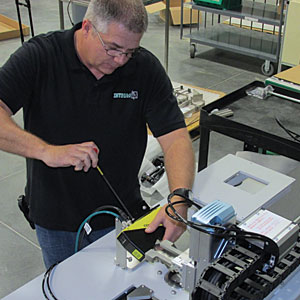
This situation does not happen because the builder or OEM is not good, or even excellent, at their core competency of building fabrication or assembly machines. Machine builders and OEMs have a very specific set of skills, but it does not typically include vision-based quality inspection systems. Machine vision systems are a science unto themselves and require a dedicated group of professionals to design an excellent quality inspection vision system.
Typically, the inspection tasks are less than 5% of the total machine scope and cost. With the disparity of the machine system to quality inspection system ratio, the primary focus of the builder or OEM is on the process. Yet, additional costs are considerable when integrators must “rescue” a machine that has already been built.
This is a call to arms: In order to maintain proper quality assurance, business acumen, lowered solution costs, and overall manufacturing dependability, quality management must remain exclusively independent. Any other decision jeopardizes the integrity of the machine, as well as the machine builder or OEM, and the overall ethics of quality assurance.
Machine vision quality management must be independent of the Machine Builder and OEM
Allowing for machine builder and OEM involvement in quality inspection places good engineers in a position of ethical conflict. To meet the growing demands of government compliance, consumer safety, and manufacturing efficiency, hardware, software, and infrastructure are continually updated and redesigned. Yet, the builder or OEM often changes the quality control criteria to meet the machine’s capability rather than the quality standards required by the manufacturer.
While advances in machine vision systems offer manufacturers greater information about product quality than ever before, these systems have become more complex. Many OEMs and builders are highly qualified in their fields, but there is an inherent conflict of interest when they install quality management hardware and software that test their own machines. There is a greater potential for incorrect hardware and software installation, as this is not a builder’s or OEM’s expertise. Other issues stem from the reallocation of funds to cover unexpected expenses. Either of these circumstances compromises quality assurance.
Manufacturers can avoid these inherent conflicts by contracting a certified integrator to work with, yet report separately from, an OEM or machine builder.
Vision integrators are continuously taking training courses, attending seminars, reviewing new technical requirements, renewing or acquiring certifications, and testing new vision systems all the while staying current in machine vision trends. Certified integrators offer not only a great deal of experience and expertise, but also the peace of mind that quality management is completely independent from the OEM.
Inadequate quality assurance can have horrific consequences
Today, manufacturers face many challenges. In the wake of some of the most disastrous manufacturing and production recalls in the United States and abroad, manufacturers are struggling to keep up-to-date on new technology, to rise to the challenge of increased production rates, and to remain within budget constraints.
How can a manufacturer be sure that the system meets the specified tolerances, rejection criteria, and data archiving requirements? The single, most important question for the manufacturer becomes: How can we be sure that the system ultimately does what it is supposed to?
The answer is simple. Manufacturers must rely on independent, trained, and certified integrators to ensure fully optimized vision systems along production lines.
If a manufacturer’s machine vision quality management is not independent of the OEM or machine builder, the implications could be dire.
Single Purchase Orders are fundamentally flawed
There is a tendency to issue a single purchase order to an OEM or machine builder for all the activity and sub-systems associated with the production line. Issuing a single purchase order to a machine builder or OEM for building a machine, which includes the quality inspection system, is fundamentally flawed.
A large number of companies, in a variety of industries, contract one OEM or machine builder, thinking that this saves time and money. Yet, the opposite tends to be true.
When purchase orders are not separate, certified integrators respond to “911” rescue efforts after the fact. Manufacturers thus waste additional time and money solving preventable problems.
“Rescue” integrators must work within the confines of an inadequate framework, and they have the unpleasant task of trying to optimize a poor solution. Not only is this scenario substantially profit eroding, but the relationship between the manufacturer and the machine builder/OEM is irreparably damaged in the process.
Hiring certified machine vision integrators from the onset
The end-user must contract directly with a qualified Advanced Imaging Association (AIA) certified integrator to design the appropriate machine vision quality inspection system from a machine’s inception.
The separation of the machine builder or OEM and the machine vision quality inspection is essential. This methodology permits the end-user to have quality built into the product from the beginning. The end-user will then achieve independent quality inspection resulting in a superior machine, eradicating any potential bias.
AIA certified machine vision integrators are critical. Rather than a one-size-fits-all integrator, the certified vision integrator trains on the software, regulatory practices, and inspection techniques required.
Vision integrator laboratories have calibration devices, varied lensing and lighting laboratory equipment, and, in some cases, the ability to simulate inspection processes at line speeds, giving them the ability to validate a system for the end-user prior to shipping the system. This capability leads to lower installation costs, as debugging and error proofing does not occur on the manufacturing floor. Thus, manufacturers are confident that a system will perform as promised.
Using a certified vision integrator is the surest way to confirm that an installed system is optimal. It also guarantees an ethical quality management system, and ensures the superior status of the machine.
Hiring a certified integrator from the onset maintains the integrity of quality assurance, protecting the manufacturer not only from the “911” rescue scenario, but the substantial time and money wasted while production is at a standstill.
Looking for a reprint of this article?
From high-res PDFs to custom plaques, order your copy today!