What to Consider When Buying a Material Tester
There is a material tester for every need.
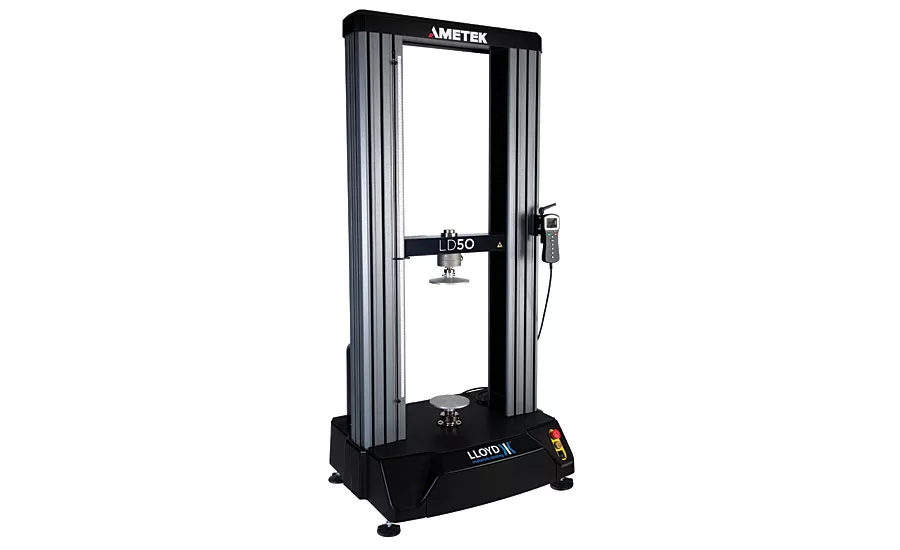
These universal test machines are designed for both routine quality control and automated testing and complex multi-stage testing. Source: AMETEK Sensor, Test & Calibration
Whether it’s called a compression tester, tensile tester, dual-column tester or twin-column tester, material testing machines go by many names. So, when users need to find the best machine to test their products, the market can appear to be a difficult one to navigate.
There are some basic criteria that users should keep in mind when making a material tester purchasing decision. These criteria include cost, quality and application. In addition, there are a range of other factors that should be considered. They include flexibility, ease of use, and adaptability.
Along with those factors, there are specific instrument characteristics. Among them are the size of the work area, the suitability of the instrument’s software for the application, the adaptability of the instrument to future needs, and the instrument manufacturer’s ability to provide aftermarket training and support.
What application need does the material tester satisfy? How much should the machine cost? How do you evaluate the different material testing machines on the market to determine which one is the right one? Will the machine that’s right for today be the right choice in the future?
When it comes to choosing the right material tester, here’s what should be considered before making the purchase.
Basic Criteria
Quality. A good quality material tester itself is not enough if users want to make sure they get the best material tester at the best price. The combination of the material tester and its testing software is what users need to be aware of when buying a machine to perform stable and reliable tests. While the material tester performs the actual test, it is the material testing software that calculates and stores the test results. It also should be able to transfer and integrate that data to user’s own analysis software.
Flexibility. If application requirements change over time, users can save by investing in a material tester that comes with a comprehensive software package that allows them to perform many different types of tests, without needing to make additional investments or to purchase new software modules.
Having a software with the flexibility to adapt to changing needs is a major benefit. Acquiring additional material testing software modules every time testing needs change can end up becoming a costly affair. Some material testers today come with a comprehensive software package as standard.
Ease of Use. Users should always remember to try the material tester before they buy, so they know whether the tester’s design is suitable and its software package is intuitive and meets their application requirements. Most modern material testers offer a standards library that can configure the machine to test according to a specific international standard with a single click. If a user needs a special test setup, some material testers have a built-in wizard that guides the user through the test setup so that it can be easily and quickly configured for unusual or complex tests.
Product Specifics
Work Area. To future proof a solution, users should make certain to choose a tester with a large work area (tall and wide). That way, if there is a need to test larger specimens in the future, they will not be limited by the size of the work area. If the user works with very large specimens, choosing a machine that is compatible with Pogos is worth considering. By adding a Pogo to a test system, users can increase the work area significantly.
Note: Some machines are compatible with Pogos from the start, so even though a user does not need the Pogo right away, adding one later is possible. This is an additional benefit should the need arise. With some machines, a user may need to add the Pogo when it is bought or may have to buy a new machine built for Pogos later to solve a need. Alternatively, a user may have to spend money on an upgrade to prepare the machine to use a Pogo.
Software Modules. Users should select a machine that offers a wide range of built-in software modules if needs change over time. By having more modules available upfront, users will have flexibility and avoid additional costs if or when their testing needs change.
Automation Ready. Users should consider choosing a test machine that is optimized for automated testing. That way they can save money by optimizing their workflow. They should make certain to choose a machine that features a CANBUS interface as this will make for better communication between add-on accessories and help to ensure faster speeds and accuracy.
Easy Mounting. Future testing needs may require the use of accessories such as splinter shields and extensometers. Some machines have easy mounting slots that makes it quick and easy to add those accessories. This saves time and helps to ensure that the accessories are properly added/installed and will not fall off during test.
Other Considerations
Future Needs. When considering the purchase of a material tester, think about future testing needs. Do users plan to expand their product range? If so, it is important that the material tester has sufficient capacity for future requirements. As a rule of thumb, one safely can assume a material tester will be able to take smaller load cells than the ones it has attached when it was purchased.
Be Realistic About Needs. There is a material tester for every need. Consider what tests it needs to perform. If they are advanced or must meet specific standards, then a material tester with high assurance documentation, traceability, reliability and accuracy is what the buyer should go for. However, if test results can be done within a wide margin, then there is no reason to invest in the most expensive model on the market. If there is uncertainty regarding future needs, consider contacting a specialist for advice in identifying the right material tester.
Think Long Term. When choosing a material tester look for a stable partner who can be there to provide aftersales support. Training, service and support are key considerations. Make certain the manufacturer has been in the market for a long time and can provide skilled professionals who know the industry and understand the specific challenges and how to overcome them.
Consider Upgrading. If the choice is between two model sizes, consider if it might be worth the extra cost to buy a larger model to ensure that the user can use the same machine if testing needs change or a larger capacity machine might be needed over time. There often is the temptation initially to purchase a smaller model with fewer features and capabilities to save money now. If there is a chance that the need for more capacity should arise later, a user may have to buy an additional machine and end up with a far-more expensive solution in the long run.
Looking for a reprint of this article?
From high-res PDFs to custom plaques, order your copy today!