Designing a Better Sensor for Small Parts Inspection
Smart technology advancements are at the heart of today's movement toward better sensor design.
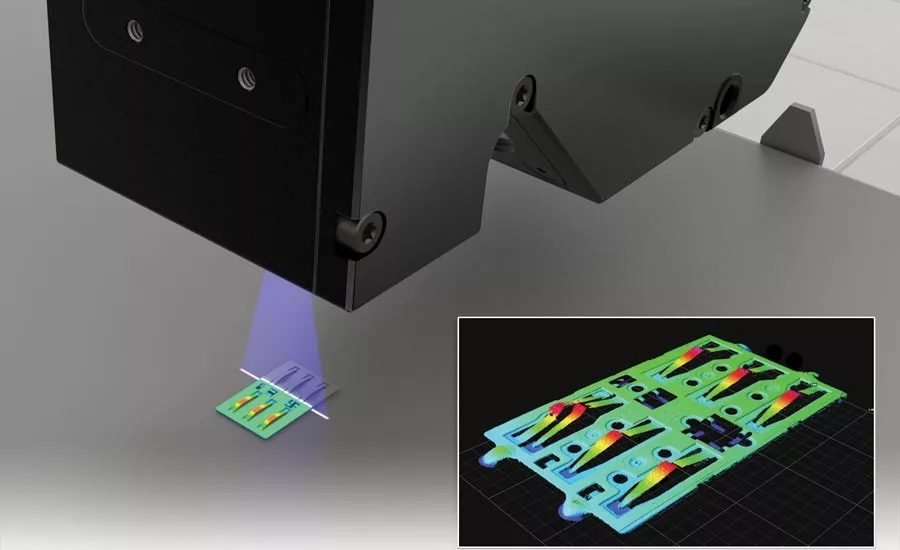
Increasing demand for higher resolution and speed in detecting small features must be met with equal innovation on the part of sensor manufacturers.
In industries like consumer electronics, battery, and solar, the race for ever faster scanning, measurement, and control is critical to delivering 100% inspection of small parts moving at production speed.
Sensor manufacturers in countries around the world are constantly striving to deliver this groundbreaking performance but have yet to produce a game-changing solution. Here is our unique approach on how to solve this challenge and design a better sensor for small parts inspection.
Start with a Better Definition of Speed
There is a common perception that scan rate is the only metric that matters in a laser sensor’s speed specifications. The reality is more complicated than that. In order to be meaningful in the real-world factory environment, a sensor’s speed calculation must not only factor in (1) scan rate (i.e., the speed of data acquisition), but also the (2) data processing/measurement, and (3) control decision-making stages required to fully inspect a part or assembly on the production line. These three stages make up a single inspection cycle, which is the true measure of effective speed in today’s factory.
Make a Technology Breakthrough
For several years now the industry standard for inspection rates has plateaued between 2-5 kHz at 800 columns resolution. This is simply not fast or resolute enough for many of the emerging small parts inspection applications facing today’s quality engineers.
Sensor manufacturers have relied too heavily on making subtle modifications to existing design in hopes of achieving the desired increase in speed, but are still not seeing significant results for their efforts. As a result, it has become evident that breaking through the 5 kHz speed barrier requires a significant technology innovation.
Combine Custom Components with Smart Design
Achieving a major breakthrough in effective inspection rate (while maintaining micron-level resolutions) can be solved with a combination of custom components and “smart” sensor design.
Building-blocks technologies such as custom cameras and advanced optics deliver the necessary resolution, repeatability, and sensitivity for defect detection on fast-moving small parts, while smart all-in-one software offers scan, measurement, and control onboard the sensor. As a result, new sensor designs are able to achieve 2.5x the resolution at twice the speed of the current industry standard.
Crunch Data at Production Speed
Even at a high rate of speed, a smart sensor is able to collect 3D profiles to build a 3D point cloud, perform metrology, and transmit results, from within its advanced hardware accelerated pipeline design.
Users can leverage this increase in speed in several ways, depending on their application needs:
- Increase Y resolution for detection of smaller features along the direction of motion.
- Increase Z accuracy for more accurate height measurement, and tighter dimensioning tolerances as a result.
- Leverage multiple exposures (HDR) to handle a wider variety of reflective targets (shiny black to white), even if they are in the same scan, and without a loss in effective speed.

Achieving a major breakthrough in effective inspection rate can be solved with a combination of custom components and “smart” sensor design.
How It’s Done - Onboard Data Processing
One of the key methods of achieving increased speed is by building onboard processing into the sensor. For example, a custom embedded dual-core controller can support raw data processing at a magnitude faster rate than when using an external controller or industrial PC. This embedded processing gives the sensor its distinctly “smart” capabilities, including the ability to execute onboard 3D alignment, part segmentation, and 3D feature extraction; run built-in measurement tools; and, most importantly, handle the entire processing pipeline—from raw image data to 3D results.
A smart sensor can process highly detailed 3D surface scans and communicate decisions onboard without the need for an external controller. With no dependencies on external hardware, latency between scan data acquisition and the decision output is minimized, allowing the sensor to keep pace with modern factory speeds. This degree of sensor autonomy is the key differentiator between smart solutions and other 3D profilers on the market that require transfers of raw data to a PC for processing.
Simple sensors that send raw pixel or profile data downstream to PCs or external controllers to carry out their 3D measurement dramatically increase latency and compound system cost and complexity. The situation is exacerbated when multiple sensors must stream and synchronize datasets before measurement can occur.
Commit to Innovation
Increasing demand for higher resolution and speed in detecting small features must be met with equal innovation on the part of sensor manufacturers. In the end, significant gains are made by paying attention to the details. Something as simple as a custom camera chip can have a major impact on performance. For example, an embedded custom 2-megapixel camera chip can generate high-density scan data up to 2.2 billion points per second, which makes it possible to thoroughly inspect micro-features such as gaps and edge widths at blazing speeds never achieved before.
Granted, this ground-up approach to sensor design is more cost and effort intensive, but it is also necessary if we are truly committed to moving the industry forward by any significant measure.
Go Beyond Raw Performance
Another key design feature of a smart sensor is a web browser-based user interface. This provides flexible configuration of settings and measurement tools using any browser running on PCs or mobile devices.
Sophisticated software is typically included at no extra cost, providing powerful built-in tools for filtering, profile and surface analysis, multi-sensor alignment, and support for various PLC and robot protocols. With no additional software to install, a smart sensor’s out-of-the-box setup and configuration is intuitive and enjoyable.
Downsize to Perfection
Small package dimensions allow the sensor to be easily mounted or retrofitted into virtually any machine environment. And, despite this small size, the sensor must still achieve an IP67 rating—making it immune to common environmental stresses such as moisture and dust.
Other beneficial features include bandpass filters to limit the effects of ambient light, while material choices such as precision aluminum and optical design mean the sensor can handle vibration and limit the negative effects of temperature drift.
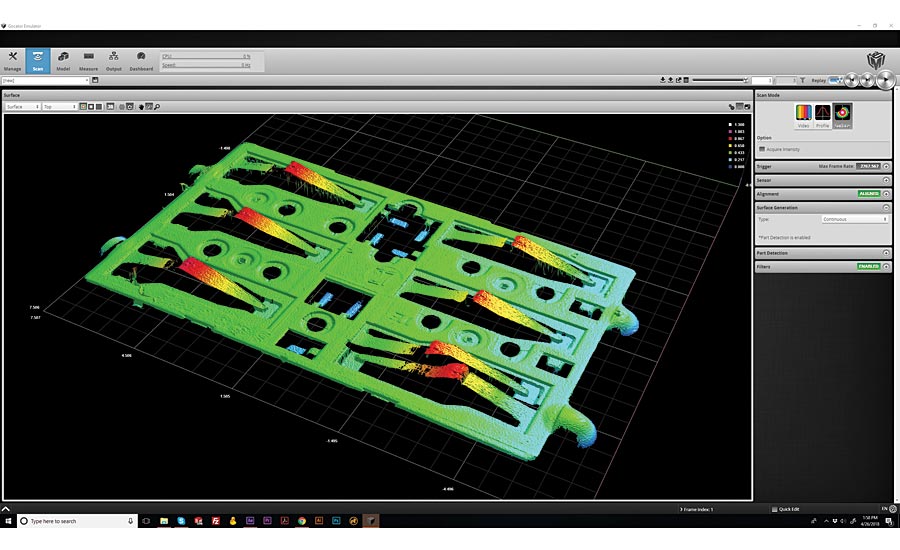
A key design feature of a smart sensor is a web browser-based user interface.
Keep Success in Your Field of View
On top of speed, sensors used in inline inspection need to have a large field-of-view (FOV) and large measurement range (MR), giving the user the ability to scan inspect more of the target with fewer sensors, while still capturing the finest surface and edge details of electronics and small parts.
A smart sensor can also provide built-in support for multi-sensor networking (including automatic alignment and built-in stitching) to deliver high-density 3D models for users who want to expand the field of view or acquire multiple angles on the same target while maintaining ultra-high resolution.
Scan Like a Bolt from the Blue
Ideally you would want to use blue laser for robust small parts inspection. Due to its shorter wavelength, blue laser light performs better than red or green lasers on the highly specular metal surfaces commonly found on electronic and shiny parts. Blue lasers produce “cleaner” profiles (i.e., less speckle) and as a result deliver superior data on these challenging surfaces.
Now Leverage the Smart Advantage
Smart technology advancements are at the heart of today’s movement toward better sensor design. The result is a complete machine vision solution that provides state of the art 3D scanning combined with onboard firmware, and a web browser user experience for rapidly setting up, scanning, measuring, and communicating control decisions to factory machinery. V&S
Looking for a reprint of this article?
From high-res PDFs to custom plaques, order your copy today!