Spectroscopy Explained
Spectroscopy is the branch of science dedicated to the investigation of electromagnetic spectra produced from the interaction between a sample and an energy source.
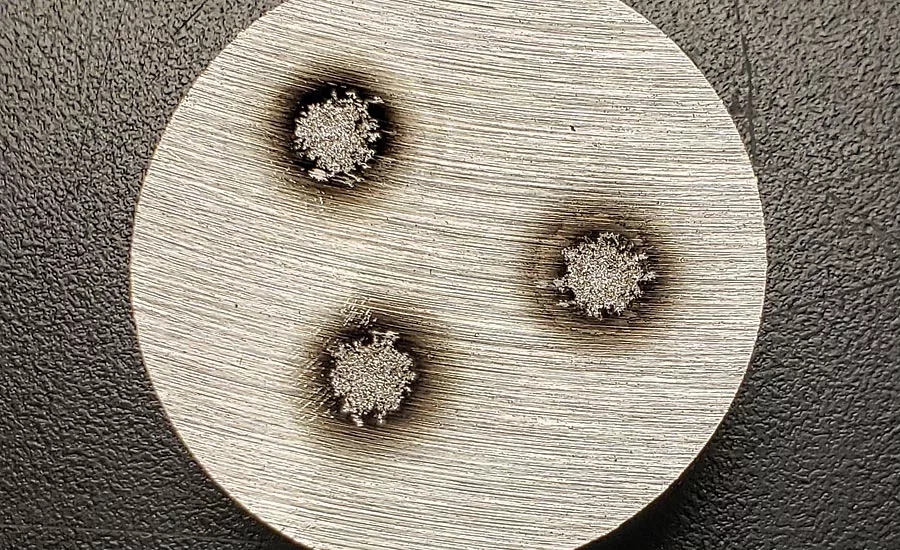
Spark OES sample burns
In the quality assurance/quality control industry, optical emission spectroscopy (OES) plays a key role in material testing. The uses of OES cover a large scope of applications, but it is generally used for material identification and composition certification to industry specifications. Additional uses include homogeneity testing, determination of material contaminations or weld dilution, and failure analysis, among others.
Spectroscopy is the branch of science dedicated to the investigation of electromagnetic spectra produced from the interaction between a sample and an energy source. Optical emission spectroscopy is a specific type of analytical technique that focuses on the emission of light by atoms in the range of approximately 100-700 nm, which encompasses visible light as well as part of the ultraviolet range.
During the analysis, the electrons in a sample are excited to emit a spectrum of electromagnetic radiation. Excitation happens when enough energy is applied to the atoms and ions that they jump from their ground state to a higher energy state. They subsequently emit photons, or light, by decaying to a lower energy state. These photons are recognized by the detector and translated into a spectrum. Each element emits light at unique, quantifiable wavelengths within the electromagnetic spectra produced by a test sample, forming an electromagnetic spectrum. The intensity of the light emitted at each wavelength is directly proportional to the concentration of the corresponding element present in the test sample. The intensities are then compared to those of known certified reference materials (CRMs) in order to quantify the percentage of each element present in the analysis.
There are various methods of excitation including flame, plasma, arc, and spark. Here, the basic principles, advantages, and limitations to Inductively-Coupled Plasma OES (ICP-OES) versus Arc Spark OES will be discussed.
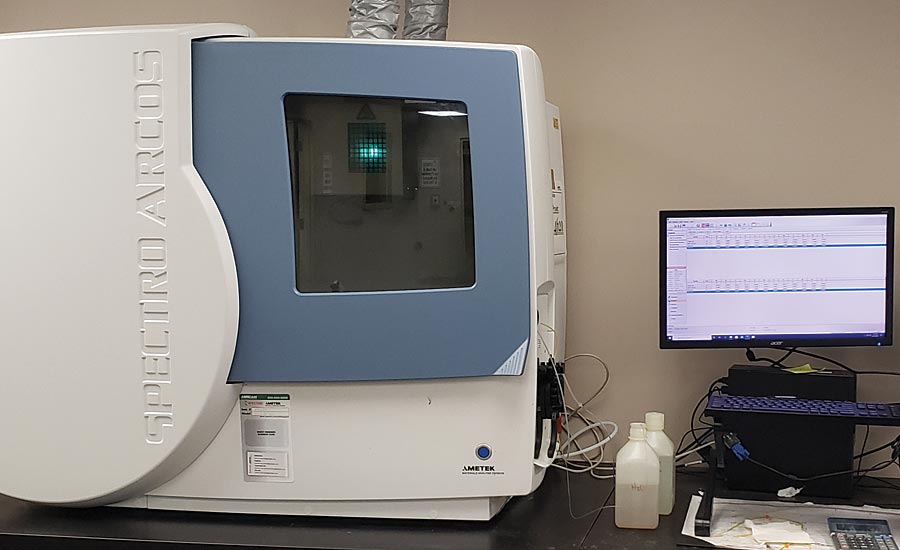
ICP-OES instrument
ICP-OES
Generally, an ICP spectrometer consists of a sample introduction system, a plasma generator, an optics system, and a detector. The factor that sets this type apart from others is the method of excitation: plasma. A radio frequency (RF) generator applies energy to a load coil. The plasma is then ignited when the energy from the load coil is transferred to a pre-ionized gas stream (typically argon or nitrogen) located in the torch. This transfer of energy is known as induction. The plasma can reach temperatures upwards of 6000 K and is used to vaporize, atomize, and ionize a material or test sample.
ICP-OES is performed on a liquid sample, typically aqueous. The reason a test sample needs to be in a liquid form is due to the sample introduction process, which consists of a nebulizer, a spray chamber, and the torch. The liquid is aspirated into the instrument, commonly with a peristaltic pump, and is converted into an aerosol suitable for transport into the plasma via the nebulizer. The aerosol is then sorted by the spray chamber so that only the smallest droplets make their way to the torch and the larger droplets are condensed and drained away. When the droplets enter the plasma, the solvent is dried and the elements within the sample are atomized.
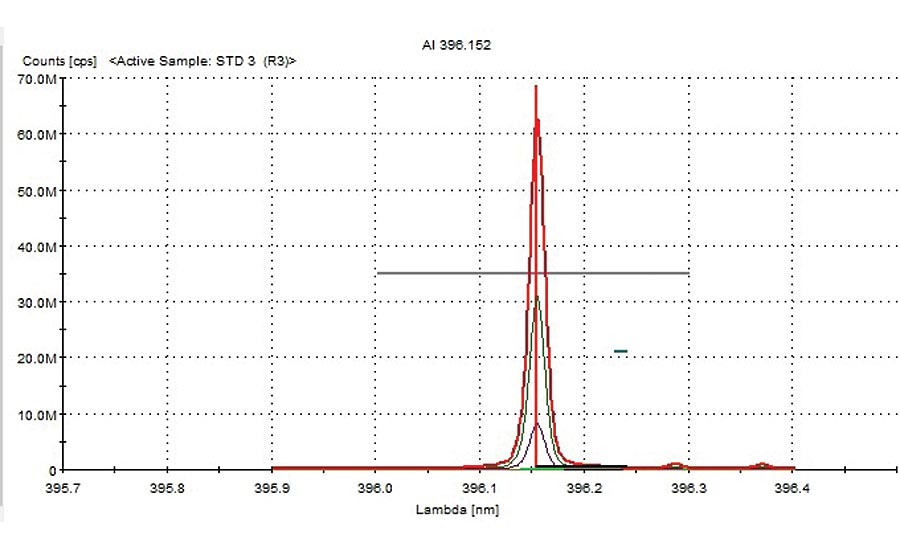
Spectra of aluminum at 396.152 nm
A common method of liquid sample preparation is acid dissolution. A set sample weight, taken in accordance with standard operating procedure to assure a lack of contamination, is heated in an acid matrix to dissolve the test sample into an aqueous form. The ideal acid matrix varies for different alloy compositions and an experienced analyst will know the correct ratio for each. This dissolution method allows for flexibility in sample size. Where spark OES has size limitations, ICP-OES does not hold to the same requirements. Most samples too small for spark OES can be analyzed by ICP-OES instead. However, this dissolution process is costly, in time and resources. This method is also completely destructive and therefore is not recommended for test samples in which the original integrity needs to be maintained.
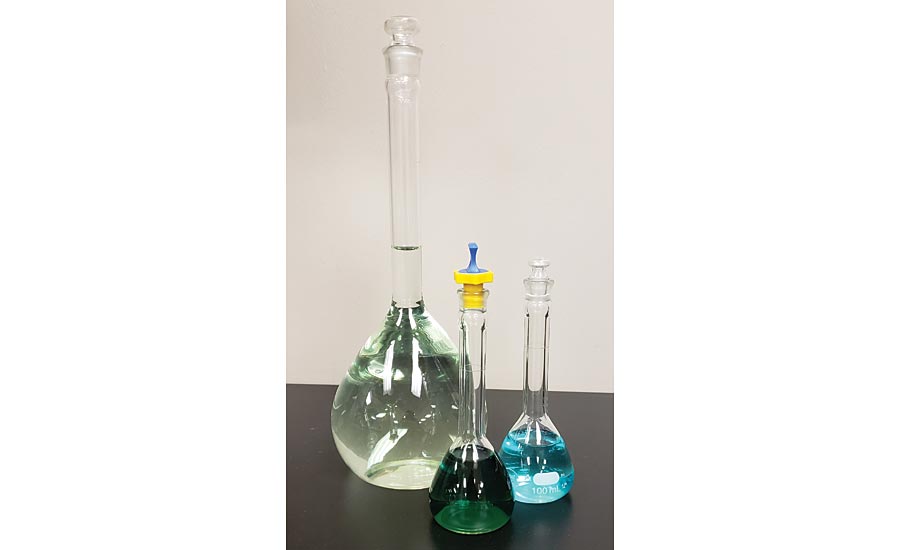
ICP-OES liquid samples
Versatility within an analysis gives ICP-OES an advantage over spark OES. An ICP spectrometer can independently detect upwards of 70 chemical elements. Calibration curves are created, in accordance with standard operating procedures, to account for any array of elements suitable for the analysis. These calibration curves are typically derived from certified, single-element solutions, which allow for the versatility of various concentrations at the analyst’s discretion.
Another advantage to an ICP-OES analysis is in the types of samples that can be analyzed. It is not confined to the parameters of a solid CRM in the same way as a spark OES instrument. Therefore, a sample can be analyzed that does not have a corresponding CRM and instead can be analyzed by creating a synthetic reference material using the same certified, single-element solutions used to create the calibration curves. This gives ICP-OES the ability to analyze the 70 elements in materials ranging from typical metal alloys, to ferro alloys, to ceramics and organic material, as well as powders.
Spark OES
The source of excitation in Spark OES is an electrical discharge, or spark, between an electrode and a solid, metallic sample from which radiant energy is produced. The resulting light of select wavelengths is then converted into electrical energy which is then stored on capacitors. After a predetermined amount of energy is stored on the capacitor, or a fixed time has been reached, the spark ends. After the measurement is complete the instrument then calculates the charge on each capacitor and converts that information into a concentration.
To perform spark OES, a sample of appropriate size must first be prepared by finishing the surface of a sample with an abrasive grinder to provide a flat and even surface. Once the sample is prepared, a type standardization must be performed using a CRM. This is done by sparking the CRM a given number of times and producing concentration readings. The instrument then compares the measured value to the certified value and creates a factor that corrects the results to match the certified value of the CRM.
Spark OES boasts a quick analysis time allowing large numbers of samples to be tested over a short period. These instruments do not require a significant amount of maintenance to keep them in operating condition and have few reagents required to achieve a complete analysis, which results in a rather low cost of operation, as opposed to ICP-OES. With few moving parts, and a relatively simple design, spark analyzers can be a cost-effective approach to an analytical analysis.
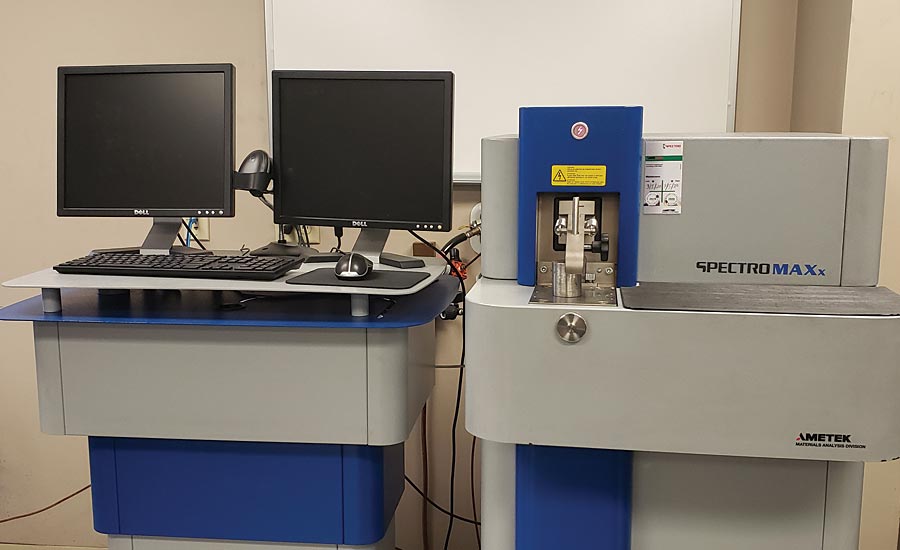
Spark OES instrument
In addition, the instrument uses material from the surface of a specimen, meaning chemical compositions at exact depths can be tested to identify carbon levels in samples that have been heat treated, carburized, or decarburized. Spark OES is also useful for the surface testing of welds and to test sample homogeneity. Using this method can visually confirm that the base metal was not tested and gives the composition of weld wire after it has been welded to check for any weld dilution that could compromise the weld integrity. Similarly, spark OES analyzers can be used to test how homogenous a material is which is useful for suppliers. Homogeneity testing is necessary in the verification of CRMs. Testing multiple areas of the same sample shows the composition at specific locations revealing if a sample is homogenous or not.
Limitations to this method of analysis include a limitation of sample sizes, sample forms, and a lack of CRM flexibility. This method can only be performed on samples big enough to cover the aperture above where the electrode sits. This method also requires specimens to be a solid and flat, so the aperture is covered. Spark OES is unable to analyze sample types such as liquids, powders, springs, and other materials that cannot cover the aperture. Another limitation is a lack of CRM flexibility. The CRMs used for the type standardization typically come in solid rounds and have set concentrations. ICP OES has more flexibility with liquid CRMs that can even be used to make customized CRMs.
Through spectroscopy many tasks can be accomplished, and many questions can be answered. Whether it pertains to industrial needs of material certification or research and development, spectroscopy is a very useful and versatile analytical application. When deciding between methods, several factors need to be taken into consideration. While Spark OES has a minimum sample size and form limitations, it also has the benefit of being quick and cost effective. Whereas ICP-OES has little size or form limitations, flexibility of CRMs, and sensitivity of analysis, but also requires an array of equipment and reagents, is costly, and time consuming. To use spectroscopy to its full potential, it is imperative to understand the strengths and limitations of each method available. Q
Looking for a reprint of this article?
From high-res PDFs to custom plaques, order your copy today!