NDT Flaw Detection
How Remote Visual Inspection Technology Contributes to a Safer World and a Robust Global Economy
Remote visual inspection products enable us to see and evaluate defects in machinery and industrial equipment.
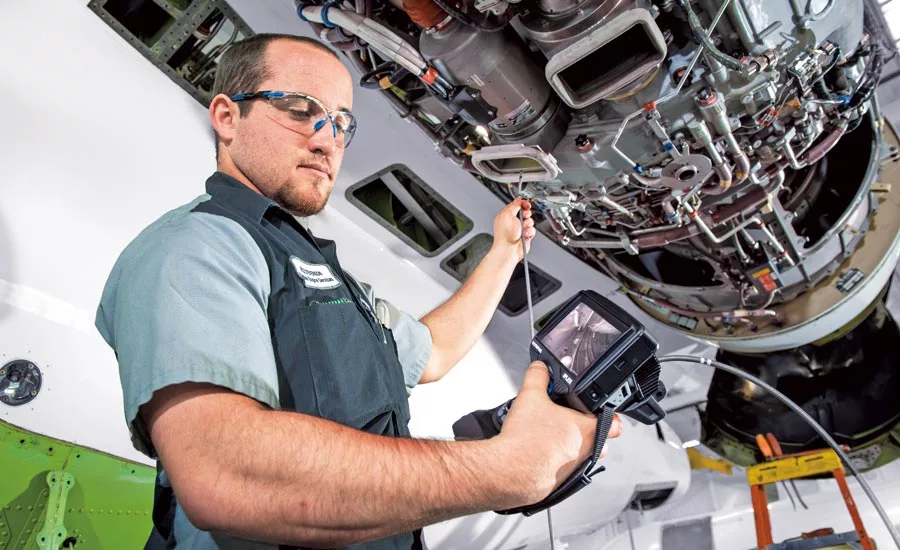
Our reliance on large-scale machinery has grown greatly over the past few decades, making it more important than ever to ensure the reliability, efficiency, and safety of our day-to-day use of these systems. From aerospace to power generation to security, remote visual inspection (RVI) products enable us to see and evaluate defects in machinery and industrial equipment. One common example is the mechanical health inspection of aircraft jet engines. These RVI instruments allow the inspector to observe the internal conditions of the jet engine without disassembling it. Instead, a thin insertion tube enables you to look into difficult-to-access areas such as the combustion chamber, turbine blades, and many others. This ability makes RVI products crucial for maintaining the quality standards of these systems, contributing to the overall safety of our society and the robustness of the global economy.
VIDEOSCOPE TECHNOLOGY
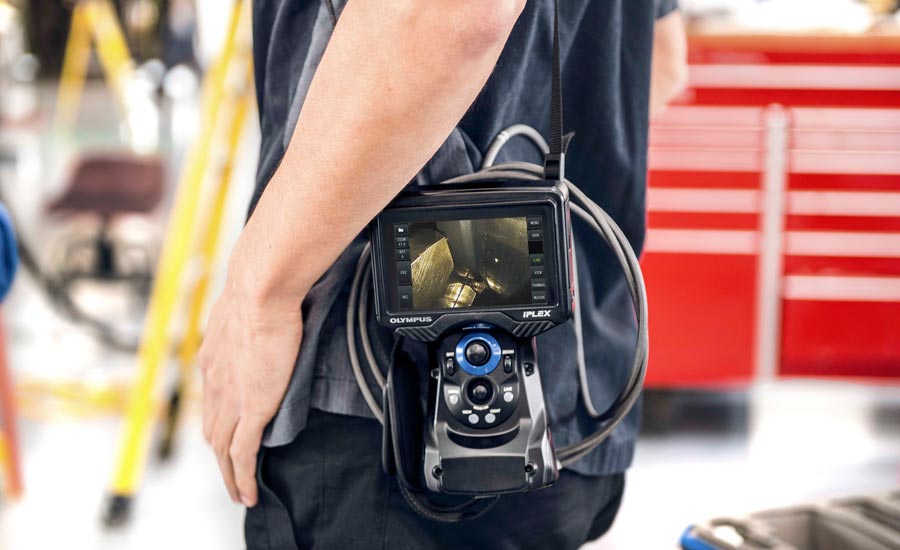
Videoscopes are the most common RVI tools. They’re comprised of two parts—a base that contains an LCD monitor and an insertion tube (scope) that is available in various diameters and lengths, depending on the application. The insertion tube has a lens system at the end that is inserted into the inspection area. It also has an imaging sensor (CCD or CMOS chip) that translates the image into an electrical signal, which then can be observed on a screen. Videoscopes can be handheld units, where the screen and the controller are together, or a system where the base and the controller are separate. Videoscopes can capture pictures, videos, and be used to take measurements. They also have features that help optimize the image taking process, such as automatic brightness control, denoising, digital zoom, and many others.
The features that are important for one industry may be less important for another. However, two features that are critical in all industries and applications are brightness and image quality. Videoscope inspections tend to be carried out in dark spaces with little to no ambient light. Having a bright videoscope enables you to see defects and make accurate decisions. Seeing the defect, however, is not sufficient if the videoscope’s image quality and resolution are subpar. These features, when optimal, make for a more successful and efficient inspection.
A videoscope’s image quality and overall capabilities are determined by its lensing system and suite of features. Below, I discuss some of the most important videoscope features and how they contribute to higher quality inspections.
TIP ADAPTORS
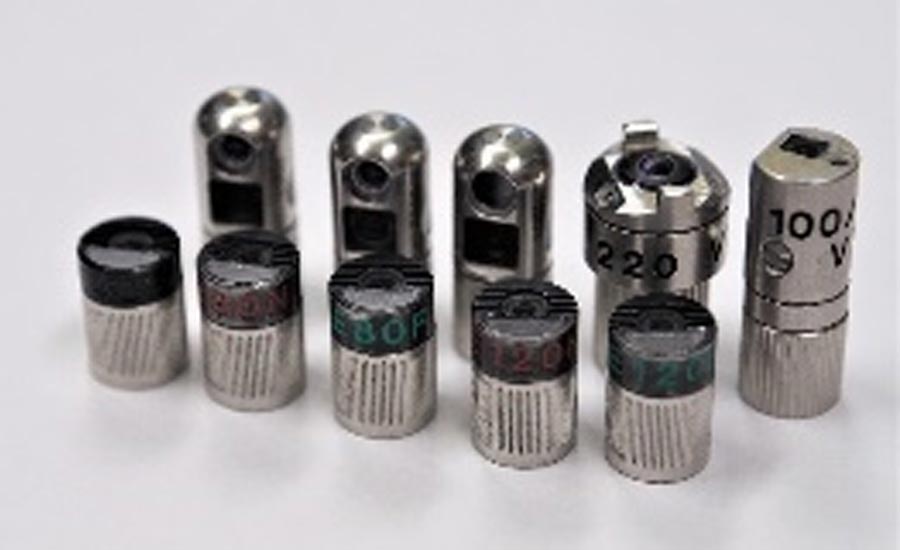
Videoscopes use tip adaptors that attach to the end of the insertion tube. Depending on the objects you want to examine, inspectors can choose a near-focus tip for observing objects that are very close to the lens (less than ¾ inch) or a far-focus tip to inspect large areas at farther distances. Tips are model specific, so they depend both on the unit model as well as the insertion tube’s diameter.
The tips’ effectiveness—and, therefore, the effectiveness of the inspection—is impacted by its field of view and depth of field. The field of view (FOV) is measured in degrees and represents the angle of the visual field collected by the tip adaptor. This means the FOV is directly correlated to how much of the inspection area is visible in a single image. A large FOV, such as 120 degrees, means that more of your area of interest can be viewed at once relative to a FOV of 40 degrees. Larger fields of view are more common as it allows the inspector to quickly search for issues. You spend less time moving the end of the insertion tube as you can see more of the inspection area. However, small fields of view can be beneficial in some applications as they enable you to see much farther, such as across a vessel chamber.
The tip adaptor’s depth of field (DOF) is the distance from the camera lens to the object you can focus on. Most lens systems for consumer cameras have a DOF starting at a few inches. Videoscopes are specialized in that they can have depths of field starting at just 1 mm (0.04 in.). Another feature unique to videoscope lensing is that the DOF is deeper. That is, the focal range can start around ½ in. and go to infinity. This means that an inspector can clearly see objects as close as a ½ in. away all the way out to as far as they need without changing tip adaptors. For these reasons, tip adaptors and their lenses are crucial to an effective visual inspection.
SCOPES
Some industries, such as nuclear power generation, require long 20 m to 30 m (65.6 ft to 98.4 ft) scopes. Long scope applications have many unique challenges. One of the biggest is the ability to reach such distant targets. Scopes need to balance the flexibility to maneuver through bends while being rigid enough to be able to be pushed through long straight sections. When your target is 25 to 30 meters away, it can be hard to make those last few meters. However, accessories—such as a push rod—can help by adding rigidity to the scope and making it easier to make that final push.
Some videoscopes have interchangeable scopes. This is useful for customers that want to use the same base for two or more applications, such as a 4 mm diameter scope for one inspection and 6 mm for another. An additional perk of having interchangeable scopes is that you can swap it out if the scope degrades. This can sometimes happen if they’re used in harsh environments such as nuclear facilities. Having an extra scope around to maintain operations and uptime is imperative.
Other industries, such as wind power, benefit from lightweight, handheld videoscopes since inspectors need to climb the wind turbine towers. Small videoscopes function the same as larger models. The only difference is that they’re compact, and the screen and controller are one piece. Being ergonomic and easy to use, handheld scopes are good options when inspecting in a confined area where there’s little to no space to move and operate. You can hold the unit with one hand while inserting the insertion tube with the other.
DEFECT MEASUREMENT
When you locate a defect, it’s important to be able to measure it. Advanced videoscope measurement capabilities are important for industries with stringent safety and regulatory guidelines. Knowing the measurement of a defect can be the difference between normal operation and a potential catastrophic event. Stereo measurement is one of the most accurate and precise measurement methods available. It uses a two-lens system to measure the distance from the tip of the scope to the target. The videoscope automatically and quickly (even before a picture is taken) calculates the Z value, or the distance to the measurement point in real space. The videoscope can then calculate all the other X and Y values in the image. The videoscope does this automatically without input from the user. Once the calculations are complete, the inspector can perform measurements on defects such as length, point to line, depth, and area. The combination of functions gives the user a wide range of tools to measure many different types of defects that they may encounter.
CONCLUSION
Videoscopes are versatile remote visual inspection tools whose suite of technological features contribute to the safety of our modern world. Videoscope inspections also contribute to the overall strength of the global economy by helping inspectors ensure that critical systems—be it airplanes, nuclear power plants, wind towers, or other infrastructure—are operating safely. Their combination of bright light sources, high-quality optics, and advanced measurement capabilities enables inspectors to peer inside an array of machinery that are critical to our modern way of life and then reliably inspect and analyze the integrity of these systems.
Looking for a reprint of this article?
From high-res PDFs to custom plaques, order your copy today!