Quality Magazine logo
search
cart
facebook twitter linkedin youtube
  • Sign In
  • Create Account
  • Sign Out
  • My Account
Quality Magazine logo
  • NEWS
  • PRODUCTS
    • FEATURED PRODUCTS
    • SUBMIT YOUR PRODUCT
  • CHANNELS
    • AUTOMATION
    • MANAGEMENT
    • MEASUREMENT
    • NDT
    • QUALITY 101
    • SOFTWARE
    • TEST & INSPECTION
    • VISION & SENSORS
  • MARKETS
    • AEROSPACE
    • AUTOMOTIVE
    • ENERGY
    • GREEN MANUFACTURING
    • MEDICAL
  • MEDIA
    • A WORD ON QUALITY PUZZLE
    • EBOOK
    • PODCASTS
    • VIDEOS
    • WEBINARS
  • EVENTS
    • EVENT CALENDAR
    • IMTS
  • DIRECTORIES
    • BUYERS GUIDE >
      • Supplier Insights
    • NDT SOURCEBOOK
    • VISION & SENSORS
    • TAKE A TOUR
  • INFOCENTERS
    • Digital Quality Management Systems
    • NEXT GENERATION SPC & QUALITY ANALYTICS
  • AWARDS
    • ROOKIE OF THE YEAR
    • PLANT OF THE YEAR
    • PROFESSIONAL OF THE YEAR
  • MORE
    • Expert Columns
    • NEWSLETTERS
    • QUALITY STORE
    • INDUSTRY LINKS
    • SPONSOR INSIGHTS
  • EMAG
    • eMAGAZINE
    • ARCHIVES
    • CONTACT
    • ADVERTISE
  • SIGN UP!
Vision & Sensors

Vision & Sensors | Software

Using machine vision without prior programming skills

Most industrial sectors today rely on a very high degree of automation in their value chains.

By Klaus Schrenker
01 VS 0124 Software feature MVTec Bild 1. Automotive factory.

Use of machine vision in the automotive industry. Source: Adobe Stock/phonlamaiphoto


December 8, 2023
✕
Image in modal.

Automation in the industrial sector is advancing inexorably. A high degree of networking and digitalization is required along the entire value chain. For this, investments in the right technologies are indispensable. Machine vision is an area that offers enormous potential. However, companies are often reluctant to make use of this potential. A lack of qualified personnel and a lack of programming skills among the employees are frequently cited as reasons for not using machine vision. But this does not have to be the case: Thanks to easy-to-use machine vision software, any company can easily and quickly leverage the benefits of machine vision – without any programming skills.

Most industrial sectors today rely on a very high degree of automation in their value chains. To meet the requirements of industry 4.0 and the smart factory, production processes must be networked and digitalized end-to-end. Machine vision can make a valuable contribution in numerous areas. Functioning as the “eye of production,” it monitors all manufacturing, quality assurance, and intralogistics processes. This involves two components: software and hardware, in the form of image acquisition devices such as cameras or sensors strategically placed in the production environment that continuously capture and generate substantial volumes of digital image data.

Easy-to-use

The machine vision software which is connected to the image acquisition devices processes the provided information almost in real-time and makes it available to superordinate quality management and plant control systems, enabling high levels of automation. However, the integration of professional machine vision applications is usually very complex. Here, easy-to-use machine vision software can provide a solution. Since no programming skills are required for such machine vision software, industrial image processing can thus also provide a valuable contribution to digitization for small and medium-sized companies in various industries, where qualified personnel or corresponding programming skills are often scarce.

Software can also address the increasing importance of artificial intelligence (AI) in the industrial context with its integrated deep learning technologies. Using self-learning algorithms, outstanding results can be achieved in object and defect detection. If neither the amount of high-quality image data, nor the powerful hardware required for training are available, or if one is dealing with very high production speeds, classical rule-based methods are often the better alternative.
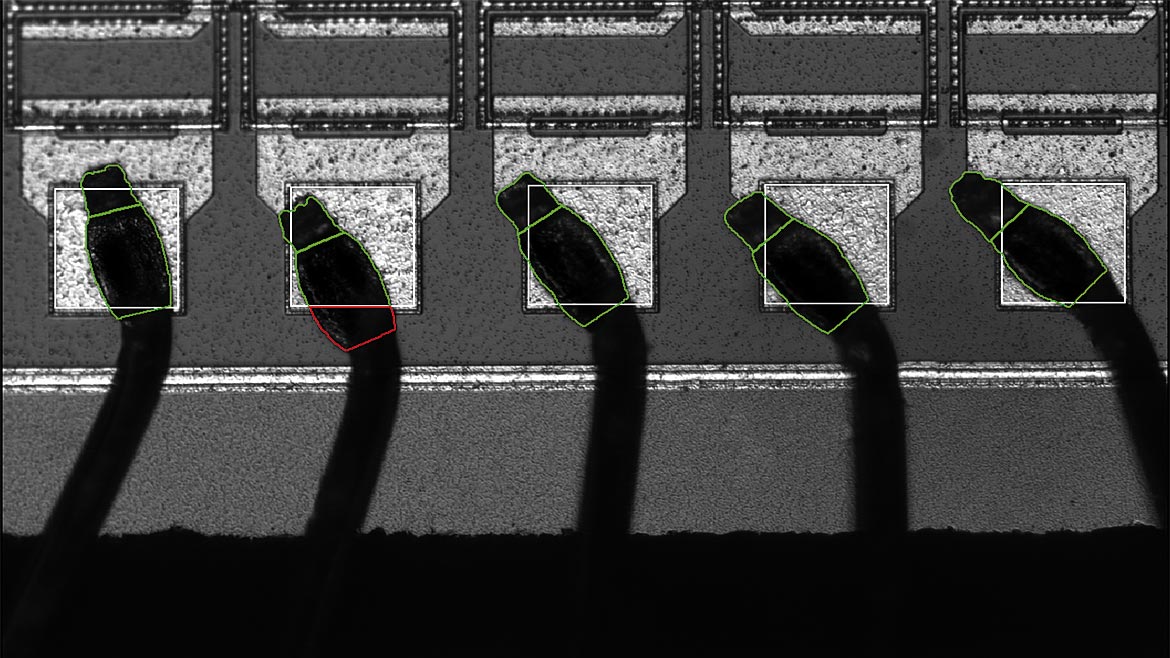
02 VS 0124 Software feature MVTec Bild 2. Fault detection in electronics production.
Fault detection in electronics production. Source: MVTec Software GmbH

What can machine vision do?

The technology is indispensable for modern, highly automated inspection processes as part of operational quality assurance. It can be used to reliably detect any type of defect in objects. The faulty products can then be automatically classified as rejects and sorted out before they enter the subsequent process chain. In addition, objects can be measured precisely to ensure the correct dimensions and thus, the required product quality. Using optical character recognition (OCR) technologies, objects are recognized not only based on shape and texture, but also based on imprinted combinations of numbers and letters. Machine vision not only enables precise positioning and alignment of workpieces but also aids robots in gripping, handling, and depositing objects accurately, eliminating the need for direct operator intervention. This automation enhances the efficiency and safety of the entire handling process.

Whether in traditional manufacturing, automotive production, machinery and plant engineering, electronics manufacturing, battery production, or even the food and beverage industry – machine vision can be used across these and many other industries. It not only operates very quickly, but also very precisely. Processing large amounts of digital image data takes place in a few milliseconds, providing very accurate, reliable, and robust results. Thus, thanks to modern machine vision, companies can save significant costs – whether in assembly, quality assurance, or logistical workflows.

Software in practice

Two examples from different industries show the advantages of using machine vision in the industrial sector.

Vision & Sensors

A Quality Special Section

  • Camera Link Proves the More Machine Vision Changes, the More it Stays the Same
  • What Drives the Trends in Machine Vision
  • Making Vision and AI Easier for Users
  • Read More ≫

In the food industry, products such as potatoes or chocolate bars are usually unsorted on the conveyor belt when they are transported to the robot packing area. To enable the robot to precisely grip the products in this chaotic scene, software can detect the products with the help of a camera and transmit precise position data to the robot. Once the food items enter the robot’s work area, it starts handling the products based on the data from the software, following the first-in/first-out principle. The machine grabs the front most product and deposits it in the designated location. The coordinate systems of the software and the robot are aligned so that the vision coordinates precisely correspond to the robot’s trained workspace. To ensure that the robot can find the objects precisely, robustly, and quickly even under difficult conditions, software’s integrated matching technology is used. This allows the robot to flexibly respond to changing variables, such as when contours are rotated, scaled, perspectively distorted, partially covered or outside the image.

Especially when inspecting complex parts, such as metal springs, deep-learning-based technologies like global context anomaly detection yield excellent results. In this process, a powerful camera captures an image from above for each component. On the captured images with the metal springs, global context anomaly detection performs the inspection. The deep learning technology consists of two neural networks. The “local” network checks for small-scale defects such as scratches, cracks, or contaminations. The “global” network goes one step further and checks for logical defects, such as bent or missing brackets. From the interference of the two networks, global context anomaly detection determines an anomaly score. This score is then compared to a pre-defined anomaly threshold. If the anomaly score is above this threshold, it indicates a defective component that is rejected. The inspection process using deep learning technology provides a major advantage over using a rule-based method. In a rule-based approach, all possible types of defects must be individually extracted and defined based on “bad images.” In contrast, for training software’s deep learning methods, only “good images” are needed.

Machine Vision for everyone

Machine vision provides significant added value for companies of all sizes and industries. Thanks to easy-to-use software, the implementation and utilization are straightforward and quick, allowing for processes optimization and employee relief.

KEYWORDS: automation Industry 4.0 machine vision manufacturing Software solutions

Share This Story

Looking for a reprint of this article?
From high-res PDFs to custom plaques, order your copy today!

Klaus Schrenker is the business development manager at MVTec. www.mvtec.com

Recommended Content

JOIN TODAY
to unlock your recommendations.

Already have an account? Sign In

  • 2024 Quality Rookie of the Year Justin Wise 1440x750px banner with "Quality Rookie of the Year" logo inset

    Meet the 2024 Quality Rookie of the Year: Justin Wise

    Justin Wise is an exceptional individual who has been...
    Aerospace
    By: Michelle Bangert
  • Man with umbrella and coat stands outside while it rains at night looking at a building.

    Nondestructive Testing: Is there an ethics problem?

    I was a whistleblower who exposed fraudulent activities...
    NDT
    By: Dale Norwood
  • Unraveling Deflategate: Football stadium with closeup of football on field

    Unraveling the Tom Brady Deflategate

    The Deflategate scandal erupted following the 2014 AFC...
    Measurement
    By: Greg Cenker and Henry Zumbrun
Manage My Account
  • eMagazine Subscriptions
  • Newsletters
  • Online Registration
  • Subscription Customer Service
  • Manage My Preferences

More Videos

Sponsored Content

Sponsored Content is a special paid section where industry companies provide high quality, objective, non-commercial content around topics of interest to the Quality audience. All Sponsored Content is supplied by the advertising company and any opinions expressed in this article are those of the author and not necessarily reflect the views of Quality or its parent company, BNP Media. Interested in participating in our Sponsored Content section? Contact your local rep!

close
  • Key Takeaways for Quality Leaders
    Sponsored byComplianceQuest

    Key Takeaways for Quality Leaders from the 2026 Gartner Magic Quadrant™ for QMS

  • This image shows a person seated next to a Bobcat T66 compact track loader.
    Sponsored byPolyWorks by InnovMetric

    Supercharging Digital Gauging at Bobcat North America

  • Dorsey Calibration Lab photo by Tom LaBarbera Picture this Studios
    Sponsored byDorsey Metrology International

    Ensuring Product Quality in a Competitive Manufacturing Landscape

Popular Stories

a titanium diaphragm speaker driver

The One Thing Elon Gets Right Is Designed to Scare You

This image shows a person seated next to a Bobcat T66 compact track loader.

Supercharging Digital Gauging at Bobcat North America

Dorsey Calibration Lab photo by Tom LaBarbera Picture this Studios

Ensuring Product Quality in a Competitive Manufacturing Landscape

2026 Quality Professional of the Year!

Events

June 9, 2026

Future-Proof your Quality Processes with Advanced 3D Optical CMM Technology

Discover how to effortlessly capture complex data, leverage true multi-sensor automation, and ensure continuous operation without creating inspection delays.

June 22, 2026

Automate 2026

Automate is North America's largest robotics and automation event — and the best place to take your ideas from insight to impact.
 
Our show floor features the world’s leading automation solutions, from AI and robotics to motion control, vision systems, and more. Plus, our educational conference is second to none, led by the brightest minds in automation today.
 
Ready to transform the way you work? Take the next step at Automate.
View All Submit An Event

Products

Lean Manufacturing and Service Fundamentals, Applications, and Case Studies

Lean Manufacturing and Service Fundamentals, Applications, and Case Studies

See More Products
Quality Podcast Channel Custom Content

Related Articles

  • Practical Vision Guided Robotics – Programming and Execution

    A deeper look into using machine vision software and tools for applications in vision guided robotics.

    See More
  • Color Imaging: Using Machine Vision to Monitor Product Color

    See More
  • Quality 101: Using Machine Vision

    See More

Related Products

See More Products
  • Machine Vision and Error Proofing DVD

  • Quality Brain Teasers: Real World Challenges to Build Your Manufacturing Skills (ebook)

See More Products

Related Directories

  • Machine Vision Store

    Machine Vision Store has a laser-sharp focus on machine vision imaging. We deliver a select group of components - cameras, lenses, lights, industrial vision PC's - from leading manufacturers known for quality. Components we understand, support and stand behind. Components and consulting services that will power your success.
  • Phoenix Imaging Machine Vision

    Porosity Inspection of machined metal components using 3D image acquisition. High resolution laser-based scanning optimizes Porosity detection. Phoenix-Middle-Man™ software package provides image storage and database, SQL query and visual display of defects. High-Speed Surface Inspection Systems from Keyence, Omron and Phoenix Imaging for the tough ICE, BEV & Battery projects.
×

Stay in the know with Quality’s comprehensive coverage of
the manufacturing and metrology industries.

Newsletters | Website | eMagazine

JOIN TODAY!
  • RESOURCES
    • Advertise
    • Contact Us
    • Directories
    • Manufacturing Division
    • Store
    • Want More
  • SIGN UP TODAY
    • Create Account
    • eMagazine
    • Newsletters
    • Customer Service
    • Manage Preferences
  • SERVICES
    • Marketing Services
    • Market Research
    • Reprints
    • List Rental
    • Survey/Respondent Access
  • STAY CONNECTED
    • LinkedIn
    • Facebook
    • YouTube
    • X (Twitter)
  • PRIVACY
    • PRIVACY POLICY
    • TERMS & CONDITIONS
    • DO NOT SELL MY PERSONAL INFORMATION
    • PRIVACY REQUEST
    • ACCESSIBILITY

Copyright ©2026. All Rights Reserved BNP Media, Inc. and BNP Media II, LLC.

Design, CMS, Hosting & Web Development :: ePublishing