Podcast: How to Use Trustworthy AI for Quality Control
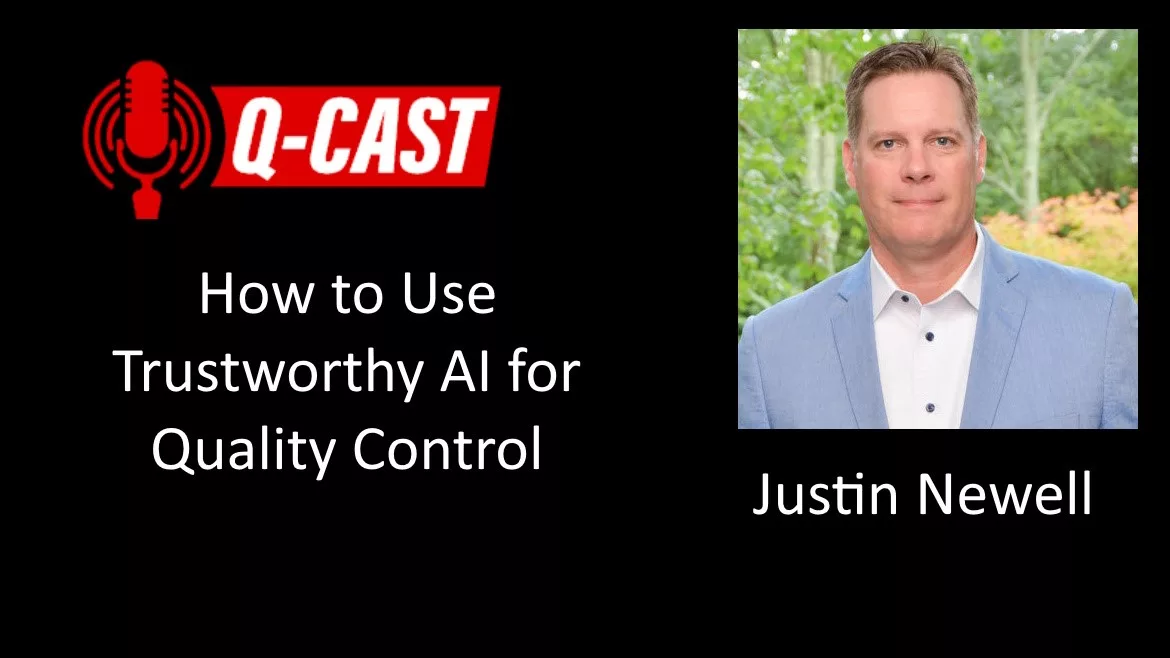
Quality managing editor Michelle Bangert talked with Justin Newell, CEO of Inform North America, who recently wrote an article for Quality on trustworthy AI.
Michelle: So of course, it's such a big topic these days, but in terms of quality in AI, what trends have you noticed lately?
Justin: Yeah, I think it's interesting that people raise this topic because obviously in today's world, you're coming across the term AI pretty unanimously across most industries. And I think it's kind of a buzzword, but, you know, just to kind of set the tone. I mean, AI has really been around since, you know, the mid eighties, early nineties in a lot of different cases. And I think where we're seeing some major shifts. In fact, I was just at a Alabama automotive manufacturers conference a couple of weeks ago. And I think what you see in manufacturing is there's been high adoption with automation and some of those technologies and 80% of most manufacturing processes have adopted some form of automation. But what you're now seeing is kind of that AI bubble and there's kind of a big portion of people, let's say maybe 30% of the people that are saying, okay, we're currently looking into AI. There's maybe a little bit higher percentage of people that know what AI is.
But then there's a smaller percentage of people that actually in the manufacturing world can say that we're adopting AI. And that was actually some information that came out of the University of Auburn. And I think, so what we're kind of seeing is we're seeing a big shift right now from what you would call kind of reactive, manufacturing quality control to more of a proactive, by using either AI machine learning to analyze data from different sensors and machines in real time.
Obviously, this allows manufacturers to look at potential defects, oftentimes before they even occur. And then they can really use preventative measures using this predictive quality to help increase their throughput and make quicker decisions when they do see some type of a defect. And what I think a lot of production companies are seeing these days is the complexity and the variety of products that they're producing. In many cases, not all, is growing substantially. So obviously that's a little bit more difficult and a little more challenging when you look at it from a quality and a production perspective. One thing that we've also seen and done a lot of research on is really something like reject prediction. That can either be kind of monitored or unmonitored. And also then moving to something more that's a little bit more common today. Which is kind of what you call reject detection, which also can be either monitored or unsupervised. And that's really where you're looking at cameras. It could be sensors, thermal sensors. And what they're really looking at then is they're seeing the final product or at least somewhere close to the final product coming off the line and able to detect, are they seeing some type of deficiency? Are they seeing an issue? Some examples of industries could be PCB boards, different types of production welds where there's welding that's going on. So they're looking at the camera and they're saying, hey, does that weld look like a good weld or not? Before they let that product move further down the line, textile production, in the automotive world, spark plugs are very common. So that's just a little bit of it. And then there's also a lot of other areas, like AI powered digital decision making, where systems can be trained to detect defects, with a much higher accuracy than you could say with somebody standing at the end of the line, that's really doing more of a repetitive type task. Which really allows those quality personnel to kind of move on to either more of a process where instead of looking at each and every single one that might be a quality defect, maybe they look at the ones that are just really where the system's saying, okay, there's a small tolerance here, and should we let this one go or not?
So, and then there's also other ones too. You know, we've done some research on focus, you know, really focus in what you would call root cause analysis. And where root cause analysis kind of comes in is more when you've got a very, let's say a very complex multi-line configuration where you might be running three or four, five, six, seven, eight, nine different manufacturing lines and where you sometimes have a product that may go from one line to the other, depending on the day, depending on the situation, depending on the product availability or the raw materials coming in. And sometimes you can't truly detect where a particular defect's coming from. So what you use is kind of root cause analysis, meaning that you're really looking at the data and you're looking at all the complexities of the different configurations that the products that had defects went through. And that ultimately allows you to slowly tie that back to, okay, here was the combinations that we saw based on data, data scientists looking at it that says, here's where we were most, I guess most Apple to have some type of a defect versus other configurations in the lines where we didn't see any defects. And so we're also seeing a big improvement in that area. And then I think just one last point, one or two last little areas that I'm kind of seeing a shift in is improved process optimization. You can imagine the production environment, it's very expensive, there's a lot of capex expense, huge expense going into creating new production facilities, increasing the footprint of the actual facility, et cetera. And we've seen this not only with our solutions with certain customers, but where we really can actually, what you basically process optimize, all the different processes going on within the facility that lead to the manufacturing line.
So this could be the dolly trains, this could be all of the internal carts, the different machines that are bringing parts to and from the factory floor. And if you can better configure that environment, we have a particular test case with a company like Audi Ingolstadt, where we basically helped from a line side management perspective, help them squeak out about another 40% worth of production by really staying with the same footprint because they didn't have additional space to grow the facility.
And so they're really optimized the entire process. And yeah, so that's just some of the things we're seeing. And one last point, I think from an AI perspective that we love to mention that it's kind of near due to our arts is really the ethical considerations of AI. I mean, AI is being used and chat GBT is being used and a lot of things that we use both personally and professionally, but ultimately, I think what people wanna know are companies using it in an ethical way.
Are they, is there a bias in the algorithms? You know, we talk about social media and all these different things. And you know, really what are the potential risks of truly powerful AI? And as informed, we actually just in the last few months released our AI ethical guidelines. And for anybody to see, that really shows how we're using them. And obviously we're trying to improve process. We're trying to improve business. We're trying to improve profitability. And all those things, all those metrics that you want in a production and or distribution type environment, but we're also trying to improve the human element of the job. We're trying to give a better workplace for the human individual, and we're using a lot of things that help improve what people do in the production environment too. Yeah, definitely. Yeah, like what you said at the end about the ethical guidelines, I saw those that you had up on your site, and yeah, it seems very important. People want to know what the technology can do, but they're also concerned what it's being used for and all the implications.
The big picture. So that's something that people should be, should be concerned about because using the right way can be very powerful and beneficial, uh, use in the wrong way. Certainly there, there's a lot of risks. You know, we also do fraud and risk, uh, work as well. And so we know there's a lot of bad actors in the industry too.
Listen to the Full Podcast Here:
Looking for a reprint of this article?
From high-res PDFs to custom plaques, order your copy today!