Management
What the Coast Guard Can Teach Us About Quality
Preparing for these missions involves a series of quality related tools and practices, many of which might also be found in manufacturing.
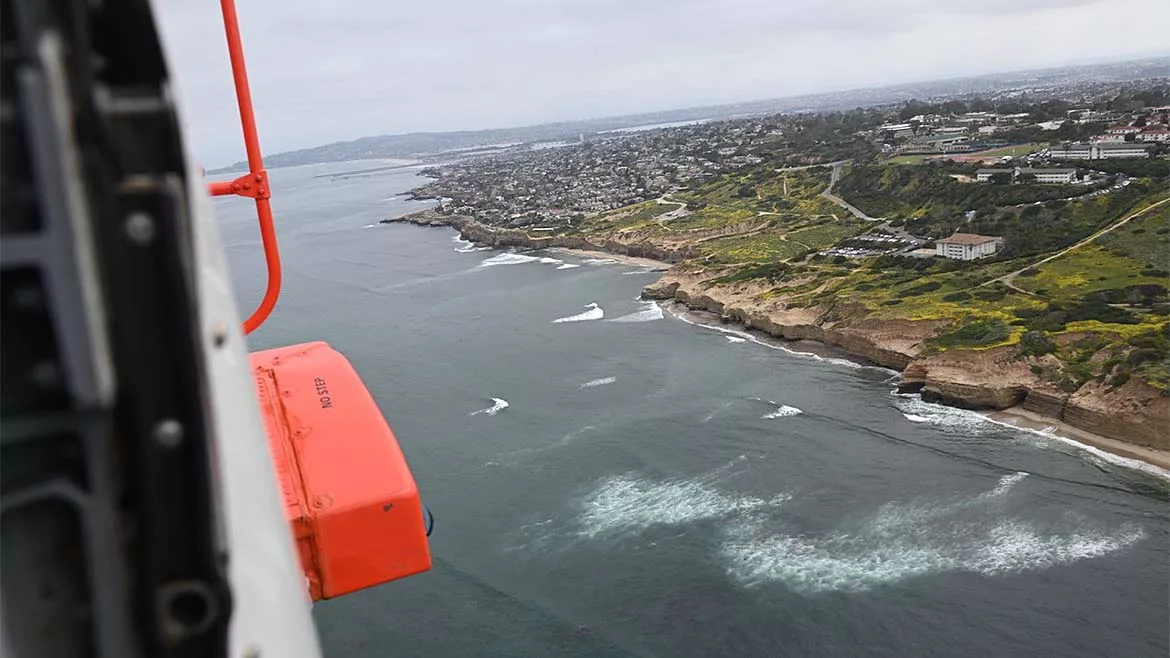
View of the La Jolla area coastline from within the Jayhawk helicopter. The USCG Sector San Diego monitors the beaches in Southern California where many boats that enter illegally from Mexico attempt to land. The Sector conducts nearly 1000 missions per year including search and rescue, and law enforcement. All Images Source: Ian Lazarus
The United States Coast Guard has been around for over 230 years and is steeped in military history, protocols, and traditions. But what could it teach us about quality? It turns out, a lot.
The idea to profile the Coast Guard’s quality focus came to me as I was conducting a vessel safety examination of a privately-owned sailboat. I’m a certified Vessel Examiner with the US Coast Guard Auxiliary, the voluntary component of the Guard that is composed of over 25,000 men and women from a variety of professional backgrounds. The Auxiliary complements the 44,000 active-duty personnel on missions while also managing the "Vessel Safety Check program" for sailboats, power boats and various personal watercraft (including jet skis and kayaks). Auxiliarists conduct approximately 50,000 vessel inspections nationwide every year.
To conduct an inspection, I use a checklist supplied by the Coast Guard which guides examination of vessels and operator readiness on over 35 different criteria, from ensuring battery terminals are covered (to prevent arching) to the availability of distress signals. The "checklist" is arguably the most basic yet essential quality tool, which prompted my curiosity: what other quality tools might I find within the Coast Guard?
The operational assets of the Coast Guard include airplanes, seaplanes, helicopters, icebreakers, cutters, and smaller boats of various lengths – in all, over 2,000 mobile assets. One or more of these vehicles are employed in conducting missions which might include search and rescue (SAR) operations, drug interdiction, prevention of suspected human smuggling, disruption of terrorist attacks, and other forms of maritime law enforcement. I am based at Sector San Diego, one of the 37 Coast Guard bases in the United States and next to a very active international border.
Preparing for these missions, and for the use of sophisticated marine and military-scale technologies, involves a series of quality related tools and practices, many of which might also be found in various manufacturing environments. In most situations, the use of these tools is evident before an accident and are rightly credited with preventing many of them. Sector San Diego conducts an average of 273 search and rescue operations annually, saving an estimated 120 lives per year and $600,000 in averted property damage.
The FMEA. Some of the most highly leveraged tools in use by the USCG are various derivatives of the Failure Modes & Effects Analysis (FMEA). The FMEA is a comprehensive spreadsheet that allows a team to prioritize failures and defects most likely to occur based on the frequency (aka "Occurrence") with which the failure is anticipated, the "Severity" of damage caused, and the existing controls in place to rapidly "Detect" and mitigate the effects of the damage. Discrete scales of (1) – (10) for each of these criteria establish an objective rating, then multiplying across the rows of each "failure mode" gives rise the value that will determine the "Risk Priority Number (RPN)" requiring the most immediate attention. A quick Google search will deliver multiple FMEA examples and templates.

The FMEA has a rich history. Its origin dates to 1949 when first appearing in a military procedures protocol of the U.S. Army. By 1960, NASA had adopted FMEA variants for missions as diverse as Apollo and Voyager (which has reached 15 billion miles after leaving Earth 47 years ago and is still functioning!). Ford Motor Company began utilizing the tool in the 1970s after rear-end collisions of their Pinto model resulted in combustion of the fuel tank, killing three people, and revealing a flawed design that should have been apparent before the car ever entered production.
Today, a well-documented FMEA can serve as the basis for a business continuity plan. That’s exactly how I used it when running a 24/7 nurse triage line serving 3.4 million health plan subscribers. We were relied upon to give not only nurse advice but advise on what roads were safe to travel during wildfire season. We could not afford to be offline, and the FMEA kept us prepared, unwittingly embracing the USCG motto Semper Paratus (Always Ready). We reviewed the FMEA as a team once per quarter to make updates and adjustments.
In the military and in hospitals, a FMEA’s "Severity" scale likely includes the risk of fatalities if a process or mission fails. In a manufacturing environment, the Severity scale might be more benign, but it doesn’t diminish the value of a robust, quantifiable way to prioritize risks and quality imperatives. Otherwise, why practice quality improvement?
The Huddle. For this piece, I was invited to "ride along" with a crew that would be taking a Sikorsky MH-60T Jayhawk Helicopter across their "Area of Responsibility" (AOR) in the San Diego County region. The first flight of each day includes a significant investment in pre-flight safety inspections: taking fuel samples, examining door seals, and calibration of onboard equipment. Pilots walk around the aircraft, and on it. The crew then reviews the aircraft’s maintenance history, current and predicted weather, temporary airspace restrictions, closed runways, or taxiways, and compares this to the flight plan route (that route can change at any time if a "search and rescue" mission is initiated). It can take two hours of preparation before the flight crew comes together for a final briefing.

Here I was introduced to a couple new acronyms that the flight crew utilized in preparation for their mission as they worked their way down a laminated card in the briefing room. One of the things the military is quite good at is conceiving of acronyms. An existing database of military acronyms contains over 15,000 entries! (militaryonesource.mil). The use of acronyms is intended to cut down on unnecessary time to convey commands during a potential conflict, so there is reasonable justification for the vast quantity of them.
First there was the elements of PEACE, which answered the questions:
(P) – Have we devoted sufficient time to planning the mission?
(E) – Have we prepared effectively for the complexity of the event?
(A) – Are our fixed, hard, and human assets adequately prepared to perform?
(C) – Are we confident our communications channels will be sustained throughout the mission?
(E) – Does the external environment (weather, visibility, air and water temp, etc) present any unique risks?
For each criterion above, the crew then applies the STAAR rubric to either Spread out risk, Transfer to other assets, and/or Avoid, Accept and Reduce the identified risks. As the flight commander walked down the list, he asked for a verbal acknowledgement from each member of his crew that they accepted all identified risks at that point and remained committed to the mission.
What I witnessed up to this point was simply an adaptation of the FMEA concept to the unique environment of the Coast Guard’s Air Operations Unit. In my research, I found a half dozen different derivatives of the FMEA concept in use within this branch of the military.
The "huddle" concept also demonstrated here, with or without the use of an FMEA tool, can be an important and effective way to proactively manage quality and risk in a manufacturing environment. They are commonly practiced in hospitals to keep patients safe and to communicate unique conditions at the beginning of each shift. The exercise calls to attention the codependence of the team on one another. Is there room for a daily huddle in your environment?
Human Factors. If the FMEA had any downside, it would be the potential for blind spots in evaluating inherent risks, because it doesn’t call to attention the many "human factors" that can introduce peril, apart from shortcomings in the process that was designed in the first place. So, the flight crew turned to one final acronym before walking out of the briefing room and toward the aircraft. Each member of the crew was required to say, "I’M SAFE," in other words, "I am fit: no Illness, Medication, Stress, Alcohol or drug use, or Fatigue that would interfere with my performance. I’ve Eaten and am well hydrated." Had I been called upon to declare I was stress-free, I am not sure what I would have said, however the degree of professionalism exhibited by this crew made clear I was in very capable hands.

Are inspections enough? While the Auxiliary focuses on inspecting recreational vessels and smaller commercial operators under 65 feet in length, the Coast Guard focuses on larger ships, including tankers, container ships and cruise ships. The USCG Inspections Division verifies compliance with U.S. regulations and international conventions for structural integrity, propulsion, seaworthiness, and safety of navigation. But notably, the ISO-style examination process is far more comprehensive for ships registered in the United States than those flying the flag of another country (more on this in a moment).
"The system is one that is built on standards," stated retired USCG Rear Admiral Richard Timme, who today runs a consulting firm advising trade associations, shipbuilders, and vessel owners on marine safety. Prior to retirement from the Coast Guard, Timme served as the commander of the Eighth Coast Guard District, charged with managing all maritime activity inside the ports of the Gulf of Mexico. Earlier in his career, he was a USCG commercial vessel inspector and USCG Port State Control Officer at several U.S. ports."We verify compliance with standards using quality tools, and when there is a failure we investigate it," he added. "Our investigations often necessarily lead to a change in the standard." What Timme says here is vitally important.
If you ever want to shake up a quality meeting, declare "inspections are fundamentally non-value added." Don’t worry, you’ll be on solid ground, repeating an argument made by Lean and Six Sigma practitioners for years who suggest an activity is "value added" if and only if:
- It materially alters the work in progress
- The alteration benefits the process or customer
- The work is done right the first time
Inspections fail on the first of those requirements. Moreover, due to human error, inspections often don’t satisfy their principal objective; some studies suggest the activity will identify only 80-90% of defects present (they may also incorrectly reject acceptable parts), and they certainly won’t fix a broken process because whatever was discovered by the inspection was already "baked in." In other words, it’s too late.
Timme’s suggestion that standards change is an acknowledgement that the Coast Guard creates the necessary feedback loop leading to more relevant standards and an increased margin of safety. "About 30 years ago we ramped up our exams of foreign vessels in response to the poor quality and marine casualties we were seeing," notes Timme. "We have driven out a significant amount of risk in the way we forced compliance, kicking out nonconforming vessels," he added.
The unfortunate reality is that, even the day after an inspection, any number of complex systems on a commercial vessel can fail, causing it to lose propulsion and run aground, or strike a structure, and cause harm to people and property. That is what happened on March 26 when a cargo ship, registered in Singapore, struck the Francis Scott Key Bridge in Baltimore.
With the investigation ongoing, it’s too early to speculate on the cause of the bridge collapse. Because vessels that fly foreign flags are not subject to the same level of inspection as domestic vessels, the responsibility falls on the "flag state" from where the vessel is registered. Certainly, there will be variation in the quality of inspections, with "flags of convenience" being used by some companies from countries that have particularly lax standards for maintenance. The Coast Guard continues to introduce new programs to assess and certify various flag states for eligibility to enter U.S. ports.
In 2001 the Coast Guard introduced "QUALSHIP 21," a program designed "for the 21st century" to certify foreign vessels, while offering an incentive for participating governments. Achieving the certification carries special benefits, from reduced port state control inspections to the streamlining of entry and exit, all resulting in tangible cost savings and fewer delays. While four flag administrating countries received QUALSHIP 21 recertification in 2023, a total of six flag administrations fell out of compliance. According to the U.S. Marine Survey, an organization providing technical services to the shipping industry, the QUALSHIP 21 certification is "the most difficult quality certification to attain in the world."
Through the efforts of the USCG to hold vessels and flag states accountable, Timme says, we have significantly increased safe navigation within the marine environment. "You’re the Six Sigma guy," he said to me. "Take a look at the numbers." So, I did.
According to the Bureau of Transportation, 465,000 commercial vessels come in and out of American ports each year. That includes an entry and an exit, so the actual number of transits where a vessel could strike a bridge is closer to just under a million. Meanwhile, since 1980 there have been 7 cases of bridge collisions where one or more fatalities occurred. One hundred eleven people died in those accidents, including those presumed dead from the most recent bridge collapse.
A "Six Sigma" level of performance would require that there were no more than 150 fatalities over the past 44 years. Like the airline industry (discussed in my April column), the process of protecting bridges (and people on them) is operating above the near-perfection level of Six Sigma.
Of course, this is a very rough computation and doesn’t consider the many other risks that the USCG seeks to manage from the recreational boating community. It is difficult to parse out negligence from vessel failures in the fatalities recorded from recreational boating, but there is something youcan do to make boating safer: become a USCG Vessel Examiner, like me. Or join the USCG Auxiliary in some other capacity to keep our maritime environment safe. Click the QR code at the bottom of this article to request more information on opportunities from a USCG Auxiliary Flotilla near you.
Finally, be grateful for the thousands of dedicated servicemen and women of the US Coast Guard and their Auxiliary. They are always ready to protect our coastline and marine environment while using the same quality tools as the rest of us.

Are you interested to learn how to join the U.S. Coast Guard Auxiliary?
Scan this QR CODE and be directed to a portal to request more information. On a computer, go to https://join.cgaux.org/join.php
Looking for a reprint of this article?
From high-res PDFs to custom plaques, order your copy today!