Vision & Sensors | System Integration
The Expanding Role for Machine Vision in Smart Factories
Making the most of machine vision starts with understanding smart manufacturing and how machine vision delivers actionable data
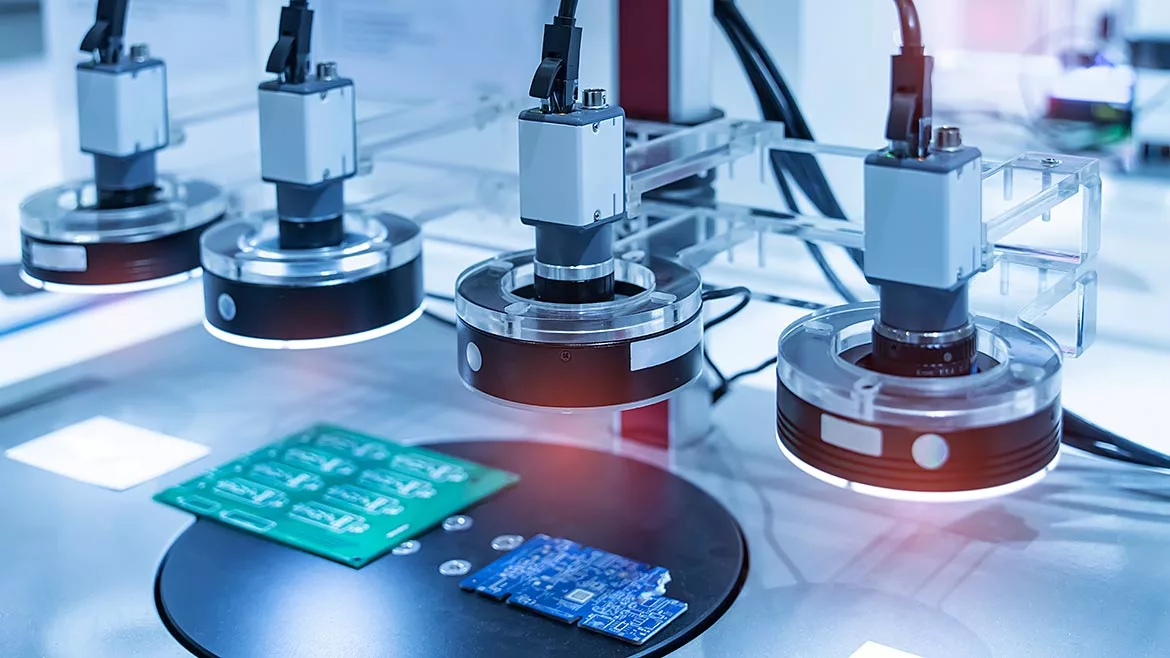
Image Source: kynny / iStock / Getty Images Plus
As companies strive to improve productivity, efficiency, and quality, more are turning to concepts like smart manufacturing, smart factories, and Industry 4.0. Not surprisingly, machine vision for automated imaging, already broadly successful in manufacturing, emerges as a critical technology in these initiatives. The capabilities of machine vision as a rich data source help drive today’s complex factory and manufacturing environments. Making the most of machine vision in this context starts with understanding smart manufacturing and how machine vision delivers actionable data. It is also important to clarify the implementation of machine vision systems in smart factory environments and the trends and innovations shaping the future of machine vision in manufacturing.
Review of smart factory concepts
READ MORE
LISTEN
"Industry 4.0", "Smart Manufacturing", and "Smart Factories" are inter-related terms that, in a practical sense, describe ways to improve the production and delivery of goods in today’s complex marketplaces. Of course, constant improvement is a longtime hallmark of a successful automation company regardless of these technical classifications. With that in mind, let’s review the smart factory concepts as they benefit from, impact, and propel the use of automated imaging technologies.
The term Industry 4.0 was coined to describe (and to encourage) a transition from a computerized generation of automation (Industry 3.0) to a new wave of technologies including big data, autonomous robotics and systems, sensing components, and IIOT, to name a few. The "4.0" refers to the "fourth" state of the historical industrial revolution.
Smart manufacturing, then, is the realization of the concepts and expectations of Industry 4.0. It refers to the implementation of technologies and digital processes over a wide-spread manufacturing enterprise which could include both production facilities and other value chains.
A smart factory is where smart manufacturing meets the plant floor, the "real world’ execution of connected machines and systems, digitization of real time actionable data, and big data analytics. Smart factories use technologies that deliver lean, flexible and adaptable production for today and the future.
These goals might sound familiar. While the term "smart factory" is being used to formally describe these objectives, companies involved in manufacturing and automation have always been forward-thinking and focused on constant progressive transformation. And in today’s technology landscape, the traditional concepts of process improvement have evolved to embrace the potential of interconnected machinery and components, and equipment that is able to sense, monitor, and adapt.
Big data and interconnected systems
Operational data are at the foundation of the smart factory concept. The path to smart factory execution starts with implementation of technologies that provide data in support of smart manufacturing; in particular, machine vision and other sensing components. Connectivity also is critical, and IIoT (the Industrial Internet of Things) plays a vital role. Other supporting technologies like cloud computing, AI/machine learning, 3D printing, and even digital twins can be a defining part of the realization of a smart factory as well.
It has become common to categorize the structure and levels of evolution of a smart factory relative to data and connectivity. Opinions differ somewhat in the exact definitions but broadly put, four typical stages are:
- Access to basic data: a fundamental prerequisite, the factory begins to digitize and collect data from manufacturing and other processes.
- Putting data in context: the structured and proactive basic analysis of centralized and organized data including visualization of data for human consumption and evaluation.
- Active analysis of big data: effectively utilizing historical data trends in real or near-real time using AI and machine learning analysis tools to predict outcomes like machine failure alerts or production problems.
- Automated and action-oriented responses: at this level, the smart factory uses data to make immediate decisions and make autonomous, real time actions to improve efficiency and productivity, communicating with individual components and manufacturing processes directly.
Some recent reports suggest that most factories are still in the early stages (1 or 2) of smart factory execution. While new supporting technologies and techniques emerge, machine vision, a mature, proven and trusted technology, has a huge role to play. Moreover, in many cases, automated imaging is already broadly implemented in industrial automation environments and ready to be used as part of a smart factory.
Machine vision technologies: source of and consumer of big data
Machine vision therefore emerges as an important part of the smart factory paradigm; it is a prominent enabling technology, improving and facilitating automation tasks that would not be practical or might even be impossible without vision. It is both a source of big data and is inherently flexible and adaptable when driven by external data.
As a data consumer, machine vision systems automatically make functional changes based on data input to, or "consumed" by the system, responding to recipe or part changes and making configuration changes based on process data provided by the smart factory.
As a data source, few sensing technologies have as much potential to provide actionable data as machine vision. At the most basic level, the task for machine vision components is to extract information, "data" from a visual scene, much like a human might do when examining a part or an automation sequence or process. When limited information is used to directly enable another process or component, as in vision guided robotics for example, it’s easy to see the value of the data being shared. However, a typical vision system can provide significantly more data in support of the four smart factory stages described earlier. Machine vision’s broad capabilities in using and providing big data have expanded the role for this technology in smart factories, but it is necessary for users to have an implementation perspective and strategy that makes the best use of these features.
Best practices in implementing machine vision for smart factories
One decades-old quote related to machine vision in manufacturing is "Quality cannot be inspected into a product". The implication here is that automated inspection, and by association other machine vision tasks discussed a bit later, are most valuable in a production process when the result is more than just a pass/fail decision. That is exactly the perspective to embrace in using machine vision in the smart factory paradigm. The basic best practices in machine vision integration include sharing more available information from vision systems to improve production, optimize manufacturing and enable predictive maintenance, and implementing vision systems that are production-data driven.
Consider the many ways machine vision is used very successfully as part of an automation system as it acts on 100% of production. The marketplace commonly identifies four broad groups of functionalities: inspection, location, measurement and identification.
Inspection
Possibly the most frequent use of machine vision, the concept of inspection covers a wide range of applications like defect, damage, and flaw detection, assembly verification, object presence/absence and more.
The configuration of vision tools for inspection tasks in a smart factory environment would be expanded to provide actionable data beyond pass/fail. Things to add to the data might include size, location, and classification of features detected. If assembly verification or presence/absence, the system might indicate the location of a missing feature, or possibly identify a wrong component.
Location
Beyond the more obvious robotic or motion guidance, machine vision might also be used to verify precise location of objects or features in some use cases. Consider providing the observed location as part of the actionable data in the smart factory context.
Measurement
Inline gaging and metrology applications naturally lend themselves to the concept of big data. Every critical measurement data point can be communicated to potentially enable evaluation and autonomous manipulation of upstream manufacturing processes.
Identification
Another broad and expanding use of vision technology, identification (ID) describes tasks like object identification and sorting. However, the most prolific use of vision technology for ID is called "track and trace" and applies to the logistics and warehousing industry. In this application case, machine vision already is widely used as a source of data, with code reading and OCR systems seamlessly linked with plant floor or even enterprise-wide data systems.
Trends and moving forward
Machine vision component capabilities in many cases already handle connectivity, but one next step for suppliers of these products may be to broaden the scope of interconnectivity. While some standards exist for big data, like OPC communication with MES and ERP/MRP systems, Ethernet/IP for IIoT, or fieldbus and other interfaces to PLCs, other protocols might need to be supported like MQTT or AMQP for IIoT.
In the near term, however, machine vision is strongly positioned as a smart factory technology. It is ready today to be a rich data source, and current installations usually can easily be expanded to provide actionable information. Long term, machine vision capabilities will continue to increase rapidly. One of many notable directions in general technology is the growing availability of standard applications and tools for specific tasks which reduce configuration and implementation time by standardizing execution.
In conclusion, the technology architecture of a smart factory extends far beyond the discussion of individual data sources like machine vision. The overall tasks of data collection and digitization, data organization, and the related software needed for analysis and ultimately autonomous action can be a challenge for an operation of any size. However, implementation of basic concepts like device and machine interconnectivity and making useful data available is within reach of most manufacturers.
Looking for a reprint of this article?
From high-res PDFs to custom plaques, order your copy today!