Quality Magazine logo
search
cart
facebook twitter linkedin youtube
  • Sign In
  • Create Account
  • Sign Out
  • My Account
Quality Magazine logo
  • NEWS
  • PRODUCTS
    • FEATURED PRODUCTS
    • SUBMIT YOUR PRODUCT
  • CHANNELS
    • AUTOMATION
    • MANAGEMENT
    • MEASUREMENT
    • NDT
    • QUALITY 101
    • SOFTWARE
    • TEST & INSPECTION
    • VISION & SENSORS
  • MARKETS
    • AEROSPACE
    • AUTOMOTIVE
    • ENERGY
    • GREEN MANUFACTURING
    • MEDICAL
  • MEDIA
    • A WORD ON QUALITY PUZZLE
    • EBOOK
    • PODCASTS
    • VIDEOS
    • WEBINARS
  • EVENTS
    • EVENT CALENDAR
    • IMTS
  • DIRECTORIES
    • BUYERS GUIDE >
      • Supplier Insights
    • NDT SOURCEBOOK
    • VISION & SENSORS
    • TAKE A TOUR
  • INFOCENTERS
    • Digital Quality Management Systems
    • NEXT GENERATION SPC & QUALITY ANALYTICS
  • AWARDS
    • ROOKIE OF THE YEAR
    • PLANT OF THE YEAR
    • PROFESSIONAL OF THE YEAR
  • MORE
    • Expert Columns
    • NEWSLETTERS
    • QUALITY STORE
    • INDUSTRY LINKS
    • SPONSOR INSIGHTS
  • EMAG
    • eMAGAZINE
    • ARCHIVES
    • CONTACT
    • ADVERTISE
  • SIGN UP!
NDT

Q-Cast

The Urgent Need for Nondestructive Testing On-the-Job Training Standards
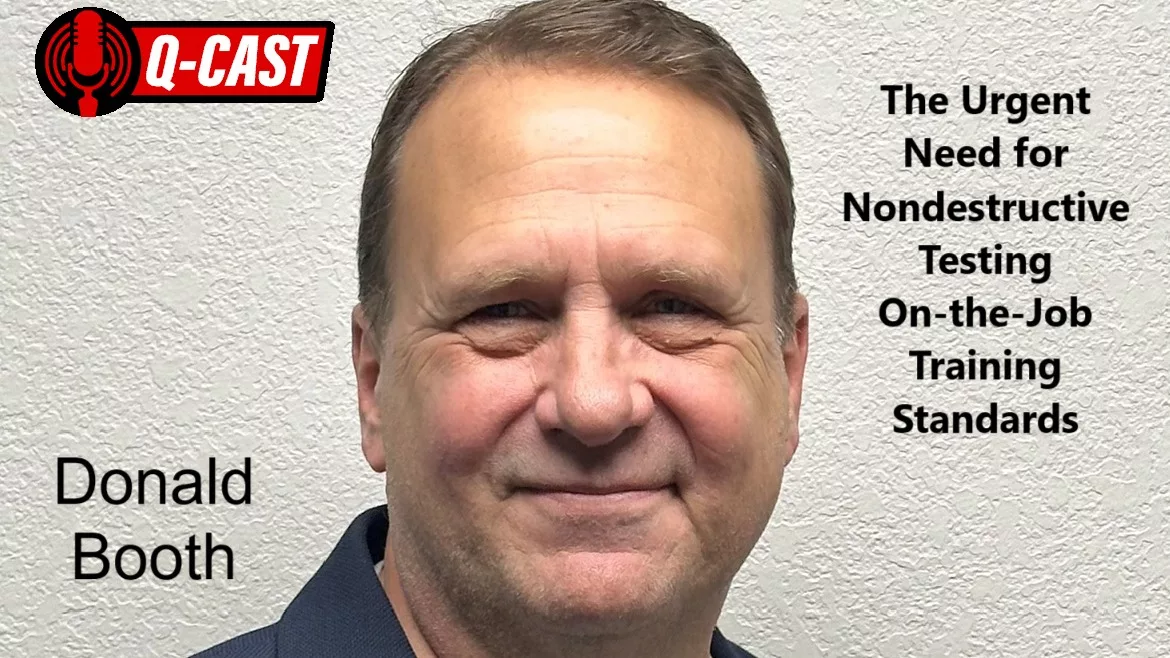
Donald Booth Q-Cast Podcast 1170x658px
May 27, 2025

The NDT industry has established in-depth guidelines and requirements for formal classroom training, but a shortfall in the standardization of on-the-job training (OJT) requirements remains.

Donald Booth, CEO of the American Institute of Nondestructive Testing, explains.


Listen to the Full Podcast ▼


Michelle: You recently wrote an article for Quality about on-the-job training for NDT. Could you summarize the article for our listeners?

Donald: Absolutely. On-the-job training, of course, we know that NDT, or many of us know that, NDT has a dual structure for training. One is the formal classroom theoretical training. For example, ultrasonics is 40 hours for level one and 40 hours for level two. And then you progress to on the job training. And on the job training can come prior to the formal classroom training. That's not the issue or the topic. The topic is once you're provided your 80 hours of training, for example, then you go into the field for 840 hours of required on the job training. So that's a major component of our training structure, right? The dual training structure of NDT. What I've found over the years in the industry, having spent the last 12 years in the education sector, developing curriculum, training thousands and thousands, I think we're at 600,000 hours of training we've provided is that there is no structure for the OJT, the on-the-job training.

We have topical outlines like CP105, SNTTC1A, ISO, different standards or recommended practices that state how many hours and the topical outline of CP105 is you have to talk about, let's say for ultrasound again, principles of acoustics or equipment calibration transducer theory. And those are listed there. And, and as trainers have a lot of clear guidance as what we have to provide for the theoretical, but nobody has really approached the OJT of what is what that entails. It's just work with a level two or level three under their direct supervision. But is it just carrying my equipment? Is it actively participating in the inspections? So I think the industry really needs to address that.

Michelle: Yes. It sounds like there's consequences. In the article you wrote that the lack of this OJT standardization jeopardizes the industry's ability to produce consistently skilled technicians. Can you talk a little bit more about this or what you've kind of seen happen?

Donald: Over the years, I've talked to so many of our clients. And we've kind of back-step here. We also wear the hat as a private career school, so we bring graduates in and we place them in careers. And people that hire our graduates like them, that's why we hold such a high placement rate. But when I talk to our clients that are in positions to hire people, they will hire somebody from a different company. Let's say someone's moving and they come in, hey, I'm level two in RT, UT, MT, PT. I want to come work for you. Oh, great. You've already been certified by prior employees. And then they bring them in, and they don't have a broad knowledge of the technique, like ultrasound or radiography.

So that is an issue they have to retrain this person that's supposed to be certified and trained. Certification says, hey, you should be a well-rounded technician. Now, there's different verticals. mean, aerospace and pressure vessels are two different animals, right? So we don't expect someone to come from the aerospace sector and come into a pressure vessel sector and be totally competent. But there are universal skills that could be used. If the OJT has universal skills that will work across all sectors, then if you bring someone in from tanks and they enter aerospace, sure, you might have to add some site-specific or vertical-specific training, but it'll reduce that. So I think we really need to just address how we record, how do we track, how do we train our mentors, right? I've met a lot of level 3s that are great at creating certifications and procedures and quality programs, but they really don't know how to transfer theoretical knowledge to people. They just don't have that skill. So kind of following up on that, in an ideal world, what do you think on the job training would look like?

I think it needs to be somewhat like CP 105, which is a standard of the topical outline of what a person needs to have been taught, right? So what does my school teach? We teach all of these things in CP 105, so we know we're creating a well-rounded graduate. That being said, I would say the OJT needs some type of structure. OK, so, maybe it's a CP 108, or I don't know, whatever you want to call it, but a document that the industry puts together that you can use. So everyone is following the same template for the universal components of each, you know, a UTRT, MTPT, each method of NDT. Like I said earlier, I don't expect someone to be a perfect inspector across all verticals, but if we can build a better base, it will reduce the retraining or the additional training that they have to add. We'll just create a more well-rounded person. think it's standardized tracking, standardized methodology, better training for our mentors. Not everyone can be a trainer. Some people just don't like it. In my career, I've worked with level twos that just, hey, carry my equipment. They didn't want to spend the time with you. I enjoyed it.

And that's why I moved into the education industry.

Listen to the Full Podcast Here:

Your browser does not support the audio element.

Listen to more podcasts here.

KEYWORDS: certification education manufacturing metrology training

Share This Story

Looking for a reprint of this article?
From high-res PDFs to custom plaques, order your copy today!

Recommended Content

JOIN TODAY
to unlock your recommendations.

Already have an account? Sign In

  • 2024 Quality Rookie of the Year Justin Wise 1440x750px banner with "Quality Rookie of the Year" logo inset

    Meet the 2024 Quality Rookie of the Year: Justin Wise

    Justin Wise is an exceptional individual who has been...
    Aerospace
    By: Michelle Bangert
  • Man with umbrella and coat stands outside while it rains at night looking at a building.

    Nondestructive Testing: Is there an ethics problem?

    I was a whistleblower who exposed fraudulent activities...
    NDT
    By: Dale Norwood
  • Unraveling Deflategate: Football stadium with closeup of football on field

    Unraveling the Tom Brady Deflategate

    The Deflategate scandal erupted following the 2014 AFC...
    Measurement
    By: Greg Cenker and Henry Zumbrun
Manage My Account
  • eMagazine Subscriptions
  • Newsletters
  • Online Registration
  • Subscription Customer Service
  • Manage My Preferences

More Videos

Sponsored Content

Sponsored Content is a special paid section where industry companies provide high quality, objective, non-commercial content around topics of interest to the Quality audience. All Sponsored Content is supplied by the advertising company and any opinions expressed in this article are those of the author and not necessarily reflect the views of Quality or its parent company, BNP Media. Interested in participating in our Sponsored Content section? Contact your local rep!

close
  • This image shows a person seated next to a Bobcat T66 compact track loader.
    Sponsored byPolyWorks by InnovMetric

    Supercharging Digital Gauging at Bobcat North America

  • Dorsey Calibration Lab photo by Tom LaBarbera Picture this Studios
    Sponsored byDorsey Metrology International

    Ensuring Product Quality in a Competitive Manufacturing Landscape

  • This image displays a Eddyfi Technologies Cypher portable inspection instrument alongside a scanner for non-destructive testing (NDT).
    Sponsored byEddyfi Technologies

    A Safer, Smarter Approach to Weld Inspection: Why Advanced Ultrasonic Testing Is Redefining Industry Standards

Popular Stories

Mukesh headshot

Building Quality Systems for Complex, Regulated Environments

MicroRidge MobileCollect wireless measurement system

Before AI Can Help, the Data Has to Be Ready

a titanium diaphragm speaker driver

The One Thing Elon Gets Right Is Designed to Scare You

2026 Quality Professional of the Year!

Events

June 4, 2026

Scaling Manufacturing Quality with Automation for Greater ROI

If you need to do more with the same resources or build a new tech foundation, this session shows where to start and how to create a more efficient, scalable, cost-conscious quality process.

June 9, 2026

Future-Proof your Quality Processes with Advanced 3D Optical CMM Technology

Discover how to effortlessly capture complex data, leverage true multi-sensor automation, and ensure continuous operation without creating inspection delays.

View All Submit An Event

Products

Lean Manufacturing and Service Fundamentals, Applications, and Case Studies

Lean Manufacturing and Service Fundamentals, Applications, and Case Studies

See More Products
Quality Podcast Channel Custom Content

Related Articles

  • Non-destructive testing technicians are checking the welds of pipes with the ultrasonic testing (UT) method. Ultrasonic testing is often performed on steel and other metals and alloys.

    The OJT Dilemma: The Urgent Need for Nondestructive Testing On-the-Job Training Standards

    See More
  • NAM_AI_Roadmap.jpg

    New NAM Roadmap Ties America’s AI, Energy Future to Urgent Need for Permitting Reform

    See More
  • PCN24/GEN General requirements for qualification and PCN certification of NDT personnel Issue 1, January 2024 cover

    Introducing PCN24: Independent Third-Party Certification for Nondestructive Testing

    See More

Related Products

See More Products
  • The Handbook for Quality Management, Second Edition

  • A Primer on the Taguchi Method, 2nd Edition

See More Products

Related Directories

  • American Institute of Nondestructive Testing

    The American Institute of Nondestructive Testing offers online and hands-on training in RT, UT, ET, MT, PT and VT nondestructive testing methods. Let us customize an NDT training program that fits your company's needs. We offer training online, at your facility or at our 22,000 Sq Ft facility.
  • American Society for Nondestructive Testing (ASNT)

    ASNT is the association for nondestructive testing (NDT) professionals committed to making the world a safer place. NDT professionals detect irregularities, flaws, and defects in materials, components, and structures that could compromise the safety, reliability, or functionality of an object or structure. Established in 1941, ASNT supports members with certifications, professional development, industry insights, advocacy, events, publications, and networking opportunities and is focused on fostering the growth of future generations of NDT professionals through the ASNT Foundation. Serving more than 22 000 members and certificate holders worldwide, ASNT is the largest technical society for NDT professionals. ASNT is based in Columbus, Ohio, with offices in Houston, Texas, and Chennai, India.
×

Stay in the know with Quality’s comprehensive coverage of
the manufacturing and metrology industries.

Newsletters | Website | eMagazine

JOIN TODAY!
  • RESOURCES
    • Advertise
    • Contact Us
    • Directories
    • Manufacturing Division
    • Store
    • Want More
  • SIGN UP TODAY
    • Create Account
    • eMagazine
    • Newsletters
    • Customer Service
    • Manage Preferences
  • SERVICES
    • Marketing Services
    • Market Research
    • Reprints
    • List Rental
    • Survey/Respondent Access
  • STAY CONNECTED
    • LinkedIn
    • Facebook
    • YouTube
    • X (Twitter)
  • PRIVACY
    • PRIVACY POLICY
    • TERMS & CONDITIONS
    • DO NOT SELL MY PERSONAL INFORMATION
    • PRIVACY REQUEST
    • ACCESSIBILITY

Copyright ©2026. All Rights Reserved BNP Media, Inc. and BNP Media II, LLC.

Design, CMS, Hosting & Web Development :: ePublishing