Management
AI as an Enabler of Continuous Improvement: Applying Quality Thinking to AI Prompt Engineering
Used appropriately, AI supports better questions and faster insight. Used poorly, it scales uncertainty. And therein lay the risks.
When artificial intelligence enters the conversation in quality and continuous improvement (CI) circles, reactions tend to fall at two extremes. Some view AI as a transformational leap that will automate analysis and accelerate improvement. Others see it as a risk—introducing bias, eroding rigor, and distancing decisions from human judgment.
In practice, AI is neither a cure-all nor a threat to sound quality management.
It is best understood as an enabler of existing CI and quality methods—capable of extending analysis, accelerating learning, and consolidating information.
But there is a condition.
— The use of AI must adhere to the same discipline and rigor that continuous improvement and quality professionals already expect of people and processes.
The challenge is not whether AI can support continuous improvement and quality. The real question is whether organizations are prepared to use it well.
Why AI Is Gaining Traction in Quality and CI
AI adoption in achieving operational excellence and quality is accelerating exponentially. AI is being used primarily as a decision‑support capability tool, not as a fully autonomous solution.
AI use in quality management systems used in most part to effectively analyze large data sets, surface patterns that may not be immediately visible, and shift quality efforts from reactive detection toward effective predictive prevention with more efficiency than before. And that’s a good thing.
Research in manufacturing and operations suggests that when AI‑enabled analytics are combined with reliable data and strong process understanding, organizations can significantly reduce defects and improve consistency. These outcomes do not come from replacing established CI tools such as SPC, root cause analysis, or control planning, they come from enhancing how those tools are applied.
AI accelerates what quality professionals already do:
- Reviewing large volumes of data
- Amalgamating qualitative and quantitative inputs
- Exploring hypotheses and potential relationships
Used appropriately, AI supports better questions and faster insight. Used poorly, it scales uncertainty. And therein lay the risks.
AI Fails for Familiar Reasons
Early failures in AI‑supported quality and CI initiatives tend to look strikingly familiar. Studies of AI‑based decision support systems consistently identify the same limiting factors: poor data quality, weak problem definition, lack of transparency, and insufficient validation. If you want more specifics on this, visit nature.com.
Empirical research shows that data transparency and data quality are the strongest predictors of trust in AI‑supported decision‑making—more influential than algorithm sophistication. This mirrors long‑standing quality and CI project lessons:
- Weak operational definitions undermine measurement systems
- Ambiguous problem statements derail analysis
- Unvalidated conclusions increase risk
AI does not remove these issues. It reveals them faster. And that’s a good thing.
Prompt Engineering Through a CI Lens
Much of the AI conversation has centered on “prompt engineering.” And for good reason. The design of well-structured inputs to guide AI systems toward useful outputs is critical. While often framed as a technical skill, prompt engineering closely aligns with core CI thinking.
Visit ucstrategies.com and you’ll discover that studies indicate that structured prompts can improve AI output accuracy by 20–30 percent without changing the underlying model. These gains are not the result of clever phrasing. They are the result of clarity.
In quality and CI terms, a prompt functions like a strong problem definition. It sets:
- Purpose
- Scope
- Context
- Criteria for acceptability
Without these elements, neither people nor AI perform consistently well.
A Quality‑Aligned Prompting Model
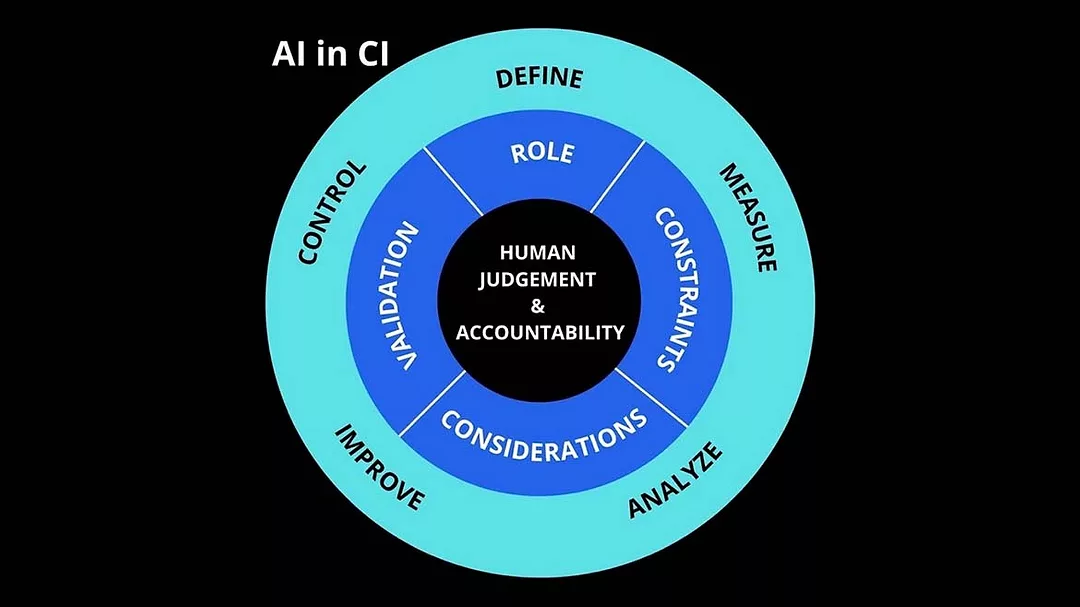
One practical way to apply CI and quality disciplines to AI is to structure prompts around four elements:
- Role – The perspective or responsibility the AI should assume
- Constraints – Boundaries such as scope, assumptions, regulatory limits, or data sources
- Considerations – Context such as variation, VOC, CTQs, recent changes to the industry, or regulatory requirements
- Validation – Requirements to surface assumptions, uncertainty, or supporting evidence
This approach aligns with formal AI guidance shared by those advanced in AI use. They emphasize explicit objectives, constraints, and evaluation criteria as critical to reliable outputs.
More importantly, it mirrors how experienced CI practitioners already think.
A Practitioner Example: Using AI to Strengthen DMAIC Training
I encountered this alignment firsthand while updating my Lean Six Sigma training materials to address the growing use of AI. Rather than adding separate “AI tools” to the curriculum, I wanted to understand how AI might enhance the effectiveness of existing DMAIC practices—without changing the underlying methodology.
To explore this, I engaged an AI assistant using a structured prompt that deliberately reflected CI discipline.
Role: I asked the AI to assume the role of a Master Black Belt with expertise in applying AI within Continuous Improvement. I even uploaded my resume to give the AI assistant greater understanding of who I was and the role I played in developing and delivering training.
Constraints: I explicitly limited the scope:
- Use the DMAIC methodology only
- Cover each phase (DMAIC) and the associated tools one phase at a time
- Apply proven Lean Six Sigma tools, not novel or experimental techniques
- Focus on how AI could support the use of those tools, not replace practitioner judgment
Considerations: I asked the AI to consider:
- How AI is being used globally by CI practitioners and trainers
- What are the cross‑industry practices where AI is used in CI, not to focus on a single sector
- Ensure practical application suitable for training environments
Validation: Finally, I required the AI to provide references or links supporting its recommendations so I could independently review and validate the suggestions.
The result was not a generic list of AI capabilities. Instead, the AI produced a structured breakdown of DMAIC phases, identifying:
- Appropriate Lean Six Sigma tools AI could support
- How AI might support their use (for example, pattern recognition, hypothesis generation, identifying obvious and not-so-obvious stakeholders, strategies, generating solution ideas were among a few of the outputs).
- Draft example prompts aligned to each tool that could be considered.
Just as importantly, the validation step surfaced where recommendations were well supported—and where they required caution or deeper review. I asked for the pros and cons and to identify the risks of using AI with the tool. The results wasn’t a copy and paste exercises, rather a thought-provoking series of outputs that were encouraging and helping me, expediting the process of AI integration into my CI training programs.
What struck me most was not the content itself, but the process. The quality of the output was a direct reflection of the quality of the prompt. The more I experimented with the prompts, the better the outputs were. I used a PDCA approach to prompting. (PDCA: Plan Do Check Act)
The experience reinforced a familiar lesson: clear definition, boundaries, and verification matter—regardless of whether the analyst is human or artificial. The iteration of the prompts using a PDCA approach proved to be an effective approach for optimizing the AI outputs.
Human Judgment Remains Central
Despite the analytical strengths of AI, it remains probabilistic and context‑dependent. The user needs to know what they are looking for and recognize it when they see it.
Research across manufacturing and operations emphasizes that effective AI use depends on human–AI collaboration, especially in regulated or risk‑sensitive environments.
Quality and CI professionals are already well suited to lead this collaboration because they:
- Question outputs
- Seek evidence and traceability
- Validate before standardizing
- Look for unintended consequences
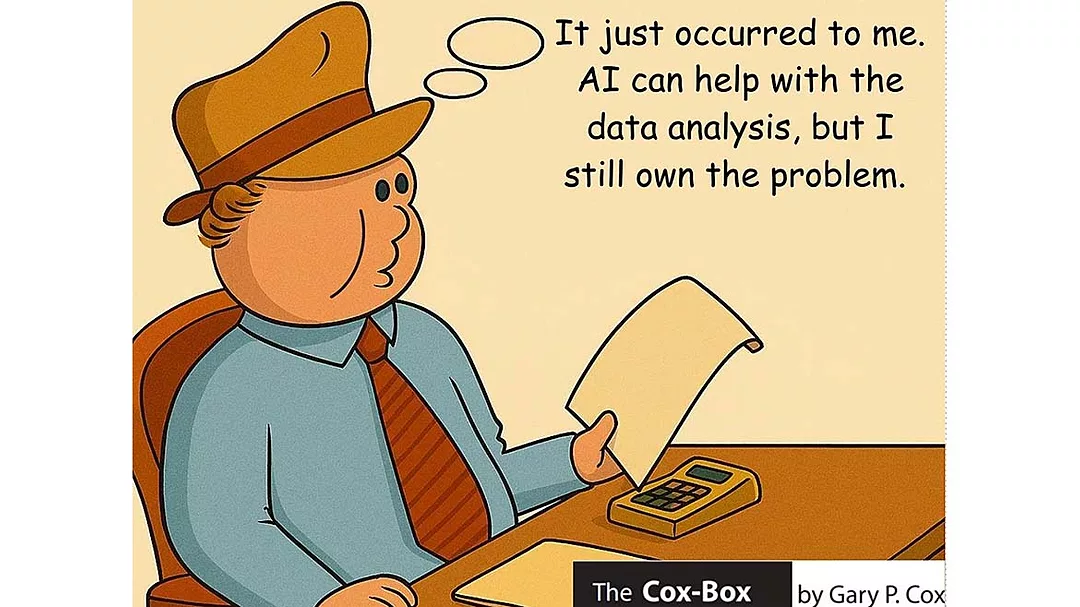
AI can suggest patterns or relationships, but it cannot own decisions. This is critical. The final use of the output and the accountability rests with the AI user. Treating AI outputs as inputs—not conclusions—preserves accountability while improving insight.
Risks, Controls, and Familiar Ground
AI introduces risks that quality and CI practitioners already know how to manage:
- Bias from incomplete or skewed data
- Lack of transparency
- False precision
- Assumptions
Manufacturing and regulatory literature consistently stresses the need for explainability, validation, and governance to ensure trustworthy AI use. These expectations are not new. They are extensions of existing risk‑based thinking.
Applying CI controls—clear ownership, review cycles, and validation checks—to AI use helps ensure it strengthens improvement efforts rather than undermining them.
Conclusion: AI Reflects the Discipline That Surrounds It
AI does not fix broken CI or Quality systems. It mirrors them.
Organizations that already define problems clearly, respect data quality, and validate learning will benefit most from AI‑enabled improvements and quality management. Those that do not will simply scale uncertainty and chaos faster.
For the quality profession, AI is not a disruption to fear. It is a familiar challenge—one that calls for the same rigor, judgment, and leadership that have always sustained meaningful continuous improvement and the highest of quality in your products or services.
AI may be relatively new. Quality thinking is not.
Gary Cox is a continuous improvement champion and author of “Cultivating Champions of CI: A Leaders Toolbox for Creating a Continuous Improvement Culture.” For more information, visit Garycoxcreates.ca.
Sources:
· Wolniak, R.
The Implementation of Artificial Intelligence in Quality Management.
Scientific Papers of Silesian University of Technology, Organization and Management Series, No. 240, 2025.
https://managementpapers.polsl.pl/wp-content/uploads/2026/04/240-Wolniak.pdf
· Bondac, G.-T., et al.
Decision‑Making in Complex Systems Using AI‑Based Decision Support: The Role of Trust, Transparency, and Data Quality.
Electronics, Vol. 15, Issue 2, 2026.
https://www.mdpi.com/2079-9292/15/2/372
· McKinsey & Company.
Clearing Data‑Quality Roadblocks: Unlocking AI in Manufacturing.
2023.
https://www.mckinsey.com/capabilities/tech-and-ai/our-insights/clearing-data-quality-roadblocks-unlocking-ai-in-manufacturing
· Ahangar, M. N., et al.
AI Trustworthiness in Manufacturing: Challenges, Toolkits, and the Path to Industry 5.0.
Sensors, Vol. 25, Issue 14, 2025.
https://www.mdpi.com/1424-8220/25/14/4357
· Google Cloud.
Overview of Prompting Strategies – Generative AI on Vertex AI.
2026.
https://docs.cloud.google.com/vertex-ai/generative-ai/docs/learn/prompts/prompt-design-strategies
Looking for a reprint of this article?
From high-res PDFs to custom plaques, order your copy today!