Quality Headline
U.S. Manufacturing Reaches Record $2.91T as Workforce Gap Threatens Next Decade of Growth
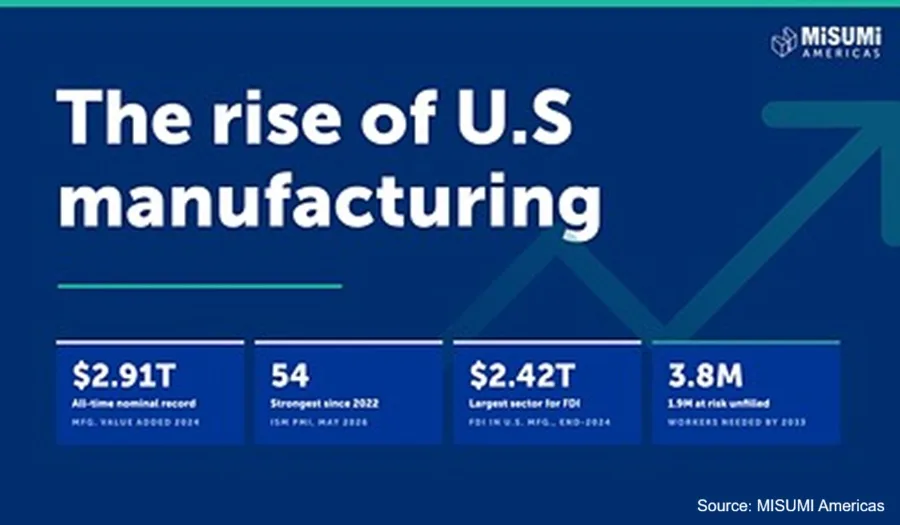
MISUMI Americas, a specification-driven sourcing partner for mechanical components and assemblies, announced The Rise of U.S. Manufacturing report. U.S. manufacturing added hit a record $2.91 trillion in 2024, and the momentum has continued: the ISM Manufacturing PMI reached 54 in May 2026, its strongest reading since 2022. Factory construction spending more than doubled from 2021 to 2024. Foreign companies have committed $2.42 trillion to U.S. manufacturing — more than to any other sector in the U.S.
That investment is now bumping into a problem it can't buy its way out of: a workforce shortage that predates it and will outlast it. The Manufacturing Institute and Deloitte project the industry will need 3.8 million additional workers by 2033, and 1.9 million of those jobs could go unfilled without action. It is, by every available measure, the single largest constraint on how far this growth cycle can go.
MISUMI Americas—the unified U.S. presence of MISUMI and Fictiv—released The Rise of U.S. Manufacturing, a data report drawn entirely from BLS, BEA, Census, NIST, ASEE, and Reshoring Initiative sources. Alongside the report, the company is endorsing H.R. 9097, the American Manufacturing Revitalization Exchange Program Act, introduced by Rep. Bill Huizenga (R-MI) and now pending before the House Committee on Foreign Affairs. The bill would send American manufacturing workers to allied nations for hands-on training in advanced production skills, then bring that expertise home.
"Having a strong manufacturing sector is critical to our economy, national security, and ability to compete globally," said Congressman Huizenga. "By focusing on advanced manufacturing in sectors such as automotive, semiconductors, and aeronautics, this bipartisan legislation will help reshore American manufacturing, equip American workers with in-demand skills, and rebuild our nation's middle class."
By the numbers:
• $2.91 trillion: U.S. manufacturing value added in 2024, an all-time nominal record (BEA via World Bank). This single sector would rank as the world's 8th-largest economy if it stood alone, ahead of France and just behind the United Kingdom. The figure reflects current, not inflation-adjusted, dollars, so part of the gain comes from manufacturers producing more goods and part comes from higher prices.
• 54 PMI: the ISM Manufacturing PMI reading for May 2026, the strongest since May 2022 and a clear signal of expansion. The index had spent most of 2025 below the 50-point threshold that separates growth from contraction, making this a meaningful reversal. New orders, production, and order backlogs all expanded that month, the broadest improvement in factory activity in roughly four years.
• $235.6 billion: peak annual factory construction spending in 2024, nearly triple the roughly $81.9 billion spent in 2021 (U.S. Census Bureau). Semiconductor fabs and EV battery plants, fueled by the CHIPS Act and Inflation Reduction Act, drove the majority of that increase. The pace has since moderated to roughly $196 billion by January 2026, though spending remains more than double pre-boom levels.
• $2.42 trillion: cumulative foreign direct investment (FDI) in U.S. manufacturing, led by Japan, Canada, and Germany (BEA). Manufacturing is now the single largest sector for inbound foreign investment in the country, representing more than 42% of all FDI in the United States. Japan alone accounts for over $819 billion of that total, more than any other country invests in any single U.S. industry.
• 2 million-plus: reshoring and FDI jobs announced since 2010, including a record 364,000 in a single year, 2022 (Reshoring Initiative). The vast majority of recent announcements, 88% in 2024, are in high or medium-high technology manufacturing sectors such as semiconductors, electronics, and electric vehicles. Roughly 1.7 million of those announced jobs have already been filled.
• 3.8 million: additional manufacturing workers the industry will need by 2033, with 1.9 million of those positions at risk of going unfilled without action (Manufacturing Institute and Deloitte). Of that 3.8 million, roughly 2.8 million comes from workers retiring and the remainder from new growth, including jobs tied directly to the CHIPS Act, the Inflation Reduction Act, and the Infrastructure Investment and Jobs Act. More than 65% of manufacturers already cite attracting and retaining talent as their single biggest business challenge.
• 20% growth since Spring 2020: enrollment at high-vocational community colleges, a workforce already responding to the opportunity (National Student Clearinghouse Research Center). Undergraduate certificate programs have grown for four consecutive years, evidence that students are choosing faster, skills-focused pathways into manufacturing careers. Even so, total enrollment at these institutions remains well under one million students nationwide, a fraction of the workforce the industry will need to recruit and train by 2033.
Every part of the investment case for U.S. manufacturing is real and verifiable: record output, a historic construction cycle, the largest foreign capital position of any sector in the country. What the data also shows is that the workforce has not yet scaled to match it. 2.8 million of the 3.8 million workers needed through 2033 comes from retiring employees — replacing the current workforce, not just expanding it. There were 409,000 open manufacturing positions as of August 2025, and 65% of manufacturers cite attracting and retaining skilled talent as their top challenge.
The encouraging signal: students are already responding. Enrollment at high-vocational community colleges is up nearly 20% since Spring 2020, and undergraduate certificate programs have grown for four consecutive years. The pipeline is moving in the right direction — it simply needs to move faster and reach deeper into advanced, specialized skills that take years to build domestically but already exist abroad.
That is the specific gap H.R. 9097 is designed to close. Japan, Germany, and South Korea — the three largest sources of cumulative foreign investment in U.S. manufacturing — also hold decades of advanced production expertise: precision engineering, semiconductor fabrication, and systemized manufacturing training models. The bill creates a structured exchange so American workers can train directly in those environments and bring the knowledge home, accelerating a domestic pipeline that is already growing.
H.R. 9097 places workers and students per year in allied nations for 6 to 12 months of hands-on training in sectors including robotics, semiconductors, and automotive, with a full stipend and industry-recognized credentials on completion.
For the full text of the bill, visit congress.gov/bill/119th-congress/house-bill/9097/all-info
"The investment case for American manufacturing has never been stronger — record output, a historic construction cycle, trillions in committed foreign capital. What we see with our customers every day is that the next constraint isn't capital. It's having enough people with the right advanced skills to run these new facilities at full capacity. The good news is that American students are already moving toward skilled trades and technical training. H.R. 9097 builds directly on that momentum by sending workers to learn from the countries — Japan, Germany, South Korea — that have spent decades perfecting advanced manufacturing training, and bringing that expertise home." — Dave Evans, President and CEO, MISUMI Americas; CEO, Fictiv
H.R. 9097 is supported by the National Association of Manufacturers, the Manufacturing Institute, United Steelworkers, IEEE-USA, BMW Group, the American Automotive Policy Council, LIFT, the Alliance for International Exchange, Automation Alley, and the Additive Manufacturing Coalition.
For more information, visit www.misumi.com or www.fictiv.com.
Looking for a reprint of this article?
From high-res PDFs to custom plaques, order your copy today!


