It is crucial to hit the right color tone in the production process and to produce it homogeneously across numerous batches. Color not only leaves an impression of quality, but can also be used as an indirect variable to control the process.
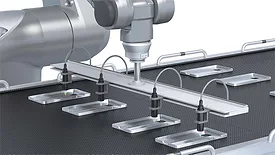
In addition to measuring the distance between a sensor and its target to determine object positions and displacements, confocal chromatic sensors are capable of measuring the thickness of transparent materials.
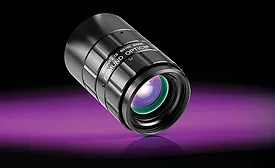
Lens and camera manufacturers need to collaborate to develop new mounting standards for the new, large sensor formats already on the market, as well as the ones that will be introduced.
Imaging sensors in the machine vision space have traditionally fit into cameras utilizing only a couple of different camera mounts. However, newer sensors are beginning to grow far too large. Lens and camera manufacturers need to collaborate to develop new mounting standards for the new, large sensor formats.
Imaging using short wave infrared (SWIR) radiation has long offered interesting properties for industrial machine vision but has been slow to be adopted.
Over the last couple of decades, stemming from changes in demand, competition, and market pressures, manufacturing has become a more complex and fraught affair requiring increased flexibility with a narrower margin of error. We can sum up this changing environment in three long-term trends affecting how stuff is designed and made: mass customization, increasing SKU proliferation, and shorter product cycles.
A smart sensor is simply a sensor that can communicate to provide real-time diagnostic data and adapt based on that data. The data can be used to optimize a system, reducing costly downtime and increasing quality.
The use of machine vision in industrial automation applications continues to increase as companies look for gains in productivity, efficiency and safety. Market forecasters estimate that the total market for machine vision will reach more than $18 billion by 2025, up from about $10 billion today.
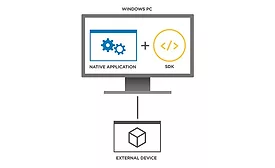
Many of today’s industrial software applications are designed to run natively on the Windows platform. Accessing and controlling external hardware devices with a Windows application is usually achieved by using a driver provided by the hardware supplier and activating hardware functions using an SDK.