These two choices for bore measurement come into play when close tolerances are the order of the day and speedy, repeatable measurements are required in a production environment. Keeping these requirements in mind, instrument makers usually offer options such as hard chromed bodies or carbide pads and contacts where needed to keep wear at a minimum.
We’ll cover some of the common problems associated with microhardness testing and address some of the techniques and technologies that can be used to avoid them.
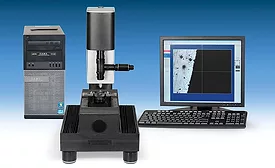
The Vickers and Knoop microhardness testing methods have become invaluable for the testing of a variety of parts, which have what can be referred to as “shallow layer hardness.” Such characteristics as surface hardness, thin cross section, coating hardness, and case depth are measured using the microhardness testing methods. These methods also can be useful for selective testing of particular grains or constituents such as those found in powdered metal parts.
Any article on dimensional measurement will usually get around to micrometers in one form or another. This series on bore measurement is no exception even though I am only offering a brief look at the application.
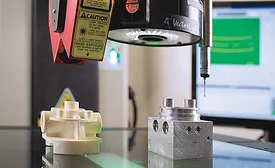
Manufactured parts need to be measured to ensure they meet the original design intent. Modern manufacturing techniques allow complex parts to be made that can have numerous critical dimensions.
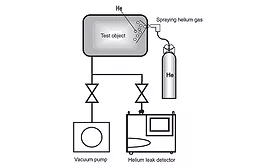
There is a broad spectrum of applications for portable helium leak detectors that touches numerous industry market segments. Vacuum systems as well as a wide variety of products and devices require leak testing as part of the quality testing process.
In September, the International Organization for Standardization (ISO) published ISO 9001:2015, the updated high-level system (HLS) quality management system standard that includes some fundamental changes in how organizations are expected to operate to remain in conformance.
As auto makers strive to meet increasingly stringent requirements for weight reduction with a range of high strength lightweight materials, many manufacturers are moving to a mixed materials environment.
What are the benefits of using a fully motorized microscope system? It’s an excellent question, and one that can be fully answered when looking at some motorized scope options.
High-speed data capture technique cuts calibration time 85 to 90%, minimizing downtime on key assets
January 1, 2016
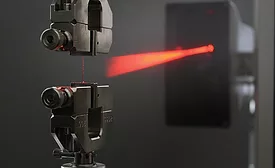
The word “laser” implies “light speed” for the casual listener, but witnessing a bi-directional laser calibration run on just one linear axis of a CNC mill conjures up a completely different image of something less than light speed.