Digital transformation is largely about automating to increase profit and productivity, improve consistency, reduce errors and repetitive labor, and improve customer satisfaction. How you choose to automate matters.
Few things are as frustrating as knowing someone has more to give in their job, to their family, or to society, but he or she routinely withholds their best efforts. How do you contend with this condition?
Research shows that 65% of manufacturers struggle to fill job vacancies. To make up for unfilled roles, 82% of manufacturers are exploring new and innovative ways to invest in workforce enablement and optimization.
Manufacturers can rely on sophisticated sensors to revolutionize the way they do business, enabling enhanced quality control, improved efficiency, and increased safety.
Many organizations fail to realize the importance of customer perspectives based on use of the ISO MSS series. How can your company utilize the ISO MSS to your best advantage?
Do you remember Curious George? If you do, picture him right now. Does he have a long tail? If you said yes, you might be shocked to hear that he had no tail at all.
Sight. This basic human sense affects our quality of life, and it can be enhanced or diminished with just a glance. Same is true in manufacturing. A wide range of industries view visual appearance as an important aspect of quality.
Is ML Useful In Integration? You may (still) be wondering whether any of this stuff is actually useful in real-world integration and factory automation scenarios.
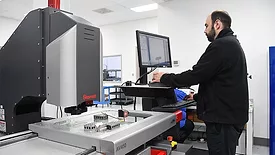
CMM touch probing surely has its place, however it is not always an optimal solution for certain part geometries and applications. Roush Yates Engines (RYE) and its manufacturing division, Roush Yates Manufacturing Solutions (RYMS), recognized there were better options.
Recent advancements in sensor and optics manufacturing technologies for UV and IR wavelengths have made imaging systems for these wavelength ranges more accessible.
As of recent years, the demand for machine vision systems that capture information in the ultraviolet (UV) and infrared (IR) spectral ranges has increased as more integrators and end users venture into new application spaces.
 RSS
RSS