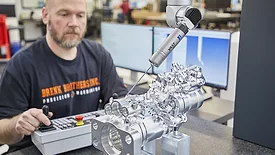
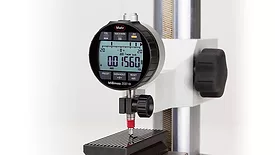
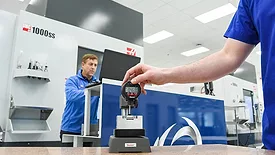
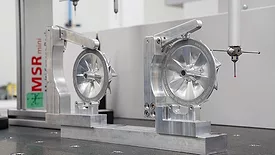
The science behind 3D scanners and CMM technologies is different; however, both collect coordinate measurement data and are widely used within the plastics industry. When is it better suited to use non-contact structured light 3D scanners than touch CMMs?
Combining the best of metrology and other industries creates products that are simple for the operator to use while also providing very complex measuring results.
There is a blur between the advances in metrology and the use of advances from other industries. But sometimes, combining the best of both worlds creates products that are simple for the operator to use while also being able to provide very complex measuring results.
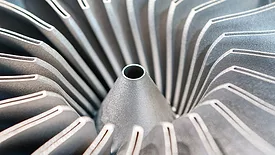
Additive manufacturing produces parts layer by layer and this opens up an array of unique issues that can affect the integrity of a finished product, and also a unique set of surface characteristics that make the job of measuring and validating that much more difficult.
Reverse engineering as a term is adopted by many industry subsets. From genetics, computer code, complex PCBs (printed circuit boards), and even military espionage. In this article, we are specifically relating to a metrology-driven process steered by high-precision 3D data acquisition tools.
Deep learning software represents a powerful tool in the machine vision toolbox, but one must first understand how the technology works and where it adds value.
In the machine vision marketplace the term “AI” typically refers to deep learning platforms that enable industrial automation and inspection. To appreciate the value proposition of AI in this context, it’s helpful to understand how the technology has evolved over the past several decades.
It is crucial to hit the right color tone in the production process and to produce it homogeneously across numerous batches. Color not only leaves an impression of quality, but can also be used as an indirect variable to control the process.
When RYE explored ways to improve the accuracy, integrity and throughput of its precision measurement data, the decision to deploy DataSure® 4.0, the industry’s latest data acquisition solution developed by The L.S. Starrett Co. of Athol, MA, boiled down to — you guessed it – seconds.
Miltera has built up a reputation as a specialist in producing everything from racecar parts to mold components, consumer electronics, turbine compressors and turbochargers for the aerospace industry.
How has Miltera Machining Research Corp. become an industry-leading producer of prototype and high-tech, ultra-precision parts? The company chalks up a large part of its success to its enduring relationship with ZEISS Industrial Quality Solutions.
 RSS
RSS