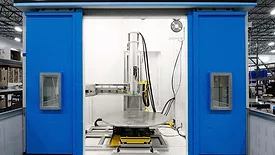
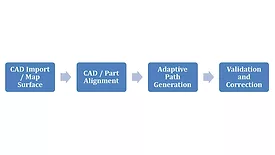
Modern automated ultrasonic testing solutions designed to perform 3D scanning of complex aircraft parts are generally programmed from the inspected part CAD coordinates, assuming exact geometric conformity.
As industries transition to higher-performance technologies, the materials used in electric vehicles, semiconductors, and aerospace systems are operating under increasingly demanding conditions.
By knowing the material, thickness, composition, and smallest feature of interest, you give your testing partner the information they need to design an efficient and accurate inspection.
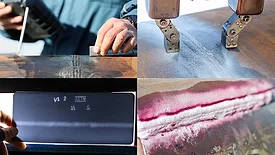
X-ray inspection has long been one of the most trusted methods for inspecting a part without cutting it open. Within the broader field of nondestructive testing (NDT), radiography remains a remarkably flexible tool—able to reveal hidden flaws, confirm weld quality, or verify internal structures that can’t be seen by eye. It’s used everywhere from aerospace and defense to energy, electronics, and manufacturing.
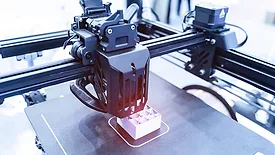
Additive manufacturing (AM), often referred to as 3D printing, has changed how metallic components are designed and produced, enabling layer-by-layer fabrication directly from digital models.
As inspection systems capture more visual and dimensional data than ever before, aerospace manufacturers are using artificial intelligence to find variation earlier, connect processes in real time and redefine what it means to manage quality.
Quality engineers on aircraft and defense programs must verify that every part meets design requirements and keep records that can be audited for years.
After Greg Weaver got out of the Navy, he started working in mining in northern Nevada. After a few winters, it was time to do something else. “It was like six degrees, and I’d be working outside.” He found a listing in the paper for an aerospace company that did turbine blade repair.
Across the global industrial landscape, nondestructive testing (NDT) faces a pivotal moment. The sector is grappling with two simultaneous forces: a shrinking and aging workforce on one hand and accelerating technological change on the other.
High-quality FIB-cut faces are essential for accurate analysis in materials research, supporting reliable imaging, defect detection, and cross-sectional studies.
Operational excellence is crucial for success in a dynamic industrial landscape. At Waygate Technologies, our Kaizen journey has transformed our efficiency and collaboration, turning challenges into victories. As we near 2025, the lessons learned emphasize a future of continuous improvement, empowering every team member to drive change and cultivate a culture of shared responsibility.
 RSS
RSS




.webp?height=168&t=1763650467&width=275 "a microscopic cross-section showing a high aspect ratio structure")


