The Inside Track on Six Sigma Training

It is essential to weigh the advantages and disadvantages of training methods that lead to certification and implementation of Lean Six Sigma and related methodologies. This is necessary for any organization to ensure alignment not only with all operational processes, but equally important, the entire enterprise.
A successful training program to qualify and certify individuals must achieve the following objectives:
- Identify and solve real business problems
- Lead team efforts and perform as a key individual contributor
- Support a Lean Six Sigma culture in which projects are pulled or chosen from operational levels for their contributions to the corporate bottom line of the enterprise rather than pushed or selected on an opportunistic basis
- Identify inherent flaws in critical operational processes
- Provide management with a dashboard that measures only key outputs over time to avoid metrics overload
- Ensure honest metrics that avoid Enron-like catastrophes
- Reduce fire fighting
- Maintain productive processes
- Stimulate innovation
- Provide a roadmap that triggers orderly project execution with everyone in the organization doing the Right things Right at the Right time-the three Rs of business
More Than Tools
Training must help organizations deal with three root problems:- Strategies that are not providing expected benefits
- Improvement initiatives that are not providing long-term gains
- Scorecards or reporting metrics that take up lots of time, but nothing seems to get better
Training is not just a matter of executing a project, but looking at data. Companies must create a system to analyze only what is important and in doing only the right things right at the right time.
Whatever choice or combination of training methods chosen, the following guidelines are essential to successful results for each student:
- Lean and Six Sigma tools must be integrated so the best tools are used for each application in meeting operational level needs.
- Unproductive tools such as the commonly used red-yellow-green scorecards are excluded.
- Hypothesis or theory testing is included in the curriculum.
- Financial and other metrics taught that are not restricted to calendar year-based analysis.
- Both enterprise DMAIC (define, measure, analyze, improve and control) and project DMAIC must be included.
- Real-world exercises should be used instead of canned projects.
- Creative thought processes with ways to put it all together must be stimulated by instructors.
- Team-based learning must be included. Apart from teaching collaboration, this enhances networking opportunities and overall productivity.
- Course content must be related to each student’s industry or basic business interests, but also must relate to other industries so they can function in areas outside their assignment.
- Certification should be included in the overall process.
- Training must be around expectations for corporate performance.
Source: REVE Virtual Mobility Manual
Training Options
A variety of training options are available.- Synchronous learning is real-time, instructor-led online learning when participants are logged on at the same time and communicate directly with each other. In this virtual classroom setting, the instructor maintains control of the class with the ability to “call on” participants. In most platforms, students and teachers can use a whiteboard to see work in progress and share knowledge. Interaction also may occur via audio- or video-conferencing, Internet telephony or two-way live broadcasts.
Traditional classroom training where an instructor teaches a course with full interaction between everyone present in a classroom that results in real-time benefits is another form of synchronous learning.
- Asynchronous learning is where interaction between instructors and students occurs intermittently with a time delay. Examples are self-paced courses taken via the Internet or CD-ROM, Q&A mentoring, online discussion groups and e-mail.
Electronic learning is a term covering a wide set of applications and processes, such as Web-based learning, computer-based learning, virtual classrooms and digital collaboration. It includes the delivery of content via Internet, intranet/extranet (LAN/WAN), audio- and videotape, satellite broadcast, interactive TV and CD-ROM.
Distance education is an educational situation where the instructor and students are separated by time, location or both. Education or training courses are delivered to remote locations via synchronous or asynchronous instruction, including written correspondence, text, graphics, audio- and videotape, CD-ROM, online learning, audio and videoconferencing, interactive TV and fax. Distance education does not preclude use of the traditional classroom.
While instructor-led, electronic and distance education are methods used to provide training, interaction of a student with an instructor is either asynchronous or synchronous. Instructor-led or on-site training can only be synchronous. E-learning and distance learning can be either asynchronous or synchronous.

The relationship between Delivery Methods and their Drivers shows an important link between content type and the way it is delivered. The top three drivers of learning methods are based on survey results on a variety of training subjects to measure the thoughts, feelings and concerns of today’s learning professionals. Source: International Data Corp.
Learning Methods
Industry reports indicate classroom training continues to be the primary delivery method for most organizations with the combination of synchronous and asynchronous e-learning the next most popular methods.The real question is which training method or combination of methods is the most effective and efficient. The bottom line should be based on what the total experience and impact needs to be on participants who become the movers and shakers for their companies in achieving corporate goals and strategies.
One student who took an online Black Belt course, but decided a more rigorous approach was needed, pursued the same objective in a classroom setting and discovered that the dynamics of participating in a real-time formal classroom environment created a whole new way of productive learning.
The freedom to learn interactively with other students as well as with an instructor in person was a world apart from experience with online training for the student. Getting to know each other, keeping up with the group, and learning more productively in real time became a great advantage for the student and a much better investment for the employer involved.
Attrition rates, also known as dropout rates, for business-based e-learning courses are much higher than for traditional face-to-face classroom training courses. In a survey of 4,100 online learners, Corporate University Xchange found that 85% of the learners surveyed dropped out from their e-learning courses in 2000 and 70% dropped out in 2001. This number is in sharp contrast to the traditional classroom training dropout rate of 15%.
- Online Options
A challenge with e-learning and self-paced courses is to be time specific and rationalize the time required during a normal work schedule consistent with an employee’s responsibilities, as well as avoid nights and weekends of personal time. Generally, e-learning is simulation based, but still involves collaboration.
Classroom Options
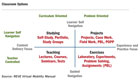
The most effective method for organizations and candidates in training is to look at it as a balance between curriculum and problem-oriented lessons while interacting in a classroom with an instructor and other students in real time. See the chart, “Classroom Options,” for an example of the dynamics in a classroom approach where the whole spectrum is included from teacher-controlled guidance to student-controlled project-based efforts.
The model embraces the entire training spectrum from traditional teacher-controlled curriculum-based approaches to student-controlled project-based efforts. The model makes a basic distinction on the horizontal level between content delivery, experience and practice, and on the vertical level between guided navigation and learner self navigation.
These distinctions give four qualitatively different ways of accomplishing learning: teaching (teacher-controlled content delivery focus), studying (participant-controlled content delivery focus), exercises (teacher-controlled experience and practice focus) and project (participant-controlled experience and practice focus).
The leverage provided by activities in all four of the quadrants is the most effective for participants in any organization since classroom training includes interactive lectures in person on course topics, self-study articles and reading materials tied directly to group discussions and homework preparation. Experimental exercises throughout reinforce the theory and statistics parts of what should be group project activities. Best practices in instruction should cover all elements in each quadrant for students to have an equal opportunity to learn.
Absolutes
Regardless of the training method chosen, there are absolutes that must be taught as integral elements which students must pursue consistently in any enterprise they serve. For example, training must integrate Lean and Six Sigma so that the best tools are chosen for each application and unproductive tools are excluded. Hypothesis testing must be taught as well as how to create financial and other metrics not bounded by calendar year. Make sure thought processes and real-world exercises are included instead of canned projects.Team-based learning, missing in many learning methods, and networking opportunities should be part of any formal training process.
The key issues to consider when choosing between classroom and e-learning training include:
- A direct connection can be made with the trainees’ daily jobs. Case studies, simulation examples and computations from a manufacturing environment are not easily understood, for example, by insurance specialists.
- Some employees cannot sit uninterrupted in their offices for an hour or more without unavoidable interruptions of all types, including the pressure of business activities. Interruptions break the learning continuity and can cause repetition.
- In-person interaction with an instructor and other students can make all the difference in the dynamics of learning from the comments, questions and answers with others.
Drivers
In designing the most effective methods of training to meet a company’s learning objectives, management and training professionals must examine the benefits of each approach against resources available to make sure the results are cost-effective. To achieve the benefits desired from the training method or methods chosen, a value must be determined for what the employee needs to learn and apply if, for example, the related responsibilities, relationships and dependencies will be in a systems environment.Corporate cultures also indicate a strong influence in determining which methods are used, particularly when it relates to more traditional forms of training. The value of student-instructor interaction remains a primary driver for both classroom-based and synchronous e-learning.
Another conclusion is that when trainers make the decision to migrate content online into a synchronous environment, they assume student-to-student interaction will be sacrificed since the examples used may be canned projects rather than analogous to a student’s professional environment.
Fine Print
While costs can vary widely when all forms of training are considered, managers must weigh carefully not only the objectives and results that will be critical to their customers, but also the corporate bottom line and profitable growth in the increasingly competitive international marketplace. This exercise also depends on how well management preserves and grows the professional talent being trained and who will determine the collective future for the organization and its constituents.Depending on whether the training is provided by an e-learning commodity provider, academic and instructional consortiums, universities and resellers, or professional specialty firms, some charge extra for certification, mentoring and coaching, and texts or books. For all methods, except classroom training, material for courses is usually derived from another source. Sources indicate that much of the material used was developed originally by consultants in the 1990s and from Motorola prior to that.
The perspective that should be explored with potential providers when considering and planning for staff training is the certification rate of students who completed their curriculum. While no published data appears to be available for Lean and Six Sigma programs, it may vary widely from 10% to 90% within 12 months of the baseline when all students started the program. The top 10% loss is usually due to re-assignment for business or personal reasons-not associated with lack of effort. Q
Quality online
For more information on Six Sigma training, visit www.qualitymag.com to read these articles:Sidebar
All training should be goal-based, tied to improving performance and led by a dynamic instructor.- Training is not just a matter of executing a project, but looking at data. Companies must create a system to analyze only what is important and in doing only the right things right at the right time.
- In designing the most effective methods of training to meet a company’s learning objectives, examine the benefits of each approach against resources available to make sure the results are cost-effective.
- When done correctly, training can help an organization improve and change the workplace environment.
Looking for a reprint of this article?
From high-res PDFs to custom plaques, order your copy today!