Adding Value for True Position Measurement

Adjustments can be made to the manufacturing process, and the portable CMM becomes part of a value-adding process chain rather than an inspection device used to build quality into parts. Source: Faro Technologies Inc.
In the 1960s a new measurement device called a coordinate measuring machine (CMM) was introduced. CMMs were created in order to automate the task of measuring manufactured parts in all types of industrial environments. CMMs were primitive at first, consisting of a digital readout displaying the X-Y-Z position of an attached probe. Operators were able to substitute these machines for hand tools in many metrology applications.
As the technology advanced, software packages became available that opened up new options for manufacturers and allowed them to compare data acquired from the CMM to drawings in order to understand how well the manufactured part met the requirements of the part’s designer. However, these products were large, bulky and immobile, often taking up sizable portions of quality control labs. Furthermore, they were kept in the labs because they provided a stable, temperature-controlled environment. This was acceptable at the time because the emphasis in industry was to inspect quality into parts after the run was completed. Any parts deviating from the required specifications were rejected and scrapped or reworked.
Source: Robert A. Ochs: Positional Tolerancing Presentation
New Technology
As time passed, two developments in the manufacturing sector made the stationary CMM with limited software functionality less attractive. These were lean manufacturing and the use of Geometric Dimensioning and Tolerancing (GD&T) in part design and manufacture.With lean manufacturing came an emphasis on quickly and efficiently turning raw materials into pristine finished goods. No longer was it acceptable to inspect quality into parts or rework them; instead, quality needed to be built into the product on the first attempt. This meant time spent walking parts to and from the CMM needed to be minimized and errors in manufacturing needed to be caught early. This is why hand tools remained a viable option in the face of the new technology. Though limited in functionality, they were portable and could be used to do on-machine inspection.
GD&T, on the other hand, provided a symbolic language for researching, refining and encoding the function of each feature of a part. With the rise of GD&T came the realization that some features’ properties could not be measured easily with hand tools.
These two developments gave rise to a new technology, the portable CMM. These could be used to make complex measurements in an on-machine inspection environment, allowing the operator to make fast, effective adjustments to his processes. This met both lean manufacturing and GD&T needs.
For example, manufacturers today realize that a key aspect of GD&T-feature location-in a part is crucial. In order to produce interchangeable parts in a manufacturing environment, care must be taken that the design is sound enough to allow mating parts to work correctly. Furthermore, the industrial process must be robust enough to produce parts called out in design in an efficient and predictable manner.
Likewise, measurement of the final parts must be done easily and with confidence in order to verify the in-process or final products. Inspection of a bore in an open setup with hand tools often requires multiple measurement steps and mathematical calculations. Portable CMM technology can alleviate much of this work by allowing the operator to fix the part in one spot, take several points to create an alignment of X and Y axes, and measure the bore. Software is then able to determine the position of the bore and its deviation from the called out position.
Traditionally, to find the deviation from true position, sometimes simply called the position, of a feature in a lean manufacturing environment, the “open setup” is used. This process involves the use of calipers, height gages, micrometers and other hand tools used in conjunction with an inspection plate to take measurements and compare the feature’s position to datums.
Following the appropriate measurements, the true position diametrical deviation, D, must then be calculated via the following mathematical formula (equation 1): D = 2{(Dx)2 + (Dy)2}1/2 where Dx = the deviation from the true position along the X axis, and Dy = the deviation from the true position along the Y axis.
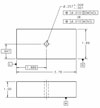
Consider the following situation, shown in Figure 1, which is one of the simplest examples using the open setup method. In order to determine the true position of this hole in an open setup, the block must be fixed in place. At this point, several measurements must be made, perhaps with a pair of calipers. First, the diameter of the hole must be determined. To do this correctly, several different measurements should be taken in order to verify the diameter and, at least in a qualitative way, the circularity of the hole.
Little can be said of the actual cylindricity of the hole, however. The diameter’s uncertainty combined with the lack of data on cylindricity often means expensive go/no-go gages must be used as well.
Next, measurements should be taken of the hole’s closest and farthest points to the X axis (defined by the datum L) and the Y axis (defined by the datum N). In this way the position of the centerline of the hole can be calculated in Cartesian coordinates. This (X, Y) position can then be compared to the position called out in the drawing (1.889,0.947) and the deviation can be calculated according to equation 1.
This cumbersome procedure representing one of the simplest measurement scenarios can take 20 minutes or more and is subject to relatively large amounts of error due to the difficulty of determining the hole’s closest and farthest points from the X and Y axes. The procedure becomes even more complex when maximum material conditions are applied or when the geometry of the part deviates from the simple part under consideration. The old alternative-walking the parts to a conventional CMM-saved little to no time and required a skilled technician to undertake the measurements.
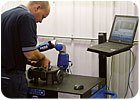
A portable CMM records positions of a probe via encoders and translates these positions into a coordinate system useful to the operator. Source: Faro Technologies Inc.
When all of the appropriate points are taken, the operator pulls away from the part and touches the red button to terminate the measurement process. The software then best fits the line and allows the operator to define the resulting line as datum L. The process is then repeated for datum N and the hole (cylinder). The operator then inputs the nominal values for the cylinder, tells the software to dimension the position of the cylinder and the result is returned, including cylindricity. The entire process, including setup, takes less than 5 minutes in most cases.
Because the device is portable, it can be done on-machine in a lean manufacturing environment. Adjustments can be made to the manufacturing process, and the portable CMM, therefore, becomes part of a value-adding process chain rather than an inspection device used to build quality into parts.
In short, hand tools lend themselves well to lean manufacturing but not to GD&T. Conventional CMMs, on the other hand, work well in a GD&T environment but not a lean one. Portable CMMs, however, meet both requirements.
The advent of portable CMM technology has greatly reduced the difficulty of measuring GD&T properties, including the deviation from true position of features. In addition, it fits neatly into a lean manufacturing environment as part of a value-adding process chain. With an accuracy of 0.0002 inch for the highest accuracy models, most manufacturers find these devices to be more than adequate for their measurement needs. In addition, a variety of probing options such as touch probes, probe extensions and different ball sizes are available.
Finally, there are many different sizes to choose from with models ranging from 4 feet to 12 feet working volumes. These features provide the operator with flexibility to use them in a range of manufacturing environments. Q
Quality Online
For more information on portable CMMs, visit www.qualitymag.com to read the following articles:- “Competition Rising in Portable CMMs”
- “Portable CMM Sorts Out Inspection Task”
- Case Study: “Portable CMM Keeps Up With Production”
Tech Tips
Looking for a reprint of this article?
From high-res PDFs to custom plaques, order your copy today!