ASME Guest Column
Registered Apprenticeship Programs Offer Significant Value for Manufacturing Employers
While not the only tool in addressing workforce shortages, apprenticeship programs offer manufacturing companies many benefits.

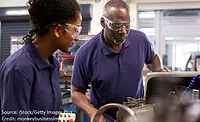
Image courtesy of Kobus Louw / E+ / Getty Images Plus
The manufacturing industry is facing a critical workforce challenge. With a growing skills gap and an aging workforce, manufacturers are struggling to find and retain qualified employees.
The National Association of Manufacturers reports that 77% of manufacturers are struggling to fill open positions. According to a study by Deloitte and the Manufacturing Institute, the U.S. manufacturing sector could see a shortage of 2.1 million workers by 2030, potentially costing the economy $1 trillion in lost productivity. The U.S. Bureau of Labor Statistics predicts 11% job growth in mechanical engineering from 2023-2033, most of them in manufacturing, compared to 9% in engineering jobs across all disciplines.
Several factors contribute to the manufacturing workforce crisis:
- Retiring Baby Boomers: Nearly a quarter of manufacturing workers are 55 or older, and retirements are creating a significant talent drain.
- Declining Interest Among Younger Workers: Many young professionals overlook manufacturing careers due to outdated perceptions about job security and working conditions.
- Evolving Technology and Skills Mismatch: Advanced manufacturing processes, including automation and artificial intelligence, require specialized training that many job seekers lack.
Enter: Registered Apprenticeship Programs
To address this crisis, many manufacturing employers are turning to registered apprenticeship programs—a proven workforce development strategy that helps build a skilled talent pipeline while benefiting both employers and employees.
Registered apprenticeship programs (RAPs) offer a structured pathway for developing skilled workers through a combination of paid on-the-job training and classroom instruction. These programs are registered with the U.S. Department of Labor (DOL) and adhere to industry-recognized standards. High-demand apprenticeship occupations include manufacturing engineering technician (MET), mechatronics technician, industrial manufacturing technician, CNC machine operator, maintenance mechanic, and robotics technician.
A registered apprenticeship typically includes:
- Hands-on training led by experienced mentors.
- Formal instruction through technical schools or community colleges.
- Wage progression, meaning apprentices earn while they learn and receive pay increases as they develop skills.
- Industry certification upon completion, ensuring apprentices meet high standards of competency.
The American Society of Mechanical Engineers (ASME) recently was awarded a $3.975 million four-year grant from the DOL to develop and implement a national RAP in mechanical engineering technology. The ASME RAP will provide additional education and training for 270 community college engineering graduates and place them into entry-level engineering technician positions between July 1, 2024, and June 30, 2028. ASME will initially develop the RAP for job roles in manufacturing and advanced manufacturing, later expanding the RAP for roles in clean energy, supply chains, semiconductors, and nanotechnology.
Using a “Learn While You Earn” approach, the ASME program consists of 144 hours of related training instruction for participants who have completed a two-year degree in engineering or a closely related field of study. The instruction will be provided by Stevens Institution of Technology, accredited by The Accreditation Board for Engineering and Technology (ABET), and will include a combination of augmented reality and virtual reality (AR/VR) instruction developed through SimInsights. The instruction will be followed by at least 2,000 hours of on-the-job learning with workforce partners. The National Institute for Industry and Career Advancement is responsible for deploying a strategy to build the talent pipeline to support strategic industry sectors and is the nation’s leader in semiconductor talent pipeline development. The $3,975,420 Federal grant will finance 85% of the cost of the ASME program and 15% or approximately $600,000 will be financed by non-governmental sources.
The ASME RAP is an extension of ASME’s Community College Engineering Pathways (CCEP) program, which connects community college and career technical education (CTE) students to opportunities for specialized training, internships, apprenticeships, and jobs.
“By understanding that designers, engineering technicians, and engineers are all valuable parts of the engineering community – and developing relationships across all categories, ASME is developing tools to help everyone build their careers through continuous learning opportunities,” says Jill Thiede, associate dean of trades and engineering technologies at Northeast Wisconsin Technical College, which participates in the ASME RAP and CCEP. “This supports not just our graduates, but our employers as well.”
Benefits for Manufacturing Employers
While not the only tool in addressing workforce shortages, apprenticeship programs offer manufacturing companies benefits including:
Talent Pipeline Development: Apprenticeships provide a reliable stream of skilled workers trained to meet the specific needs of a company. Instead of relying on external hires, manufacturers can cultivate talent from within, reducing dependency on an unpredictable labor market.
Reduced Turnover and Higher Retention: Employees who participate in apprenticeship programs tend to be more loyal and engaged. The DOL reports that 91% of apprentices remain employed with their sponsoring company after completing their training, significantly lowering turnover rates.
Cost Savings on Recruitment and Training: Hiring and onboarding new employees is costly. By training apprentices internally, manufacturers reduce the expenses associated with external recruitment and ensure that new hires have the necessary skills from the outset.
Increased Productivity and Innovation: Apprentices often bring fresh perspectives and are trained in cutting-edge manufacturing technologies. This enhances productivity, fosters innovation, and ensures that companies remain competitive in an evolving industry.
Access to Government Funding and Incentives: Employers who establish registered apprenticeship programs may qualify for tax credits, grants, and workforce development funding at the federal and state levels. These financial incentives help offset training costs and make apprenticeship programs an attractive investment.
Success Stories
Many manufacturers have successfully leveraged apprenticeship programs to address workforce shortages. For example, Lockheed-Martin and AON participated in the DOL ApprecticeshipUSA initiative to create a pipeline of skilled employees and reported better matching of employee skills and character with employer needs and firm culture, as well as the development of future managers. Siemens USA implemented a registered apprenticeship program that resulted in higher retention rates and a 50% reduction in hiring costs. Similarly, Volkswagen’s apprenticeship initiative in Tennessee has created a steady supply of highly skilled workers, boosting operational efficiency.
Getting Started: Steps for Employers
Manufacturers looking to establish a registered apprenticeship program should consider taking the following steps:
- Identify Workforce Needs: Assess current and future skills gaps within the organization.
- Engage Partners: Collaborate with professional associations like ASME and others, technical schools, community colleges, or state and local workforce development agencies, many of which already have programs in place, and/or can customize a program for your company’s specific needs.
- Participate in or Develop a Structured Training Plan: Ensure the program includes a balance of hands-on training and classroom instruction.
- Register the Program with the DOL: Secure official recognition to access funding and resources.
- Recruit and Mentor Apprentices: Work with your program partners to select candidates and assign experienced mentors to guide them through the program.
RAP the Workforce Gap
Registered apprenticeship programs present a win-win solution for manufacturing employers and the workforce. By investing in apprenticeships, manufacturers can address labor shortages, reduce hiring costs, and develop a pipeline of highly skilled employees. As the manufacturing industry evolves, apprenticeships will continue to play a crucial role in ensuring businesses remain competitive and innovative. Now is the time for manufacturers to embrace apprenticeships as a sustainable strategy for long-term success.
Looking for a reprint of this article?
From high-res PDFs to custom plaques, order your copy today!