Quality Magazine logo
search
cart
facebook twitter linkedin youtube
  • Sign In
  • Create Account
  • Sign Out
  • My Account
Quality Magazine logo
  • NEWS
  • PRODUCTS
    • FEATURED PRODUCTS
    • SUBMIT YOUR PRODUCT
  • CHANNELS
    • AUTOMATION
    • MANAGEMENT
    • MEASUREMENT
    • NDT
    • QUALITY 101
    • SOFTWARE
    • TEST & INSPECTION
    • VISION & SENSORS
  • MARKETS
    • AEROSPACE
    • AUTOMOTIVE
    • ENERGY
    • GREEN MANUFACTURING
    • MEDICAL
  • MEDIA
    • A WORD ON QUALITY PUZZLE
    • EBOOK
    • PODCASTS
    • VIDEOS
    • WEBINARS
  • EVENTS
    • EVENT CALENDAR
    • IMTS
  • DIRECTORIES
    • BUYERS GUIDE >
      • Supplier Insights
    • NDT SOURCEBOOK
    • VISION & SENSORS
    • TAKE A TOUR
  • INFOCENTERS
    • Digital Quality Management Systems
    • NEXT GENERATION SPC & QUALITY ANALYTICS
  • AWARDS
    • ROOKIE OF THE YEAR
    • PLANT OF THE YEAR
    • PROFESSIONAL OF THE YEAR
  • MORE
    • Expert Columns
    • NEWSLETTERS
    • QUALITY STORE
    • INDUSTRY LINKS
    • SPONSOR INSIGHTS
  • EMAG
    • eMAGAZINE
    • ARCHIVES
    • CONTACT
    • ADVERTISE
  • SIGN UP!
NDT

Scoping Four Manufacturing Processes

By Douglas Kindred Ph.D.
August 1, 2006
Borescope inspection is gaining added importance in diverse and increasingly sophisticated manufacturing applications.

Checking for weld continuity, a rigid borescope inspects an internal weld of a tube contained in the hydraulic line of a plane engine. Source: Gradient Lens Corp.


Four processes-metal machining, welding, casting and electrical discharge machining (EDM)-are key manufacturing foundations for industries such as aerospace, medical equipment, automotive, heavy equipment and power generation. The evolution of these four processes has brought ever-increasing technological sophistication to the plant floor and to quality assurance.

A common quality-assurance practice for parts and components made via these processes remains relatively low-tech: visual inspection. That is not to say technology does not enter into visual inspection. Borescopes, based on sophisticated and technologically advanced optical systems, are frequently manufacturers' first choice in inspecting mission-critical parts or components.

A vast array of parts manufactured by any one of the aforementioned four processes can be, and often need to be, inspected with borescopes. Borescopic inspection becomes imperative for parts made by these four processes when the following factors exist:

• The area to be inspected is difficult to access. Borescopic inspection probably is not necessary to inspect shallow holes in a manifold that are easily examined by eye or using a loupe. But deep bores, cross holes or undercuts in the same manifold require borescopic inspection to determine surface finish and other key characteristics.

• The part or component is mission critical, for instance, mating surfaces with a gasket between them that might prevent leakage in a fuel system.

• The specified characteristics are not well defined such as rust, blockages and debris. In situations such as these, there is no substitute for the human brain making subjective judgments. A machine vision system can identify certain characteristics-reflectance, edges or quantity-but cannot interpret unusual anomalies.
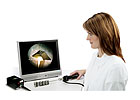


This borescope image is of a spool, made by EDM, used in a hydraulic system for aircraft ailerons. Source: Gradient Lens Corp.

Scopes Play Specific Roles

Borescopes play specific roles in visual inspection, roles dictated by the quality issues inherent in the manufacturing process. However, a general rule applies. Rigid borescopes offer better resolution, brighter images and greater durability and cost less than flexible borescopes. When the option exists, rigid scopes are the better choice.

EDM is frequently used for parts that have strange geometries or small details that do not lend themselves to normal machining, such as fuel injector nozzles and hydraulic sleeves. Visual inspectors of EDM'd parts or components are typically looking at the roughness of a surface-how well the material has been melted away by the electron beam. In these situations, rigid scopes are usually the tool of choice.

Aircraft engine oil coolers, power-generation and chemical-processing systems, and pharmaceutical processing equipment all contain welds and welded tubes. Inspectors of welds usually look for weld continuity or strength at a heat-affected zone. Most stainless steel tubing, such as hypodermic needles, is made through the welded and drawn process, where the welded seam needs to be inspected for smoothness and integrity. Tubing often requires the use of flexible borescopes for visual inspection.



Inspecting a casting, a flexible borescope checks for issues such as porosity or sand. In this instance, an obvious surface anomaly, a burr, is visible. Source: Gradient Lens Corp.
Casting produces engine blocks, exhaust manifolds and turbochargers for automotive and some aviation applications. Voids and sand are the primary issues in casting visual inspection. In pressure die-casting, for example, air often mixes with the metal. As the metal solidifies, bubbles of air become trapped in the casting. Subsequent machining can open up any resulting voids and lead to surface irregularities or leaks. In industrial sand casting, the mold can lose integrity, leaving some sand in the finished product. Castings often feature complex shapes that may require flexible borescopes for inspection.

Metal machining touches nearly every part of an auto engine-brake manifolds or fuel injector bodies and nozzles-valves in medical instruments; and manifolds, valves, sleeves, cylinders and spools in hydraulic systems. Metal machining problems can include burrs, surface finish irregularities and contaminants.


A borescope inspects a brake manifold. Source: Gradient Lens Corp.

Applications

In many instances, products and their component parts are made with more than one manufacturing process. Turbine engines are the foundation of the power-generation industry. Turbine blades are complex castings; the igniter and fuel nozzles-part of the burner can-are machined parts; the burner can itself is a welded system. Other applications demonstrate that parts and assembled products both are candidates for borescopic inspection. A designer and manufacturer of engines, including turbo-shaft engines for helicopters, had a backlog of 3,000 helicopter fuel control units needing inspection. Each unit required hours to disassemble and reassemble. By using rigid borescopes to inspect the units without disassembly, the firm quickly eliminated the backlog. It now uses the scopes for routine inspection every 800 hours. The result is increased helicopter safety and reliability at a lower cost.

A defense contractor uses both rigid and flexible borescopes to inspect hypergolic rocket engines. Inspectors look at mixing nozzles that mix fuel and look for pitting and scarring inside the missile thrust chamber. Another defense contractor uses both rigid and flexible scopes to detect foreign objects, contamination burrs and other irregularities in castings, and machined parts and components such as small detail castings and attach holes.

Machinists at a company that designs and manufactures precision-machined automotive parts use rigid borescopes to check for burrs and imperfections in hard-to-see interiors of automotive-transmission turbine shafts. The scopes can see deep inside a part where a problem such as an incomplete drill hole could cause catastrophic transmission failure. Scopes also help the plant's manufacturing engineers optimize the setup process, reducing errors and scrapped parts. They can now check parts as they come off the line to verify all the specifications. Catching problems early in the process cuts costs in time, labor and materials.
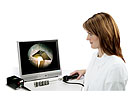


This borescope image is of a spool, made by EDM, used in a hydraulic system for aircraft ailerons. Source: Gradient Lens Corp.

A manufacturer that makes fittings for aircraft hydraulic systems had to reorganize its manufacturing processes after its largest customer refused to buy fittings with minor, common imperfections on internal surfaces. The company became a lean manufacturing plant with each work group responsible for its own quality control. Machinists needed tools sensitive enough to see the minor flaws they had previously missed. Rigid borescopes deliver clear, sharp views of interior surfaces and are sturdy enough for a machine-shop environment. Machinists also use the scopes to adjust their processes to further reduce flaws and keep the work on schedule. By putting the scopes into machinists' hands, the company kept its customer happy and reduced de-burring man-hours while processing the same volume of parts as before.

Often, a common theme among these applications is fluid flow. Fuel, hydraulic fluid, water, oil, medication-the parts through which any of these vital fluids flow must be free of burrs and contaminants that can clog and possibly limit the flow. The parts also must not have cracks through which fluid could leak. Hydraulic systems must maintain pressure to work correctly, and that pressure can be compromised by the loss of fluid.


Multiple Benefits

The benefits of using borescopic inspection in the welding, casting, EDM and metal machining processes are numerous. Unlike destructive testing, borescopic inspection does not require tearing down and damaging parts. Destructive testing in the aerospace industry can be particularly problematic because of the low volumes and high costs of many of the parts involved.

More and more manufacturers are instituting 100% inspection policies. The strict quality control is necessary because, in almost every instance, the parts are mission critical, and manufacturers want assurance that not one defective part will pass out of their facility. Destructive testing is impossible with such constraints and other methods require too much time to test every part that comes off a line.

There is no substitute for the human eye and brain working together. The combination allows the inspector to identify and evaluate issues that other, more high-tech inspection processes such as X-ray, machine vision and eddy current simply cannot. Inspectors identify quality issues that are difficult to pick up even on video. They can see color, texture and other qualities of a part or surface that are not apparent with other inspection systems.

As borescopes become more affordable, manufacturers can use them more often on the plant floor. The advantage is time. Companies do not have to stop a production line to inspect a part in the quality lab, nor do they have to return to the floor to stop the line if they detect a problem. Manufacturing engineers or machine operators can test items right off the line, allowing for faster decisions on how to correct any problems uncovered. Using X-rays to inspect the head of a car engine could take up to 16 hours; borescopic inspection takes just seconds.

Testing techniques such as X-rays and eddy current require trained personnel to operate the equipment and interpret the data. Borescopic inspection is easy to learn and requires minimal training. What inspectors see through a scope is usually easily recognizable, requiring no interpretation or guesswork. NDT

Share This Story

Looking for a reprint of this article?
From high-res PDFs to custom plaques, order your copy today!

Douglas Kindred is the president of Gradient Lens Corp. (Rochester, NY). For more information, call (800) 536-0790, e-mail [email protected] or visit www.gradientlens.com.

Recommended Content

JOIN TODAY
to unlock your recommendations.

Already have an account? Sign In

  • 2024 Quality Rookie of the Year Justin Wise 1440x750px banner with "Quality Rookie of the Year" logo inset

    Meet the 2024 Quality Rookie of the Year: Justin Wise

    Justin Wise is an exceptional individual who has been...
    Aerospace
    By: Michelle Bangert
  • Man with umbrella and coat stands outside while it rains at night looking at a building.

    Nondestructive Testing: Is there an ethics problem?

    I was a whistleblower who exposed fraudulent activities...
    NDT
    By: Dale Norwood
  • Unraveling Deflategate: Football stadium with closeup of football on field

    Unraveling the Tom Brady Deflategate

    The Deflategate scandal erupted following the 2014 AFC...
    Measurement
    By: Greg Cenker and Henry Zumbrun
Manage My Account
  • eMagazine Subscriptions
  • Newsletters
  • Online Registration
  • Subscription Customer Service
  • Manage My Preferences

More Videos

Sponsored Content

Sponsored Content is a special paid section where industry companies provide high quality, objective, non-commercial content around topics of interest to the Quality audience. All Sponsored Content is supplied by the advertising company and any opinions expressed in this article are those of the author and not necessarily reflect the views of Quality or its parent company, BNP Media. Interested in participating in our Sponsored Content section? Contact your local rep!

close
  • Key Takeaways for Quality Leaders
    Sponsored byComplianceQuest

    Key Takeaways for Quality Leaders from the 2026 Gartner Magic Quadrant™ for QMS

  • This image shows a person seated next to a Bobcat T66 compact track loader.
    Sponsored byPolyWorks by InnovMetric

    Supercharging Digital Gauging at Bobcat North America

  • Dorsey Calibration Lab photo by Tom LaBarbera Picture this Studios
    Sponsored byDorsey Metrology International

    Ensuring Product Quality in a Competitive Manufacturing Landscape

Popular Stories

a titanium diaphragm speaker driver

The One Thing Elon Gets Right Is Designed to Scare You

This image shows a person seated next to a Bobcat T66 compact track loader.

Supercharging Digital Gauging at Bobcat North America

Dorsey Calibration Lab photo by Tom LaBarbera Picture this Studios

Ensuring Product Quality in a Competitive Manufacturing Landscape

2026 Quality Professional of the Year!

Events

June 9, 2026

Future-Proof your Quality Processes with Advanced 3D Optical CMM Technology

Discover how to effortlessly capture complex data, leverage true multi-sensor automation, and ensure continuous operation without creating inspection delays.

June 22, 2026

Automate 2026

Automate is North America's largest robotics and automation event — and the best place to take your ideas from insight to impact.
 
Our show floor features the world’s leading automation solutions, from AI and robotics to motion control, vision systems, and more. Plus, our educational conference is second to none, led by the brightest minds in automation today.
 
Ready to transform the way you work? Take the next step at Automate.
View All Submit An Event

Products

Lean Manufacturing and Service Fundamentals, Applications, and Case Studies

Lean Manufacturing and Service Fundamentals, Applications, and Case Studies

See More Products
Quality Podcast Channel Custom Content

Related Articles

  • Aerial Car Top View Factory Digitalization Concept: Automated Robot Arm Assembly Line Manufacturing High-Tech Electric Vehicles. AI Computer Vision Analyzing, Scanning Production Efficiency.

    How Harnessing Edge Learning AI Technology Simplifies Manufacturing Processes

    See More
  • Lean Manufacturing Processes Have Measurable Results

    See More
  • Computer connected Air Gaging

    Air Gaging Transforms Manufacturing Processes in Automotive and Aerospace Industries

    See More

Related Products

See More Products
  • 9780071839778.jpg

    Manufacturing Engineering Handbook, 2E

  • Quick Changeover for Lean Manufacturing DVD

  • smart manu.jpg

    Smart Manufacturing Factory Artificial-Intelligence-Driven Customized Manufacturing

See More Products
×

Stay in the know with Quality’s comprehensive coverage of
the manufacturing and metrology industries.

Newsletters | Website | eMagazine

JOIN TODAY!
  • RESOURCES
    • Advertise
    • Contact Us
    • Directories
    • Manufacturing Division
    • Store
    • Want More
  • SIGN UP TODAY
    • Create Account
    • eMagazine
    • Newsletters
    • Customer Service
    • Manage Preferences
  • SERVICES
    • Marketing Services
    • Market Research
    • Reprints
    • List Rental
    • Survey/Respondent Access
  • STAY CONNECTED
    • LinkedIn
    • Facebook
    • YouTube
    • X (Twitter)
  • PRIVACY
    • PRIVACY POLICY
    • TERMS & CONDITIONS
    • DO NOT SELL MY PERSONAL INFORMATION
    • PRIVACY REQUEST
    • ACCESSIBILITY

Copyright ©2026. All Rights Reserved BNP Media, Inc. and BNP Media II, LLC.

Design, CMS, Hosting & Web Development :: ePublishing