Quality Magazine logo
search
cart
facebook twitter linkedin youtube
  • Sign In
  • Create Account
  • Sign Out
  • My Account
Quality Magazine logo
  • NEWS
  • PRODUCTS
    • FEATURED PRODUCTS
    • SUBMIT YOUR PRODUCT
  • CHANNELS
    • AUTOMATION
    • MANAGEMENT
    • MEASUREMENT
    • NDT
    • QUALITY 101
    • SOFTWARE
    • TEST & INSPECTION
    • VISION & SENSORS
  • MARKETS
    • AEROSPACE
    • AUTOMOTIVE
    • ENERGY
    • GREEN MANUFACTURING
    • MEDICAL
  • MEDIA
    • A WORD ON QUALITY PUZZLE
    • EBOOK
    • PODCASTS
    • VIDEOS
    • WEBINARS
  • EVENTS
    • EVENT CALENDAR
    • IMTS
  • DIRECTORIES
    • BUYERS GUIDE >
      • Supplier Insights
    • NDT SOURCEBOOK
    • VISION & SENSORS
    • TAKE A TOUR
  • INFOCENTERS
    • Digital Quality Management Systems
    • NEXT GENERATION SPC & QUALITY ANALYTICS
  • AWARDS
    • ROOKIE OF THE YEAR
    • PLANT OF THE YEAR
    • PROFESSIONAL OF THE YEAR
  • MORE
    • Expert Columns
    • NEWSLETTERS
    • QUALITY STORE
    • INDUSTRY LINKS
    • SPONSOR INSIGHTS
  • EMAG
    • eMAGAZINE
    • ARCHIVES
    • CONTACT
    • ADVERTISE
  • SIGN UP!
Quality 101

Standard Gage or Custom? How to Analyze Your Gaging Requirements

How to analyze your gaging requirements. Learn how to specify the gaging solution that provides the best results.
By George Schuetz
Standard Gage or Custom? How to Analyze Your Gaging Requirements

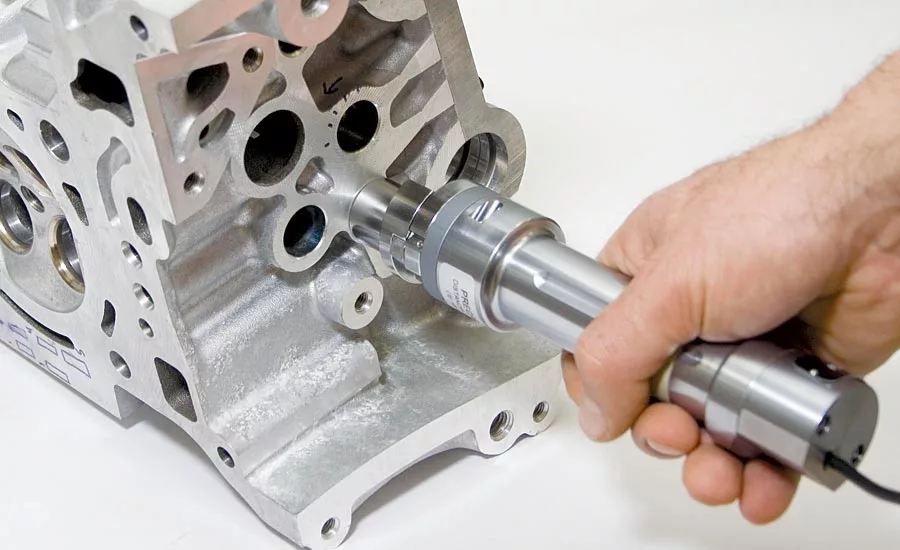
Is the surface to be checked for finish so difficult that even a very skilled operator would be unable to make accurate and repeatable measurements using standard portable gages and fixtures? If so, a custom dedicated probe holding and alignment system can drastically speed the process, improve the measurement, and likely save on broken probe replacements. Source: Mahr

May 1, 2017

It’s certainly not news that more and more gages are being forced out onto the shop floor. Tight tolerance measurements that were once performed by a trained inspection technician are now being done right next to the machining center, most likely by the machine tool operator.

Like every other function in modern manufacturing operations, inspection is subject to management efforts at cost control or cost containment. It’s good business sense to try to maximize the value of every dollar spent, but it means that hard choices must be made when selecting gaging equipment. Issues as diverse as the machinist/inspector and his training, warranties, throughput requirements, manufacturing methods and materials, the end-use of the workpiece, and general company policies on gaging methods and suppliers may influence both the effectiveness and the cost of the inspection process.

Standard off-the-shelf gaging may not be the best choice for specific inspection processes at the machine, or for best throughput by the operator simply because a gage that was good for the inspector in the receiving room is not apt to be the best gage solution for the machine operator at his or her station.

The question for the manufacturing engineers who have become more responsible for quality issues is how do they specify the gaging solution that provides the best (fastest, most reliable, easiest to use, and cost effective) results. Since the manufacturing engineers are most likely not gaging experts they will often rely on a gage supplier to recommend a standard, modified or custom gage solution.

In order to make a proper recommendation, the gage maker is apt to need answers to a number of questions. These are pretty basic, but the answers will usually steer you and the gage builder towards hardware capable of performing the tasks at hand. Here’s a baker’s dozen of key factors to consider:

Part feature, dimension and tolerance to be inspected. Is it flat, round or otherwise? ID or OD? Is it a static or dynamic check? Where is it and is it easily accessible, or is it next to a shoulder, inside a bore or a narrow groove? Is it critical or just nice to have?

Workpiece material and finish. Is the part compressible? Is it easily scratched? Many standard gages can be customized to avoid such influences. Or proper contacts can be chosen to reduce scratching or picking up material.

Accuracy required for the inspection. There should be a reasonable relationship between part tolerance and gage accuracy—very often on the order of a 10:1 ratio, although a resolution and repeatability requirement for statistical gage repeatability and reproducibility (GR&R) testing may require 20:1.

Type of gage you think you need. Do you want to bring the gage to the part or the part to the gage? Do you want to try for multiple checks with one operation?

Time and throughput. How many parts are produced per hour, shift, or day? Can the operator be expected to measure this many parts—or is there a chance of physical harm in trying? Fixed purpose-built gaging may seem less economical than a more flexible, multi-purpose instrument, but, if it saves a thousand hours of labor (or possibly injury) over the course of a production run, it may pay for itself many times over.

Ease of use, and training. Does the operator have the time or skill to manipulate the gage or part? Or does the gage need to be designed to accept the part only in one easy to load process? Especially for shop floor gaging, you want to reduce the complexity of gage operation and the possibility of operator influence.

Part cleanliness. Is the part dirty or clean at the stage of processing when you want to measure it? That may affect labor requirements, maintenance, and the level of achievable accuracy, or it might steer you toward air gaging, which tends to be self-cleaning.

Gaging environment. Will the gage be subject to vibration, dust, changes in temperature, etc.? Is the part warm when it comes off the process? Are the tolerances tight enough to think about temperature compensation?

Parts handling. What happens to the part after it’s measured? Are bad parts discarded or reworked? Is there a sorting requirement? Do you need to have the operator make this decision, or may the gage do so as part of an automated process?

Manufacturing process. Every machine tool imposes certain geometric and surface finish irregularities on workpieces. Do you need to measure them, or at least take them into consideration when performing a measurement? Is the surface finish or form not in line with the part tolerance?

Inspection costs. These increase sharply as gage accuracy improves. Before setting up a gaging operation for extremely close tolerance, verify that the particular level of accuracy is really necessary.

Budget. What do you have to work with? What is the cost of a bad part getting through? If it is a life critical component, don’t be penny wise and liability foolish.

Cost of maintenance. Can the gage be maintained, or is it a throwaway? How often is maintenance required, and who’s going to perform it? Gages that can be reset to a master to compensate for wear are generally more economical over the long run than those that lose accuracy through extended use.

If the part is simply an OD with a generous tolerance, then a caliper, micrometer, or even a dedicated snap gage would be potential solutions. However, if your key factors include performance (accuracy and repeatability), time and throughput, ease of use and operator skill, assured part classification, and cost per piece, then a custom gage solution is one that should be considered.

Often custom gaging is thought of when a solution is needed for a high precision, tight tolerance part. But things can get complicated: there may be more checks; they may not be ODs or IDs; the process being checked might be automated and a gage user may not exist. You may even have a fairly wide tolerance but the feature being checked is so difficult that any user—even the most skilled—would be unable to make accurate and repeatable measurements. Along with the gage, you need to consider part staging.

In any case, if you can’t express what, where, how and why you want to measure something, then your knowledge is insufficient to determine an optimum solution. Find the answers to the questions above and you can start speaking the language of measurement.

KEYWORDS: custom gaging Gage R&R ID and OD measurement

Share This Story

Looking for a reprint of this article?
From high-res PDFs to custom plaques, order your copy today!

George schuetz

George Schuetz has been employed with Mahr Inc. for over 40 years in the metrology business.  During that time, he has worked in the applications areas for Precision Gages, Special Gage Designs, Surface and Form Gaging working to solve customer's specific gaging problems.

Over the years, he has contributed articles to magazines including Quality in Manufacturing, Quality Digest, Quality Magazine, and is a monthly contributor to Modern Machine Shop. He has also written a book entitled Quality Gaging Tips, a compilation of modern machine shop tips.

Presently George is responsible for Precision Gage Product management at Mahr Inc. For more information, call (401) 784-3392, email [email protected] or [email protected] and visit www.mahr.com.

Recommended Content

JOIN TODAY
to unlock your recommendations.

Already have an account? Sign In

  • 2024 Quality Rookie of the Year Justin Wise 1440x750px banner with "Quality Rookie of the Year" logo inset

    Meet the 2024 Quality Rookie of the Year: Justin Wise

    Justin Wise is an exceptional individual who has been...
    Aerospace
    By: Michelle Bangert
  • Man with umbrella and coat stands outside while it rains at night looking at a building.

    Nondestructive Testing: Is there an ethics problem?

    I was a whistleblower who exposed fraudulent activities...
    NDT
    By: Dale Norwood
  • Unraveling Deflategate: Football stadium with closeup of football on field

    Unraveling the Tom Brady Deflategate

    The Deflategate scandal erupted following the 2014 AFC...
    Measurement
    By: Greg Cenker and Henry Zumbrun
Manage My Account
  • eMagazine Subscriptions
  • Newsletters
  • Online Registration
  • Subscription Customer Service
  • Manage My Preferences

More Videos

Sponsored Content

Sponsored Content is a special paid section where industry companies provide high quality, objective, non-commercial content around topics of interest to the Quality audience. All Sponsored Content is supplied by the advertising company and any opinions expressed in this article are those of the author and not necessarily reflect the views of Quality or its parent company, BNP Media. Interested in participating in our Sponsored Content section? Contact your local rep!

close
  • This image shows a person seated next to a Bobcat T66 compact track loader.
    Sponsored byPolyWorks by InnovMetric

    Supercharging Digital Gauging at Bobcat North America

  • Dorsey Calibration Lab photo by Tom LaBarbera Picture this Studios
    Sponsored byDorsey Metrology International

    Ensuring Product Quality in a Competitive Manufacturing Landscape

  • This image displays a Eddyfi Technologies Cypher portable inspection instrument alongside a scanner for non-destructive testing (NDT).
    Sponsored byEddyfi Technologies

    A Safer, Smarter Approach to Weld Inspection: Why Advanced Ultrasonic Testing Is Redefining Industry Standards

Popular Stories

MicroRidge MobileCollect wireless measurement system

Before AI Can Help, the Data Has to Be Ready

a titanium diaphragm speaker driver

The One Thing Elon Gets Right Is Designed to Scare You

This image shows a person seated next to a Bobcat T66 compact track loader.

Supercharging Digital Gauging at Bobcat North America

2026 Quality Professional of the Year!

Events

June 4, 2026

Scaling Manufacturing Quality with Automation for Greater ROI

If you need to do more with the same resources or build a new tech foundation, this session shows where to start and how to create a more efficient, scalable, cost-conscious quality process.

June 9, 2026

Future-Proof your Quality Processes with Advanced 3D Optical CMM Technology

Discover how to effortlessly capture complex data, leverage true multi-sensor automation, and ensure continuous operation without creating inspection delays.

View All Submit An Event

Products

Lean Manufacturing and Service Fundamentals, Applications, and Case Studies

Lean Manufacturing and Service Fundamentals, Applications, and Case Studies

See More Products
Quality Podcast Channel Custom Content

Related Articles

  • QM 0623 Measurement 1-844-T ID-OD Long-Gage 2809 120ppi Q8

    How to Measure Big IDs and ODs

    See More
  • QM 0322 Measurement feature image

    It is Never Too Late to Teach an Old Custom Gage New Tricks

    See More
  • Everything You Need to Know Before You Ask About Custom Gaging

    See More

Related Products

See More Products
  • 118877.jpg

    How to Audit ISO 9001 2015 A Handbook for Auditors

  • temp_6351_1_5705_1_8318_1_17674.jpg

    How To Implement Lean Manufacturing, 2E

See More Products

Related Directories

  • EMI Gage

    EMI Gage supplies calibration and accessories for ALL surface roughness, form, contour and roundness measuring instruments. We repair and manufacture standard and custom diamond, ruby, sapphire and tungsten carbide styli. ISO/IEC17025 certified laboratory and field service provides calibration for surface and roundness artifacts and instruments. Specialize in repair of Taylor Hobson instruments.
  • Edmunds Gages

    Dimensional measurement specialists for 75+ years! Our turn-key custom solutions range from simple manual fixtures to fully automated gaging with size compensation control, robotics, or in-line automation using Air, LVDT, and Vision. Comparative measurement with NIST traceable masters from our A2LA accredited laboratory. AccuTouch, Trendsetter, EPIC-ADAMM, and EPIC-CAG gaging amplifiers.
  • Gage-Line Technology Inc.

    Manufacturer Custom/Standard Gaging, Optical, Calibration, & Imaged Products; e.g. Vision & Comparator Calibration Kits, Scratch-Dig Comparison Standards; Calibration Glass Scales & Grids, Reticles, Inspection Gages, Optical Comparator Charts, Test Patterns, Sight-gages, Hard Gaging, Overlay Sight-gages, In-Process Gaging, Contour Tracers, Inspection & Calibration Services.
×

Stay in the know with Quality’s comprehensive coverage of
the manufacturing and metrology industries.

Newsletters | Website | eMagazine

JOIN TODAY!
  • RESOURCES
    • Advertise
    • Contact Us
    • Directories
    • Manufacturing Division
    • Store
    • Want More
  • SIGN UP TODAY
    • Create Account
    • eMagazine
    • Newsletters
    • Customer Service
    • Manage Preferences
  • SERVICES
    • Marketing Services
    • Market Research
    • Reprints
    • List Rental
    • Survey/Respondent Access
  • STAY CONNECTED
    • LinkedIn
    • Facebook
    • YouTube
    • X (Twitter)
  • PRIVACY
    • PRIVACY POLICY
    • TERMS & CONDITIONS
    • DO NOT SELL MY PERSONAL INFORMATION
    • PRIVACY REQUEST
    • ACCESSIBILITY

Copyright ©2026. All Rights Reserved BNP Media, Inc. and BNP Media II, LLC.

Design, CMS, Hosting & Web Development :: ePublishing