Vision & Sensors | Trends
Machine Vision Trends for Manufacturing
Recent years have seen steadily growing interest about the applications SWIR can offer for manufacturing, particularly in machine vision.
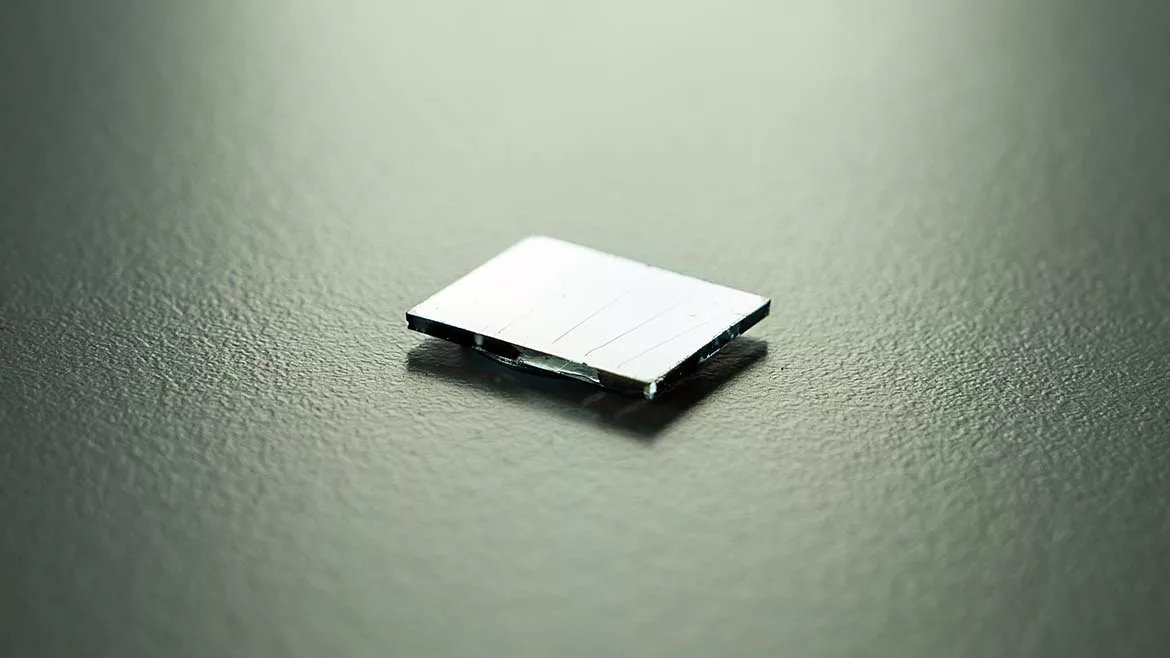
A quantum dot film deposited onto a glass substrate that has been scratched to allow measurement of the thickness. All Images Source: Quantum Science
In the fast-paced and dynamic world of manufacturing, one trend is clear: short-wave infrared (SWIR) imaging and sensing is revolutionizing the industry.
Recent years have seen steadily growing interest about the applications SWIR can offer for manufacturing, particularly in machine vision. Thanks to its ability to differentiate materials based on their reflectance properties and to ‘see’ through materials that are otherwise opaque to the human eye, SWIR technology is unlocking exciting applications in machine vision. Widespread adoption of this technology will facilitate advanced quality control processes and drive significant growth in the industry.
Of the technologies that are competing to bring SWIR sensors into everyday use, quantum dots (QDs) are widely recognized as the best positioned. Offering exceptional broadband tuneability and performance at a low cost, QDs have the potential to make high performance SWIR capability affordable for all. However, to conquer the market and make these benefits accessible, there are several barriers that must first be overcome.

SWIR sensors
SWIR sensors use the part of the infrared spectrum between near infrared and middle-wave infrared light to facilitate unique sensing applications. Typically, this encompasses approximately 1000 to 2,500nm. Many rely on materials like indium gallium arsenide (InGaAs) to enable them to capture SWIR light, the unique properties of which enable sensors to detect things that would otherwise be invisible under other wavelengths.
Although this technology is already being used by some businesses today, the growing recognition of its potential means its value is soon set to explode. Industry analysts predict the market for SWIR imagers and sensors will reach a value of $2.9 billion by 2028, thanks to a profusion of new technologies becoming available that are making low-cost, efficient imaging systems a reality.
The true value of SWIR in manufacturing lies in quality control. Because SWIR can see through some materials that are opaque to the human eye, it can be used to monitor the internal structures of a product without causing damage. Silicon is one such substance; the material’s high transmission rate in the SWIR spectrum renders it transparent at certain wavelengths above approximately 1,100nm. As a result, using SWIR sensors enables defects like cracks or misalignment to be detected and accounted for early in production, increasing product reliability and thereby reducing the cost and complexity of production.
This capability is not limited to silicon alone. Plastics that block visible light can also be rendered transparent under SWIR wavelengths, as can certain paints or films. Tracking moisture is another area where SWIR sensors excel - water strongly absorbs some wavelengths of SWIR light, meaning any areas of moisture show up as darker patches on images captured by a SWIR camera. This enables SWIR sensors to detect hidden areas degradation within a product, or to monitor fill levels of containers, without the need for intrusive, time-consuming, and costly procedures.
SWIR cameras also offer applications for temperature monitoring. For example, when creating products from glass or metal, SWIR can detect emitted thermal radiation, which grants it uses in monitoring uniformity and critical dimensions while a high-temperature product is still undergoing construction.
Crucially, the performance of SWIR sensors is growing by the day. The high frame rate of SWIR cameras enables inspections to be conducted quickly, while low noise and high dynamic range help to ensure excellent image quality. As a result, SWIR technology offers truly the best solution for improving quality control processes in manufacturing – and if certain limitations can be overcome, its potential will only increase.
Barriers to implementation
To date, the biggest obstacle to widespread SWIR introduction has been the high cost of incumbent technologies. In particular, even though InGaAs technology offers high performance due to its quantum efficiency and wide spectral response, the prohibitive price – often up $10,000 per unit – is effectively keeping SWIR out of certain applications.
Camera technology based on InGaAs photodiodes operates with the range of 900 to 1,700nm. These systems are often capable of high detection performance with good quantum efficiency, low dark current, fast response speed, and high reliability. Extending the InGaAs alloys using higher InAs composition enables longer wavelengths of light up to 2,600nm to be detected, but doing so highlights one of the main problems with InGaAs – the high rate of defects encountered during batch production that reduce device performance and increase the overall cost of production.
The high cost and limited pixel pitch of InGaAs sensors is a result of the complexity of the InGaAs fabrication process. InGaAs is epitaxially grown onto indium phosphine (InP) wafers, which are diced into chips that are attached to silicon readout circuits using flip-chip hybridisation bonding. At low yields, the complexity of this fabrication method, combined with the inherent fragility of InP materials, makes the scale-up process even harder.
InGaAs sensors are also highly susceptible to dark noise due to the high dark current present at room temperature. As a result, many require cooling systems to achieve adequate image quality which further adds to the cost and bulk of the final product and renders InGaAs unsuitable for ushering in a true revolution in image sensor technology.

QDs light the way forward
In contrast, infrared QD technology offers great potential for improving machine vision in the manufacturing sector. Featuring a wide spectral response covering wavelengths from ultraviolet to SWIR, as well as high detection performance and resolution, QDs make SWIR capability possible at 100-1,000 times lower costs than existing legacy SWIR technology.
QD technology sees QD-based pixel stacks integrated onto CMOS ROIC circuits at wafer scale. The ability to precisely control nanocrystal size during synthesis offers unique wavelength tuneability in a wide spectral range, combined with strong optical absorption, large dielectric constant, and small exciton binding energies, ensures QDs make excellent active infrared layers for image sensors.
The fact that QDs are manufactured using benchtop wet chemistry makes high-scale manufacturing much simpler, and the precise control over nanocrystal size during synthesis, means QDs offer unique wavelength tuneability in a wide spectral range, at a fraction of the price of other SWIR sensing solutions. This scalability will be instrumental to providing supply chains with sufficient resources to feed the growing demand for SWIR sensors.
Bringing QDs to market
Creating sufficient QDs to meet market requirements will require the industry to overcome several significant challenges, not least of which is the problem of maintaining batch-to-batch consistency. Many QD suppliers struggle with controlling each stage of the complex QD manufacturing process, with defects prone to emerging during controlling the chemical binding status of a QD’s surface, or through impurities entering the colloidal system. Achieving sufficient process control requires extensive expertise in QD synthesis and scale-up.
However, advances in SWIR technology mean this barrier is becoming smaller by the day. Infrared QD technology can now be produced at kilogram scale due to its inherent high scalability. The efficient formulation process of QDs enables them to be deposited in a single layer of a colloidal solution. Compared with other processes that can require 14-16 deposition layers on a single sensor, with each one presenting a potential failure point, this method significantly reduces the risk of defect formation, making mass production much more feasible.
Infrared QD technology also overcomes a second major obstacle to widespread QD adoption – the presence of lead. Although lead is highly useful for QDs due to its broad absorption spectrum, it is also extremely toxic and is such is restricted for use in many major applications. QD technology can be produced in a lead-free form that is responsive to wavelengths up to 1,550nm, providing a viable SWIR-sensitive alternative suitable for many machine vision applications. As the technology behind lead-free QDs develops further, this performance will only increase.
Infrared QD technology is already being used for certain machine vision applications today, offering high performance SWIR capability for mass market applications. With the value of SWIR sensors set to escalate rapidly over the next few years thanks to this technology, the machine vision sector has a bright future ahead of it.
Looking for a reprint of this article?
From high-res PDFs to custom plaques, order your copy today!