Measurement
Efficient Use of Coordinate Measurement Machines
A CMM fulfills many types of measurement needs, yet is often programmed and operated in a way tailored for only one of those needs.
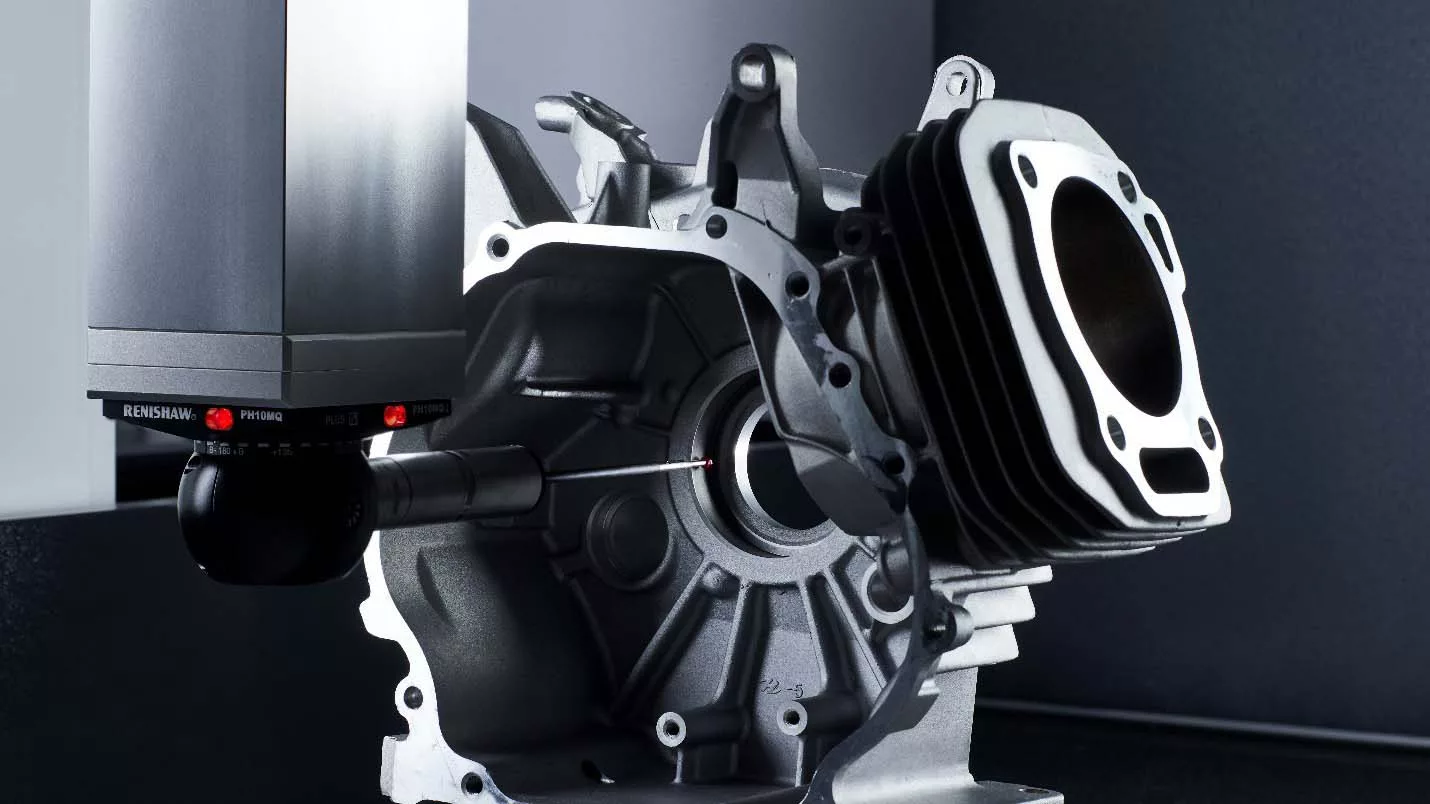
All Images Source: Renishaw
The coordinate measurement machine (CMM) is a hallmark instrument of modern manufacturing and quality departments. It is often considered the gauge of record for most if not all measurements; it is often the most important, and most expensive, measurement instrument in a manufacturing plant. Like other capital equipment, its time is valuable, yet the CMM is all too often the center of bottlenecks, which limit daily production but also creates friction between manufacturing staff and quality staff. This is because the CMM fulfills many types of measurement needs, yet is often programmed and operated in a way tailored for only one of those needs. In this article, three different use cases of a CMM are highlighted, with the most efficient usage technique for each described.
First Article Inspection
CMMs are most often associated with first article inspection (FAI) as part of quality control. The goal is to verify that the finished part meets design intent according to the engineering drawing. FAI programs are the most common type of CMM programs, and the longest and most exhaustive. As such, these programs can benefit the most from putting in the effort to eliminate inefficiency.
One technique for making a FAI program more efficient is to eliminate redundant probehead angle changes and stylus changes whenever possible. Every time a stylus tool is changed, the mechanical motion of driving back and forth to the rack and the electronic controller effort of recalling calibrations is unproductive time. Multiple styli tools can be necessary, but a program should be structured so that it does not pick up and drop off the same tool more than twice in a program. This might mean rearranging the order of features measured.

In addition, each stylus tool change or probe head angle change requires periodic qualification. Qualifying these tool setups takes time. Even if a new stylus tool adds 30 seconds of pick-up/drop-off time, it could add 30 minutes of additional qualification. Eliminating unnecessary tool setups could amount to a few extra hours per work week in time saved. There are exceptions to this; a 5-axis probe head needs only one qualification routine per stylus tool compared to a typical 3+2 indexing probe head which requires a qualification routine
Process Control
The second most common use case for a CMM is process control. A manufacturing process, particularly one centered around CNC metal cutting, often has numerical parameters that can be directly adjusted to adjust the geometry and characteristics of the finished product. For example, on a CNC mill or lathe, there are cutting tool offset parameters that can be increased or decreased to change some diameters or lengths in the workpiece. Manufacturing staff typically want workpiece measurements to adjust those parameters. Sometimes they rely on measurement instruments near the process, but other times the measurement is best obtained from a CMM. There are three elements to efficiently using a CMM for process control: programming for offsets only, programming for individual operations, and programming for speed.
The first step is to write a new program with the bare minimum number of features and characteristics. The minimum here is going to be defined by the amount of adjustment parameters, i.e. CNC tool offsets, available to the process operator. Consider for example a small engine crank case cover made in two operations. Each side has a set of holes cut in one operation.

The engineering print may require all characteristics, but the shopfloor-savvy CMM programmer will know that he could break the FAI program down into two new programs, each focusing on one side and operation. In this way, if a machinist is looking for feedback on OP10, he doesn’t have to sit through half of the features he doesn’t need. In addition, only some characteristics can be fed back. While an interpolated bore at the crank journal can be controlled with CNC cutter comp using the CMM inspection results, the drilled bolt hole pattern can neither be offset for size, nor position. So an OP10 process control program would be slimmer still. It would not only skip all the OP20 features, but also all the uncontrollable features in OP10, such as drilled holes.
Process control typically can only be executed using linear dimensions, not geometric dimensions and tolerances (GD&T). This is because GD&T measurement values are always unsigned according to ASME and ISO standards. For example, the profile of a surface that has .001” excess material on and the profile of a surface that has .001” too much material removed will read the exact same profile value according to GD&T. This does not give machinists and manufacturing staff sufficient information on which way to tune the process.
While adding GD&T characteristics does not directly impact program efficiency, it can do so indirectly. For example, a crank journal that has a cylindricity callout might typically be measured using at least two circle scans of various depths, or a series of line scans, or helix scans. These are good approaches for an FAI program. But in a process control program, only its size is relevant, not its form, which opens the possibility of measuring the feature as a three touch circle. On slow scanning systems, typically those with 3+2 indexing heads, switching to touch points could save time while providing sufficient process control information.
Finally, process control programs allows the CMM operator to measure parts in process rather than at the final stage. Again, this can be very valuable to manufacturing staff, who want information right at the operation of interest. Waiting for the part to reach its final state not only uses up time unnecessarily, but can also cloud an individual operation’s output if the features are altered by another operation further down the line.
Process Discovery
Both FAI and process control are needs for a mature manufacturing process that has been verified, validated, and certified to produce parts meeting the engineering requirements for the majority of the time. But every product life cycle begins with an immature unproven manufacturing process, which not only produces large amounts of nonconformance, i.e. scrap, but can also produce parts which might meet the engineering drawing but fails to function properly in an assembly. In such cases, engineering drawings get revised frequently, process tooling and operations change, and CMM programs are tinkered and altered with each new preproduction part produced. For such a scenario, the role of inspection should be to quickly discover pitfalls in both production and in engineering. This is called process discovery.
While an FAI type CMM program may be a good starting point for undertaking process discovery, the length of such programs may hinder quick iterations in production and design. An initial piece should go through FAI, but shorter and more flexible programs should be used once the FAI program has uncovered characteristics out of tolerance that production and engineering expected to pass. These surprise nonconformances are the stumbling block to process maturation, and so a CMM program should be developed that focuses just on these “known unknowns.” Running the FAI program when 90% of characteristics pass as expected (or have known corrective actions) delays getting feedback on the surprise nonconformances. The FAI program should be run during periods when all staff expect a good part; in this way the FAI program should confirm that. As soon as there is uncertainty about a particular characteristic, a smaller program should be developed that quickly measures that characteristic, so production can iterate their process and get feedback over and over quickly, honing on process stability.
Consider for example a small engine crank case made in four operations. A typical characteristic may be the linear distance between the combustion face and the crank journal. A “simple” linear dimension, yet to everyone’s surprise, is out of spec on every preproduction part made. The combustion face may be cut in one operation and the crank journal in another. Each operation uses different machining datums to control the cut features’ positions. Adjusting one operation is useless without controlling the other operation using some common setup. In this example, a FAI program could take two hours to run, a great amount of time when the machinist just wants to know more about one single challenging characteristic.

A shortened version of the FAI program would be a good first step. But it would not give the machinist insight into the root cause nor the solution. FAI programs, and abbreviated versions, can only tell staff that they are failing to meet engineering requirements, not how to get out of this mess. A much better program would report each feature to its machining datums, like a process control program, but also report the machining datums to the print datums. A few sample runs with this program would reveal to the machinist that his datum choices between operations are unrelated. An expert machinist might then solve the problem by keeping his work holding as-is, but using a CNC probe to pick up the same consistent datums on each operation. These probing features need not be the workholding datums, nor print datums, but any mathematically stable coordinate system.
This example shows that process discovery programs for CMMs take the lessons of process control to a whole new level. Quality staff, like referees and weathermen, are often blamed and jeered for just reporting the facts. The successful CMM programmer can be the hero messenger that provides the key intel which gets a struggling manufacturing process off top-dead-center.
Conclusion
CMMs are the gauge of record for many quality departments, with their primary purpose to fulfill FAI in the most repeatable, reproducible, and automated manner economically possible. But CMMs also fulfill two other typical needs: process control and process discovery. Understanding the differences in these needs allows the quality department to implement different programming and hardware strategies, which increases the overall equipment efficiency, reduces the workload on the department, and harmonizes the CMM’s capabilities to the rest of the organization’s needs.
Looking for a reprint of this article?
From high-res PDFs to custom plaques, order your copy today!