Vision & Sensors | Inspection
Will AI Replace the Human Eye in Inspection?
AI is better than us at high-resolution, repetitive inspections, but humans are better at understanding messy, random visual information.
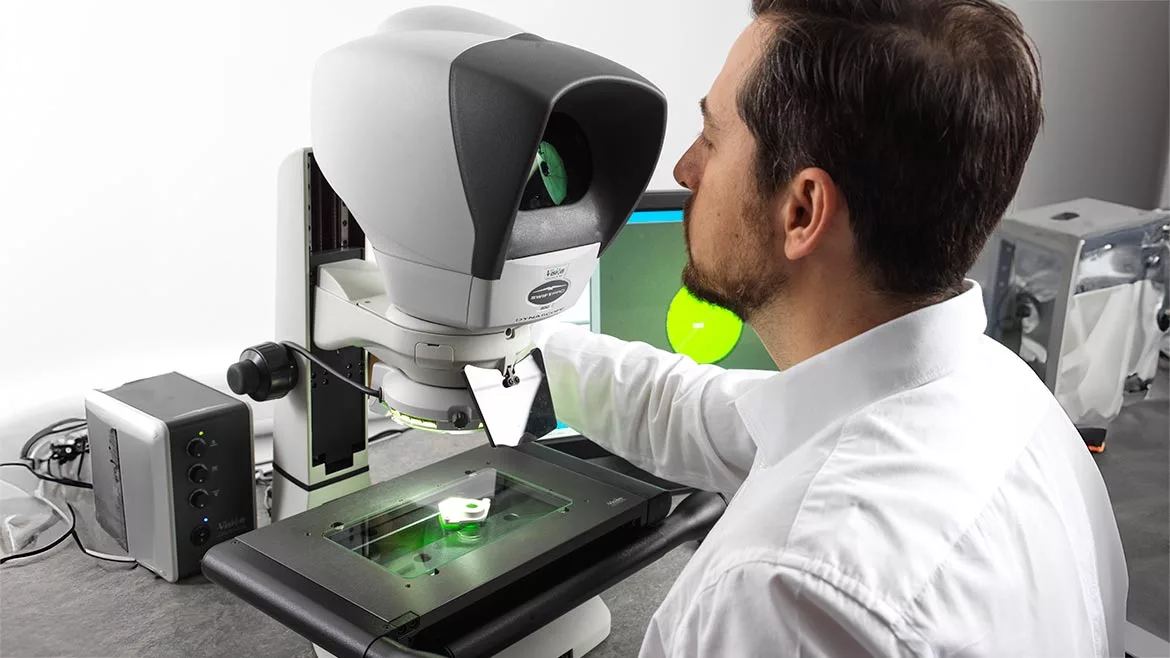
Image Source: Vision Engineering
At a time when technology keeps pushing the limits of the possible, one of the most fascinating conversations today concerns AI vs. the human eye – in the inspection arena. Manufacturing and medical settings are left puzzled: Is AI better than the human eye when inspecting, or does the human eye retain an indisputable advantage?
Understanding Inspection: Human vs. Machine
The inspection process includes checking an object, part, or system for quality, conformity, and function. Human inspectors have long used their eyes, ears, and hands to detect problems or inconsistencies. But with AI, machines can get the job done just as efficiently, allowing them to inspect using cameras, sensors, and algorithms that can do the task quickly and accurately.
To see if AI is better than the human eye, we will examine the two on the following metrics: precision, speed, accuracy, modularity, and cost-effectiveness.
Accuracy: Precision vs. Perception
Our eyes are good at picking up small differences in texture, color, and shape, particularly in cluttered spaces. For instance, a good quality control inspector can pick out small flaws in a product that an automated search engine can’t see. The visual data we can render in context are unmatched by the human brain.
AI, however, is more precise in another sense. Machine vision devices that have high-resolution cameras pick up microbeads whose structure is imperceptible to the human eye. They’re especially effective in the kinds of places where uniformity is important, such as semiconductor production or pharmaceutical pharma packaging. Software can be programmed to check images pixel for pixel, with no bug left unnoticed. Not only that, AI’s precision is also improved with machine learning, allowing it to detect patterns and anomalies better than humans in repetitive tasks. AI is better than us at high-resolution, repetitive inspections, but humans are better at understanding messy, random visual information.
Speed: Machines Don’t Blink
Another issue in inspection work is the speed. The physical limitations of human inspectors are physical exhaustion and processing capacity. A good inspector can inspect a few hundred parts in an hour, but AI systems can perform thousands at the same time, depending on how detailed the job is.
AI in automotive manufacturing, for example, can measure weld joints, paint rust, and assembly line alignment in real-time while vehicles are running. It is not only productivity that this tool can enhance, but it also reduces production bottlenecks. AI is unmistakably faster than human inspectors especially when it comes to massive-scale production.
Consistency: Eliminating Human Error
Humans are fallible. Fatigue, distractions, inclination, etc, can lead to discrepancies in inspection data. It happens to the best inspectors too, and it is hard to focus during long shifts.
AI systems, on the other hand, provide unbreakable consistency. They do the same thing every time, irrespective of the external environment, once they are programmed. That consistency is invaluable in a sector such as aerospace where even a small flaw can have catastrophic effects. AI is much more consistent than we can ever be, which is why it is always the choice for applications in which consistency is needed.
Adaptability: The Human Edge
The one area in which humans still have the edge is adaptability. Human inspectors are quick to get used to conditions, teach themselves, and use gut feelings to pick up issues that don’t fit within set parameters. For instance, in a factory, a defect pattern could be identified by an inspector and assigned to a certain faulty machine (this is an intelligence that current AI systems cannot imitate).
AI can be trained to work in new environments, but that takes time, data, and computation. In addition, AI systems are constrained by their training data: they may not see defects very different from patterns that were trained to detect.
People are great at being flexible and reasoning – they are better at working in fluid, uncertain worlds.
Cost-Effectiveness: Balancing Investment and Returns
The infrastructure and software costs for installing AI inspection systems are expensive upfront, not to mention the integration costs. But these costs are paid back in the long run in labor savings, productivity gains, and lower error rates. Further, AI platforms are scalable which means that enterprises can scale up with higher volumes of production without having to pay increased inspection costs. However, human inspectors need regular pay, education, and allowances. And human error can be high in fields where accuracy is not a matter of opinion. While AI systems are more expensive upfront, in the long run, they’re a better option for most sectors.
Experiments: AI vs Human Eye at Work Case Studies
Manufacturing
The assembly of printed circuit boards (PCBs) in electronics requires absolute accuracy. AI systems are machine vision-based to scan solder joints, component placement, and circuits down to the micron level.
Healthcare
Ai has already changed diagnostics in medical imaging. AI algorithms, for example, recognize the first symptoms of a disease such as cancer on X-rays and MRIs with precision rates far higher than radiologists. However human expertise remains essential to interpretation in the larger clinical setting.
Food Industry
Making sure food is good and safe means looking for toxins, stains, and damage. AI systems using hyperspectral imaging can detect defects at levels that human inspectors can’t and, in so doing, meet the tightest of quality standards.
Challenges and Limitations of AI
AI is not perfect, despite its merits. Machine vision systems can also fail in scenes with changing lighting, reflections, or textures. It takes big data to train AI models and if there is some bias in the training data, the results are going to be wrong. In addition, AI algorithms don’t have any way of discerning things that aren’t programmed, leading to false positives or missed defects in unproven cases.
Inspection’s Next Generation: Co-operation, Not Competition.
Instead of judging AI and the human eye as competitors, industries are starting to work together. Enhanced human capabilities could be supported by augmented reality (AR) and AI-powered software, giving inspectors accurate analytics and overlays to direct them in the field. The benefits of this symbiosis between the capacity of human judgment and that of machine precision are tapped.
In aerospace, for instance, inspectors wearing AR glasses can see AI-computed data overlaid on plane parts so they can scan those identified as high-risk. The efficiency and reliability of these hybrid systems can be optimized through such systems.
Conclusion
Although AI has changed inspection, it is not one-size-fits-all. Whether to use AI or human inspection will be based on the task specifics, accuracy, adaptability, and cost.
AI can do things fast, repeatable, and accurate – perfect for any industry with strict requirements of quality and massive scale. However, the human eye’s flexibility and contextual awareness are still untapped in dynamic and cluttered environments.
The real path forward for inspection is to bring the power of AI and human skill together and build systems that are more than they are. With this kind of cooperation, industries can become better than ever in terms of quality and efficacy, making the way for a smarter, more secure future.
Looking for a reprint of this article?
From high-res PDFs to custom plaques, order your copy today!