Q-Cast
PODCAST | AI-Powered Robotics in Quality Manufacturing

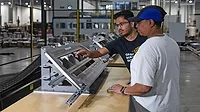
Graphic Credit: BNP Media / Image courtesy of Dr. Satyandra K. Gupta
Dr. SK Gupta discusses robotics and its impact on manufacturing for Quality, including AI-powered robots delivering consistent quality, addressing high labor churn in ergonomically challenging jobs like surface finishing, and the vitalness of a human-centric approach. Dr. Gupta is the co-founder and chief scientist at GrayMatter Robotics and he recently wrote for Quality about AI-powered robotics.
Michelle: So, I think this is a big topic for our audience and really a question on a lot of people's minds right now. Do you think you could summarize--How can AI-powered robotics impact quality?
Dr. Gupta: Sure. So let's set the context a little bit, and hopefully this will then become clearer. So humans are amazing, right? And they can do remarkable things, right? And absolutely, they accomplish phenomenal things. The challenge that we are beginning to see is that work, which is ergonomically challenging, increasingly, you're seeing that people do not want to do.
So, for example, if the work involves a lot of surface finishing, such as sanding and grinding and sandblasting, these are the kind of things that people do not want to do. So industry is seeing significant churn in labor. You join the workforce, they get trained, and then they decide they do not wish to do this job and then they leave. Now, the challenge that happens that when you have this type of situation where you get a new person, you train them, and then after a while they leave, it introduces a lot of inconsistency in human work.
And as a result, then quality suffers. So if you have somebody who is doing the work for a long time, they're really well trained, they love the work, then they can deliver you very good quality. However, if you bring some new people on board, you train them, they start doing the work, they're hating the work, and they quit. So all this has huge implication on quality, right? You get completely inconsistent quality, and all sorts of challenges associated with it.
So that's where robots can be tremendously useful, because robots are consistent. System. Once you, you know, basically get a robot to start producing certain level of quality, it's going to keep delivering you the same level of quality over time.
Now, robot, if you use them and if you have a human programmer programming them, then economically it doesn't make sense to use that kind of robot. So what you would prefer would be an AI which can program the robot, an AI which can control the behavior of the robot.
Humans still get to give tasks to the robot, what they need to do, and they need to basically provide robot information about what kind of quality is expected. But once the task is defined and quality level have been agreed upon, robot can deliver very consistent quality. So that's where AI-powered robots are coming in. And they are delivering completely consistent quality compared to a scenario where we have right. High churn in labor. We have often new people starting on the work are really not interested in doing the ergonomically challenging work, which has injurious to their health. And then you start having quality issues there
Listen to the Full Podcast Here:
Looking for a reprint of this article?
From high-res PDFs to custom plaques, order your copy today!