Quality Magazine logo
search
cart
facebook twitter linkedin youtube
  • Sign In
  • Create Account
  • Sign Out
  • My Account
Quality Magazine logo
  • NEWS
  • PRODUCTS
    • FEATURED PRODUCTS
    • SUBMIT YOUR PRODUCT
  • CHANNELS
    • AUTOMATION
    • MANAGEMENT
    • MEASUREMENT
    • NDT
    • QUALITY 101
    • SOFTWARE
    • TEST & INSPECTION
    • VISION & SENSORS
  • MARKETS
    • AEROSPACE
    • AUTOMOTIVE
    • ENERGY
    • GREEN MANUFACTURING
    • MEDICAL
  • MEDIA
    • A WORD ON QUALITY PUZZLE
    • EBOOK
    • PODCASTS
    • VIDEOS
    • WEBINARS
  • EVENTS
    • EVENT CALENDAR
    • IMTS
  • DIRECTORIES
    • BUYERS GUIDE >
      • Supplier Insights
    • NDT SOURCEBOOK
    • VISION & SENSORS
    • TAKE A TOUR
  • INFOCENTERS
    • Digital Quality Management Systems
    • NEXT GENERATION SPC & QUALITY ANALYTICS
  • AWARDS
    • ROOKIE OF THE YEAR
    • PLANT OF THE YEAR
    • PROFESSIONAL OF THE YEAR
  • MORE
    • Expert Columns
    • NEWSLETTERS
    • QUALITY STORE
    • INDUSTRY LINKS
    • SPONSOR INSIGHTS
  • EMAG
    • eMAGAZINE
    • ARCHIVES
    • CONTACT
    • ADVERTISE
  • SIGN UP!
Test & InspectionAutomotive

Test & Inspection

Wire Terminal Testing and Onshoring: It’s All About Connections

Quality testing is paramount to preventing costly and dangerous failures.
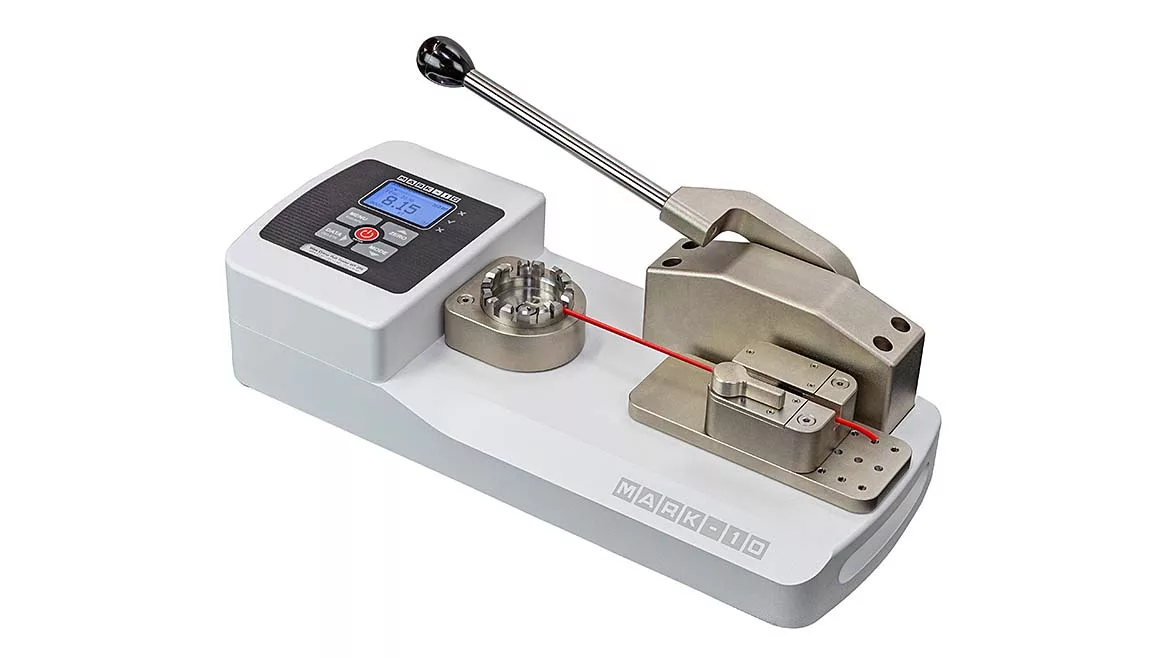
By Tyler Laravuso, Jennifer Redmond
Mark-10 WT-205 with a white background.
Source: Mark-10, Photographs by Roy Mauritsen
July 6, 2025
✕
Image in modal.

Force measurement analyzes the amount of compression (push) or tension (pull) an object experiences in order to assess its quality and performance. Testing by hand with a suitable gage or sensor is a simple and quick option, but more reliable data is achieved by benchtop systems that control the angle and speed of force actuation. One force measurement application seeing growing interest is wire terminal testing, in which a controlled pull against a crimped connection produces a force measurement, characterizing its integrity and quality.

Wire terminal testers generally involve a mechanism to apply a test force, a grip to hold the terminal, a grip to hold the wire, and a load cell and electronics to process and display the data. Force results may include a date and time stamp and pass/fail indicator according to pre-configured acceptance limits.

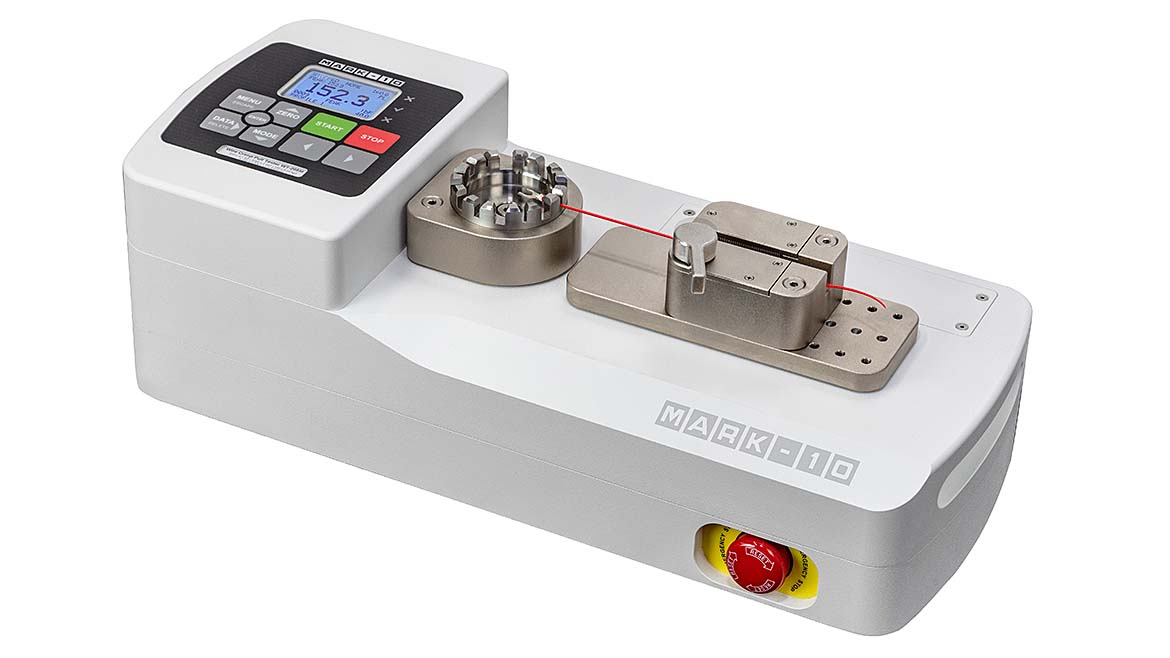
During the test, which can be conducted using either a lever- or wheel-operated manual system or a motorized tester, the actuator speed should be controlled to yield the most repeatable possible results.
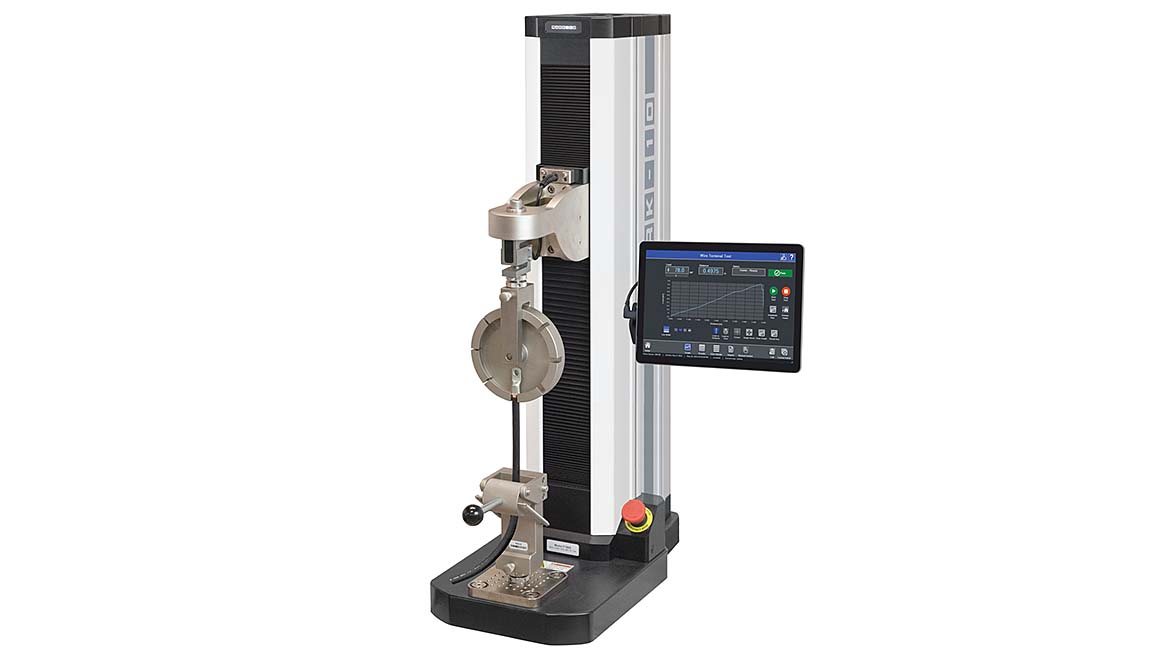
Mark-10 F1505S-IM wire pull with a white background.
Source: Mark-10, Photographs by Roy Mauritsen

Three common test methods are (1) pull-to-failure, a destructive test which applies force until the wire separates from the terminal, (2) pull-to-load, where a sample is deemed acceptable if it remains attached at a target force, and (3) load-hold, where a sample is held at a target force for a specified amount of time. Results for these tests are typically measured in lbF (pound-force), kgF (kilogram-force), or N (Newton) units. Other data that may be included are test speed (in/min or mm/min) and location of failure, which can identify if there is an issue with the crimp or the wire itself. Results depend on several factors like wire gauge, type of terminal, crimping process, and crimping tool condition, type/quality of wire, and environmental factors like temperature and humidity.

Although it may seem logical that a higher force measurement represents higher quality, it’s not always the case. Higher forces may be a symptom of over-crimping, in which incorrect or faulty tools excessively crimp the terminal. Over-crimping can be just as problematic as weak crimping and may lead to a brittle, easily broken connection. Industry testing standards like UL 486A specify the force required to pull a terminal off a wire as well as the speed of the pull. These harmonized processes allow data to be seamlessly shared amongst vendors up and down the supply chain.

Supply chains today are changing. Self-shoring/onshoring, or the process of relocating manufacturing back to or near a company’s home country, has gained traction in recent years, driven not only by the need for stability in the face of external crises such as COVID, but also by a growing emphasis on national security and technological independence. Companies also recognize that onshoring can reduce transportation costs and help to rebuild technical workforces hollowed out in earlier deindustrialization cycles. Challenges remain, such as high costs and limited skilled labor pools, which industries must balance with the opportunities that arise from a more localized approach. Three industries in particular that are self-shoring and rely heavily on wire terminal testing are appliance, automotive, and aerospace manufacturing.
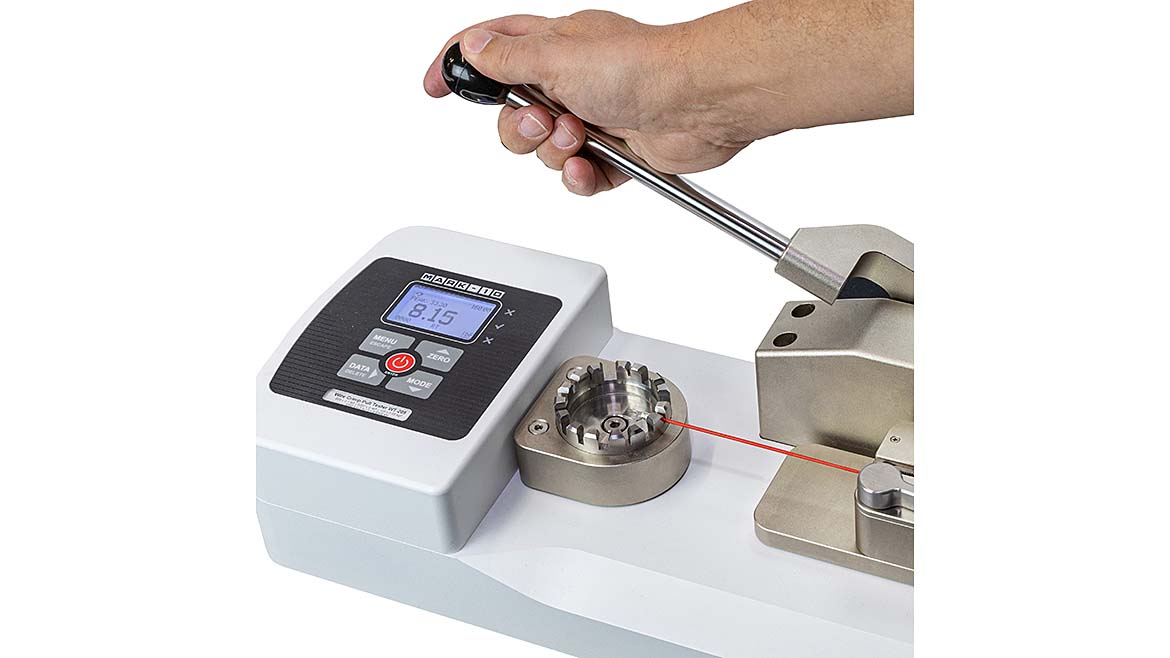
A hand using the Mark-10 handle-pull with a white background.
Source: Mark-10, Photographs by Roy Mauritsen
Mark-10 WT3-205M with a white background.
Source: Mark-10, Photographs by Roy Mauritsen

Pull testing is critical in household and commercial appliances where electrical reliability is critical to performance and safety. This includes high-power appliances such as refrigerators, washing machines, dryers, ovens, and dishwashers, as well as smaller devices like microwaves, coffee makers, and vacuum cleaners. In these products, wire harnesses connect motors, heating elements, sensors, and control boards - components that demand secure and consistent electrical connections to function safely. A weak or faulty crimp in any of these appliances can lead to intermittent operation, short circuits, or overheating, posing risks to the user. Crimp pull testing ensures that each terminal can withstand the mechanical stress and thermal cycling over the appliance’s lifetime, helping manufacturers meet UL, IEC, and other relevant standards.

Automobiles are major users of wire harnesses. These must be rigorously tested for safe, dependable connections that can withstand vibrations, temperature fluctuations, and other environmental factors typical in use. Data from these tests directly influence the design and manufacturing phases, enabling engineers to refine their techniques and materials to more stringently comply with industry standards and resolve weaknesses before they reach assembly lines.
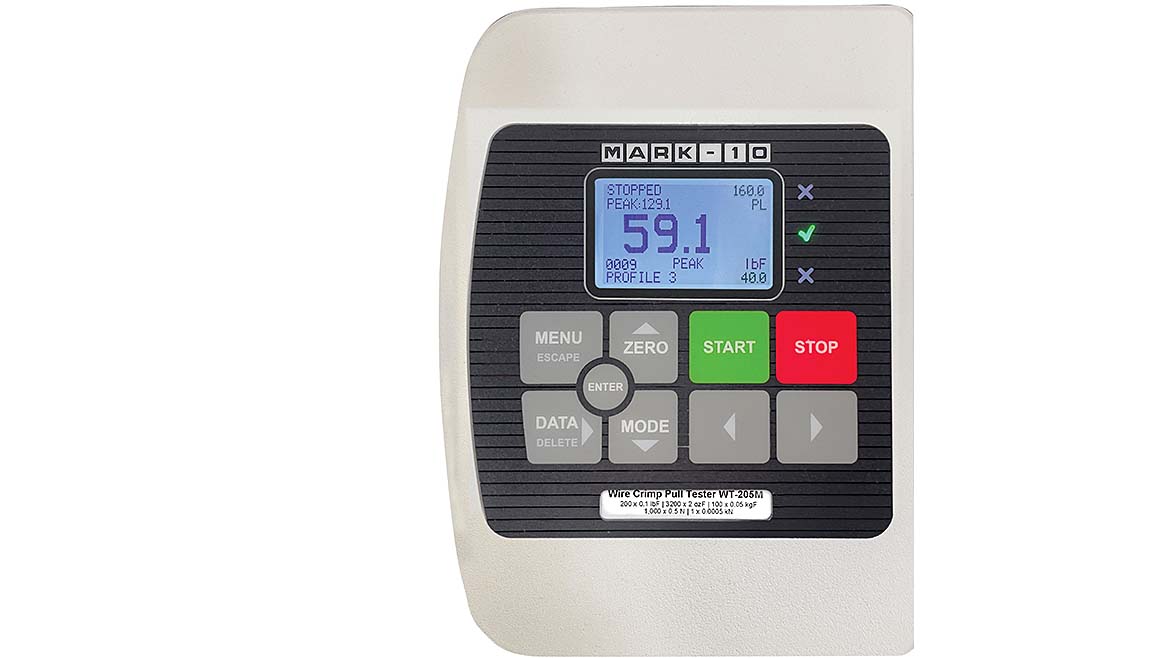
Mark-10 digital display with a white background.
Source: Mark-10, Photographs by Roy Mauritsen

High-voltage electric vehicles (EVs) and batteries are particularly reliant on wire harnesses, where malfunctions can lead to breakdowns and hazardous situations. Successful crimps equal trustworthy connections in battery management systems, drive controls, and other EV components. This ensures proper performance, dependability, and the manufacturer’s reputation in an increasingly competitive market. In the U.S., construction of battery production facilities and EV assembly plants have grown significantly. More long-term growth is expected, despite temporarily softening in the adoptation rate of EVs.

Wire terminal pull testing is vital to the aerospace industry as well. Wire harnesses are employed in navigation, flight controls, hydraulics, engines, and almost every part of an aircraft, including cabin comforts like climate control and entertainment. Military helicopters and fighter jets use wire harnessing for additional purposes like weapons control. Space vehicles and satellites rely on them for dependable communications. These components must perform safely and optimally under extreme conditions. Quality testing is paramount to preventing costly and dangerous failures.

In these examples, localization of production requires opening new production facilities, with all of the associated challenges of construction, tooling up, and staffing. Whether it’s a barbecue or a Boeing, effective wire crimp pull testing, and uniform standards for how to perform it, help identify issues before they become hazards, keeping costs down and ensuring end-user satisfaction as production shifts closer to home.

READ MORE

  • Highly Acclaimed Bedtime Story Offers a Look Into Intricate World of Materials Testing
  • EV Batteries: Materials Quality Testing to Avoid Bumps in the Road
  • Specifying a Force Measurement and Material Testing System to Suit Your Application
KEYWORDS: electric vehicle (EV) ev batteries force measurement manufacturing metrology quality

Share This Story

Looking for a reprint of this article?
From high-res PDFs to custom plaques, order your copy today!

Tyler Laravuso is Lead Product Specialist for Mark-10.

Jennifer Redmond is a Customer Service Specialist for Mark-10.

Recommended Content

JOIN TODAY
to unlock your recommendations.

Already have an account? Sign In

  • 2024 Quality Rookie of the Year Justin Wise 1440x750px banner with "Quality Rookie of the Year" logo inset

    Meet the 2024 Quality Rookie of the Year: Justin Wise

    Justin Wise is an exceptional individual who has been...
    Aerospace
    By: Michelle Bangert
  • Man with umbrella and coat stands outside while it rains at night looking at a building.

    Nondestructive Testing: Is there an ethics problem?

    I was a whistleblower who exposed fraudulent activities...
    NDT
    By: Dale Norwood
  • Unraveling Deflategate: Football stadium with closeup of football on field

    Unraveling the Tom Brady Deflategate

    The Deflategate scandal erupted following the 2014 AFC...
    Measurement
    By: Greg Cenker and Henry Zumbrun
Manage My Account
  • eMagazine Subscriptions
  • Newsletters
  • Online Registration
  • Subscription Customer Service
  • Manage My Preferences

More Videos

Sponsored Content

Sponsored Content is a special paid section where industry companies provide high quality, objective, non-commercial content around topics of interest to the Quality audience. All Sponsored Content is supplied by the advertising company and any opinions expressed in this article are those of the author and not necessarily reflect the views of Quality or its parent company, BNP Media. Interested in participating in our Sponsored Content section? Contact your local rep!

close
  • Key Takeaways for Quality Leaders
    Sponsored byComplianceQuest

    Key Takeaways for Quality Leaders from the 2026 Gartner Magic Quadrant™ for QMS

  • This image shows a person seated next to a Bobcat T66 compact track loader.
    Sponsored byPolyWorks by InnovMetric

    Supercharging Digital Gauging at Bobcat North America

  • Dorsey Calibration Lab photo by Tom LaBarbera Picture this Studios
    Sponsored byDorsey Metrology International

    Ensuring Product Quality in a Competitive Manufacturing Landscape

Popular Stories

This image shows a person seated next to a Bobcat T66 compact track loader.

Supercharging Digital Gauging at Bobcat North America

a professional in the aviation field performing maintenance, repair, and overhaul (MRO) work

Manufacturing Retention: Strategies for Improving Company Culture, Engagement and Skill Development

Dorsey Calibration Lab photo by Tom LaBarbera Picture this Studios

Ensuring Product Quality in a Competitive Manufacturing Landscape

2026 Quality Professional of the Year!

Events

June 22, 2026

Automate 2026

Automate is North America's largest robotics and automation event — and the best place to take your ideas from insight to impact.
 
Our show floor features the world’s leading automation solutions, from AI and robotics to motion control, vision systems, and more. Plus, our educational conference is second to none, led by the brightest minds in automation today.
 
Ready to transform the way you work? Take the next step at Automate.
July 14, 2026

Quality Leaders Forum: Better Communication, Better Quality Data

The Quality Leaders Forum is a quarterly, editor-moderated fireside chat series hosted by Quality Magazine, featuring candid conversations with senior manufacturing and operations executives shaping enterprise-level quality.

View All Submit An Event

Products

Lean Manufacturing and Service Fundamentals, Applications, and Case Studies

Lean Manufacturing and Service Fundamentals, Applications, and Case Studies

See More Products
Quality Podcast Channel Custom Content

Related Articles

  • One half of the finished layup tooling.

    Reverse Engineering: What’s it all about?

    See More
  • It's All About Growth: Quality's 18th Annual Spending Survey

    It's All About Growth: Quality's 18th Annual Spending Survey

    See More
  • Intelex Principles of Quality Management

    It’s All About the Customers

    See More

Related Products

See More Products
  • Mechanical and Non-Destructive Testing DVD

  • Certified Quality Technician Handbook Third Edition.jpg

    The Certified Quality Technician Handbook - Third Edition

See More Products
×

Stay in the know with Quality’s comprehensive coverage of
the manufacturing and metrology industries.

Newsletters | Website | eMagazine

JOIN TODAY!
  • RESOURCES
    • Advertise
    • Contact Us
    • Directories
    • Manufacturing Division
    • Store
    • Want More
  • SIGN UP TODAY
    • Create Account
    • eMagazine
    • Newsletters
    • Customer Service
    • Manage Preferences
  • SERVICES
    • Marketing Services
    • Market Research
    • Reprints
    • List Rental
    • Survey/Respondent Access
  • STAY CONNECTED
    • LinkedIn
    • Facebook
    • YouTube
    • X (Twitter)
  • PRIVACY
    • PRIVACY POLICY
    • TERMS & CONDITIONS
    • DO NOT SELL MY PERSONAL INFORMATION
    • PRIVACY REQUEST
    • ACCESSIBILITY

Copyright ©2026. All Rights Reserved BNP Media, Inc. and BNP Media II, LLC.

Design, CMS, Hosting & Web Development :: ePublishing