Management
Visual Cues to Navigate the Journey
Let’s look at three ways mistake proofing is typically applied.

As technological advancements continue to be a multi-purpose companion, our physiological senses, namely our eyes, are the ultimate compass to provide direction, connection, and assistance. Graphical messages in the form of visual cues enhance an organization’s processes as well as our day-to-day lives. This moment in quality was reflected on a community walk-run event where visual cues exceeded my expectations and reminded me that this lean tool doesn’t always require advanced technology but simplicity in purpose and alignment with the strategic goals.
Introduction
Every year for a period of eight to ten weeks, a local running club hosts a family friendly walk-run. Picture a field trip on foot where people can get their workout in, walk the dogs, push their babies in the strollers – together at their own pace. While they are familiar with the main streets, they are amazed at the landmarks, murals, streams, and other sights that we tend to miss because we are caught in the hustle and bustle of life.
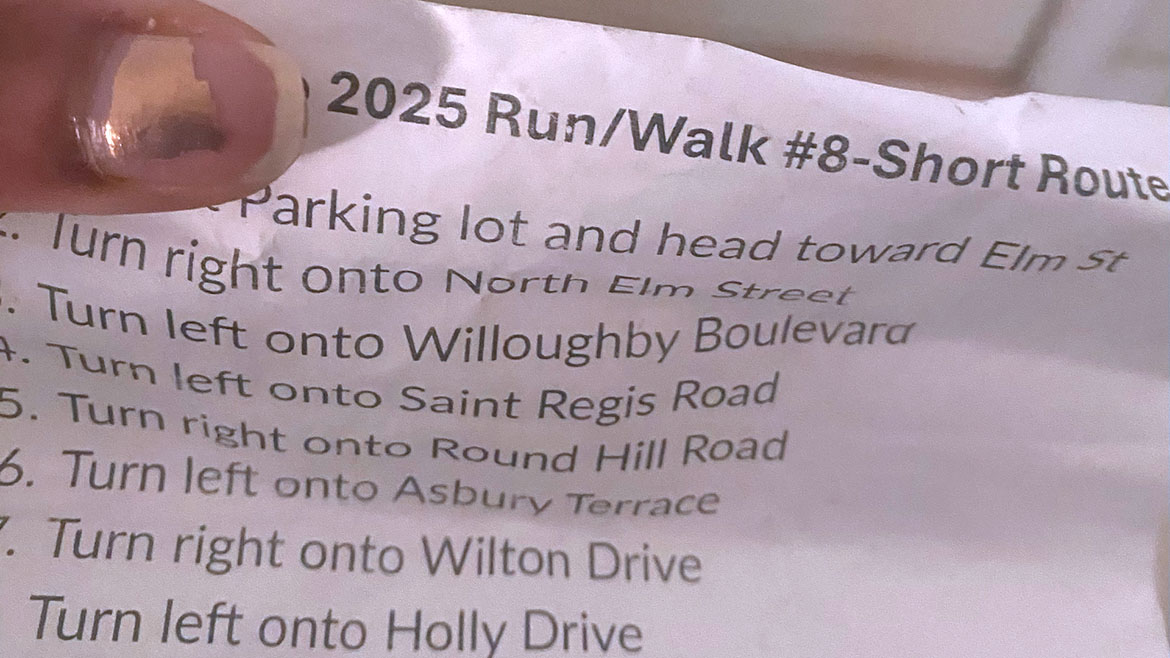
Well, I arrived late for one of these outings but was determined to get it in… Thankfully the host had these neat printouts of the route. Whew, maybe I can catch up and enjoy the sights while getting my miles in too! I dash away alone but equipped with the paper clinched in my left hand. I notice another person running behind me. I look over my right shoulder and she holds up the paper (route). Short route or long route? Short, I reply. She responds “long” and takes off. I continue with my mini atlas and hang a left into a glorious neighborhood. Now I lock eyes with the couple on the porch and one of them yells, “They went that way!” I’m like how do they know I am looking for the pack? Then I see the compass resting in my hand. I wave it at them and jog on until I see a small pack in front of me. I scan the group and then I crack a smile when I scope out the handy old guide in one of their grasps. Success. I am reunited with (part) of my tribe.
That experience made me realize that no matter what the mode (voice activated or manual), visual cues have utility beyond mere information. Visual cues represent a level one mistake proofing device, or an intervention design or process that helps to prevent errors [1]. The Japanese term is poka yoke. In what ways does mistake proofing contribute to consistent defect reduction? Moreover, how does this technique facilitate confidence and a favorable user experience?
Purpose of Mistake proofing
Mistake proofing is described as the optimal design or steps that prevent inadvertent errors or the warning indicators that alert the user before an error happens [2]. This technique has been promoted for over six decades and is grounded in the principle of preventive actions that influence first pass yield and increased customer satisfaction [2]. This technique tends to accompany changes implemented during the improve phase of a lean six sigma project or operationally – when a problem is identified, and a solution is required.
Before we consider the benefits of mistake proofing, teamwork must be done before mistake proofing is integrated in a process, part, or service. It is important to note that this technique just doesn’t happen without careful analysis of what could go wrong (risks). For example, brainstorming via the fishbone diagram, can be used to take a known problem and identify potential contributors. If needed, the team can expand their brainstorming by using the five whys or take the known problem and ask why until a potential cause that can be tested emerges [3]. Another tool is the failure mode and effects analysis or FMEA. The team examines the current process (or design – DFMEA) and identifies what can go wrong. The score (RPN) that is applied helps them discover what they need to focus their mistake proofing efforts on.
Benefits of Mistake proofing
When designed intentionally and connected to customer requirements, mistake proofing produces gains in efficiency, safety, and quality [2]. When it comes to efficiency, eliminating a step that is non-value-added such as waiting can improve metrics such as turnaround time. Depending on the process, safety can be enhanced or improved as well. This is significant for processes that are manual and repetitive in nature. Lastly, when products and services are completed right the first time, organizations tend to maintain customer loyalty.
What is cool about mistake proofing is that it tends to extend grace to customers by intervening so that the chances of making an error are mitigated or eliminated. I had the pleasure of experiencing this benefit – who knew that a piece of paper would have such an impact! This brings about another benefit of mistake proofing: it doesn’t have to be expensive or exclusive. It just has to work consistently.
Applying Mistake proofing
So how do we know what mistake proofing techniques to include in our improvement efforts? Well, it depends on what you aim to achieve and whether the technique will be added on or designed in. Let’s look at three ways mistake proofing is typically applied.
Level 1. The most simplistic application is through awareness. This can occur via signs or other visual cues. We use these all the time in our personal and professional existence. From online training modules to the stop sign on the corner, the aim is to give the customer useful information so that the steps they take reduce the chances their actions will produce an error.
That is exactly what my paper atlas did for me (see Figure 1). The simple step by step instructions not only informed me where to go but reinforced my confidence because I was alone. To add to the experience, others saw it and connected me to the pack despite my being separated from them!
Level 2. The next level is detection. An error is insight but hasn’t fully manifested. For instance, if you had a prescription filled, there are protocols built in that will block the fulfillment of the prescription if certain information is not received by the pharmacy. This prevents a prescription from being released to the wrong person (or the person getting a prescription that is not for them). While it may produce rework for the pharmacy, the customer is protected.
Level 3. The highest level is prevention. This is the goal of mistake proofing. This level echoes Deming’s quote: “Quality must be designed into the product, not inspected into it” [4]. An error is anticipated, and the organization has invested in avoiding inadvertent errors at the design phase. In the age of mass customization and quality 4.0, this level sets organizations apart in terms of the reliability of their products and services.

Let’s look at a scenario to frame level 3. People who live within walking distance to shopping centers take advantage of this amenity. They avoid transportation costs by walking to the area, make their purchases, and return. Shopping carts are instrumental in transporting their goods back home. After all, they are steps away from the parking lot where the carts are staged. The problem is that some of them push the carts home and don’t return them. The impact includes costs to the retail owners. In addition, the carts present a safety risk as they are not securely parked.
Notice Figure 3. This retailer responds to this phenomenon via mistake proofing. First, they include a courteous visual cue (level 1). The sign warns the customer of the cart’s limitations. It is a kind way of saying this shopping cart is not your vehicle. Hopefully the customer notices it. If not, they will find out. Well, I tested the sign. Apparently, the wheels on the cart are designed to lock when the cart is outside of the perimeter of the parking lot that is adjacent to the retail store. Prevention accomplished.

Conclusion
Mistake proofing is a multi-faceted technique that is available to all. Organizations should leverage their employees’ experience and imagination so that process and design improvements are reliable and sustainable. When mistake proofing is used in a thoughtful, customer driven, and practical way, the entire company benefits.
References
[1] American Society for Quality, “Quality glossary of terms”, April 24, 2024.https://asq.org/quality-resources/quality-glossary/m
[2] Trojanowska, J.; Husár, J.; Hrehova, S.; Knapˇcíková, L. Poka Yoke in Smart Production Systems with Pick-to-Light Implementation to Increase Efficiency. Appl. Sci. 2023, 13, 11715. https://doi.org/10.3390/app132111715
[3] Kubiak, T.M. The Certified Six Sigma Master Black Belt Handbook. ASQ Quality Press, 2012.
[4] OpenAI. (2025). ChatGPT (Version 4). {Link: https://chatgpt.com/?utm_source=google&utm_medium=paidsearch_brand&utm_campaign=DEPT_SEM_Google_Brand_Acquisition_NAMER_US_Consumer_CPA_BAU_Mix&utm_term=chatgpt&gad_source=1&gad_campaignid=21714513245&gbraid=0AAAAA-IW-UXHnHiRNgR0UjPtaOb22wI3K&gclid=EAIaIQobChMI4e2gyYODjgMVtTMIBR1pKgH0EAAYASAAEgLF-vD_BwE}.
Looking for a reprint of this article?
From high-res PDFs to custom plaques, order your copy today!