Artificial Intelligence (AI)
The #1 Skill for Quality Professionals
The future of quality is going to be AI-enabled — and the sooner you become fluent, the sooner you will lead the conversation instead of playing catch up.

A few months ago, I was giving a talk at the ASQ New Jersey Spring Quality Conference on AI Literacy in Quality. Lots of folks. Lots of engagement. Lots of questions.
Why were quality professionals engaged? Great question! According to a LinkedIn survey in March of 2025, AI Literacy is the fastest growing skill in the U.S. and in most of the world:
"Change is a constant in today's work landscape, as technological transformations upend ‘business-as-usual' and force companies and professionals alike to adapt. Artificial intelligence is at the forefront of this shift, and its impact is significant: LinkedIn data reveals that by 2030, 70% of the skills used in most jobs will change."
So, why does AI literacy matter to today's quality professional? This quote says it all:
"AI is the most important technology of our lifetimes, and we need to understand it." - Marc Benioff – Salesforce CEO
What is AI Literacy?
So, let's start at the beginning. What is ‘AI Literacy?' Google Gemini offers this definition:
"AI literacy refers to the ability to understand, evaluate, and responsibly use artificial intelligence systems and tools. It encompasses both technical understanding of how AI works, its applications, and its broader societal impact. Essentially, it's about being able to navigate an AI-driven world with confidence and critical awareness."
Several things are important about this definition. AI literacy has both a technical and social element. Technical are tools. Social are impacts on humans.
Also, AI literacy is often domain specific. What this means is that AI will disrupt lawyers and quality professionals differently.
What Are Drivers of AI Literacy?
Well let's look at two critical drivers of AI literacy:
- EU AI Act requirement for AI literacy.
- White House AI Literacy Executive Order
Most if not all products will have IOT and some form of embedded AI. If the product involves safety or critical infrastructure, the product will have to comply with Article 4 of the EU AI Act. This is where the AI regulations kick in. Companies with high risk AI systems such as employment, biometrics, and critical infrastructure need to comply with Article 4 on Ai Literacy. Article 4 requires.
"Providers and deployers of AI systems shall take measures to ensure, to their best extent, a sufficient level of AI literacy of their staff and other persons dealing with the operation and use of AI systems on their behalf, taking into account their technical knowledge, experience, education and training and the context the AI systems are to be used in, and considering the persons or groups of persons on whom the AI systems are to be used."
In the U.S., the White House issued the Advancing AI Education for American Youth in April 2015. The Executive Order states:
"Artificial intelligence (AI) is rapidly transforming the modern world, driving innovation across industries, enhancing productivity, and reshaping the way we live and work. To ensure the United States remains a global leader in this technological revolution, we must provide our Nation's youth with opportunities to cultivate the skills and understanding necessary to use and create the next generation of AI technology."
So, what do these approaches to AI mean for the quality professional? Opportunities and risks. If your company is designing, deploying or integrating AI into safety related products in the EU, you are going to have to comply with the Act. If you are in the U.S., then your kids are going to start learning AI in middle school or even elementary school. And it's going to be a bumpy ride.
Current State of the Quality Profession
World Economic Forum (WEF) each year has a critical mission focusing on the Future of Jobs Report 2025. Why? As you can see from the above LinkedIn quote, work, careers, and jobs are being disrupted globally. The disruption is both technical and social. And it is happening to our profession.
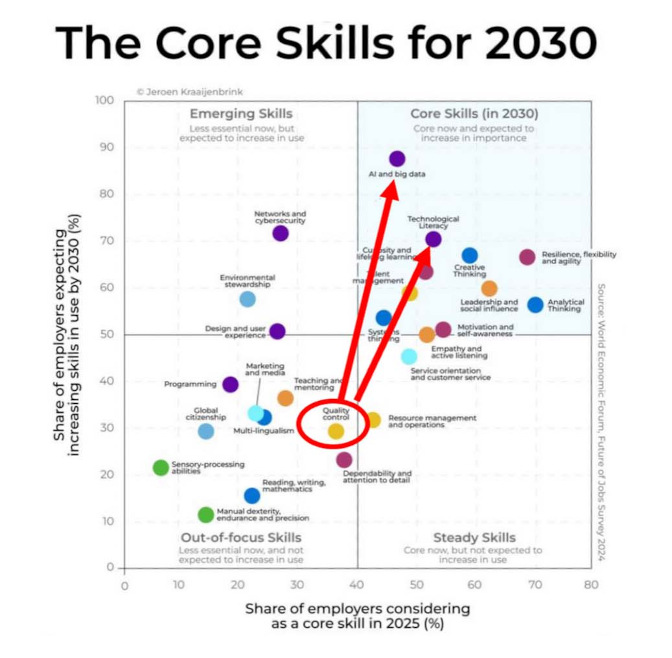
So what's happening to quality according to the 2025 Jobs report? Well unfortunately, quality seems to be going through a difficult time. Let us check out the above graph developed by WEF. The horizontal axis is ‘Share of Employers Considering as a Core Skill in 2025 (%)'. The vertical axis is ‘ Share of Employers Expecting Increasing Skills in Use by 2030 (%).' As you can see ‘Quality Control' is in the lower left ‘Out of Focus Skills' quadrant and is circled in Red.
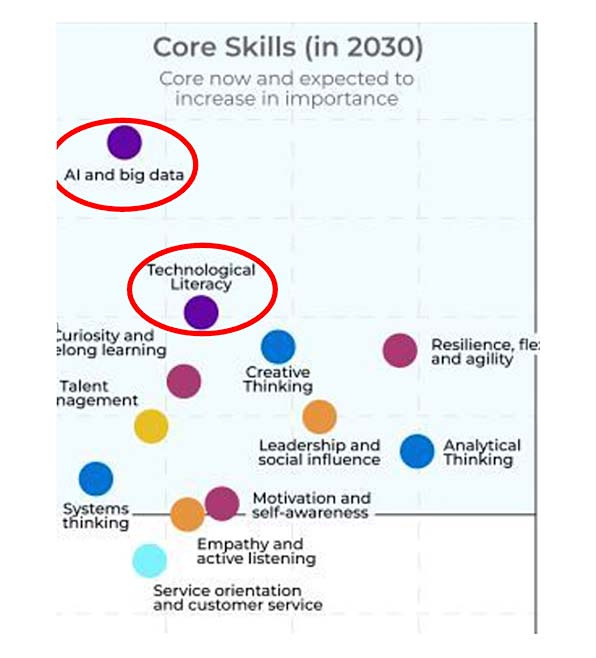
Where do we want to be? Quality Control preferably should be in the upper right quadrant called ‘Core Skills in 2030.' We want Quality Control to adopt AI and Big Data and Technology Literacy.' Both of these are key elements of AI Literacy.
What AI Literacy Means for Quality Professionals?
Most of us think that writing killer prompts is the essence of AI literacy. Yes, prompts are important, but there is a lot more to AI literacy that quality professionals need to know and do. Let us look at a few areas in the upper right quadrant:
- AI and Big Data: Big data is core to the work of quality professionals assuring that products meet standards and processes are capable and improving. AI tools are the way to manage, measure and make decisions based on big data.
- Technological literacy: Technology is the essence of our profession. AI can detect patterns in statical analyses, detect micro defects, and predict imminent product failures.
- Creative thinking: AI can hallucinate and go wrong in a big way. Quality professionals need to understand the limitations and uses of AI so they can detect and correct any hallucinations.
Your Next Steps
Check out the above figure to get a better higher resolution. Look at the upper right quadrant other core skills that will be needed. Then ask yourself three key questions that will impact your work, career, job, and revenue for the next 10 years:
- Where are you right now in the ‘Core Skills for 2030' figure?
- Where in the upper right quadrant do you want to be?
- How are you going to move to the upper right quadrant?
How to Move to the Upper Right Quadrant
A few killer tips: Start now. Start small. Learn fast. Stay curious.
The future of quality is going to be AI-enabled — and the sooner you become fluent, the sooner you will lead the conversation instead of playing catch up.
What to do NOW? Here are 10 things you can do today to move to the upper right quadrant:
- Learn risk management: You already know FMEA. Now learn enterprise risk management. Why? Every AI risk regulation, standard, and guideline is based on risk governance, compliance, and trust.
- Use ISO 31000 to solve a problem: Use the risk management framework to solve a quality problem you are facing by identifying boundary conditions, constraints, and assumptions.
- Use an AI tool to analyze process or inspection data. Many eQMS and inspection tools now have AI capabilities to detect anomalies. Use the tool to expand your capabilities as an AI quality engineer.
- Conduct a supplier evaluation based on risk: Most quality supplier evaluations are based on compliance to ISO standards, internal specifications, or drawings. You got that. Now, broaden your horizons and evaluate a supplier on total risk including cost, delivery, quality and schedule using a weighted average method in consultation with ChatGPT. Remember do not disclose any confidential information to the machine.
- Identify a possible bias risk in an AI quality application: Most quality products have AI smarts. Look at the product and see if you can find any social and/or technical bias risks.
- Understand how ISO 42001 can be used: ISO 42001 is the AI risk management system. It is new. Its use is going to escalate over the next 5 years. Purchase the standard from ANSI or your national standards body. Learn it. Use it.
- Conduct an AI pilot in your quality workflow: Identify a critical process with risks and controls. Use AI tools to automate the flow.
- Learn basic prompt engineering techniques: Writing prompts is now as easy talking through a problem. Now use prompt engineering to state a hypothesis and go through the logic flow to test it using sequential prompts.
- Integrate AI output into a root cause analysis: Use prompt engineering to find the root cause of a quality problem by using ChatGPT.
- Review a supplier AI compliance systems: Most suppliers are developing AI governance, risk, and compliance systems. Evaluate these against Colorado's AI statutes or against the EU AI Act.
Is My Company Going to be AI Disrupted?
After reading this piece, you are probably wondering if quality is really going to be disrupted. Our friends at WEF had a recent piece on ‘Why AI is Replacing Some Jobs Faster Than Others.' This quote pretty much explains what you should be doing:
"AI is basically like that kid in college who had access to all the old exams and study guides. Of course they're going to crush the test compared to someone scrambling with incomplete notes from a few lectures."
And what is the job market telling us?
"Some industries are drowning in useful data that AI can learn from. Others? They're working with scraps. The numbers are pretty stark. Industries with tons of good data could have AI adoption rates around 60-70%. Meanwhile, sectors without much data might struggle withless than 25%."
So, I cannot speculate on your specific company. But I do know the quality profession is drowning in data. AI loves data. And the quality profession is ripe for change and even disruption.
Your AI Future
AI won't replace you – at least not for now. But AI will definitely change what you do and how you do your job. AI will also change your career arc. There is a famous quote that goes something like this: "AI will not replace you, but a quality professional who knows how to use AI will."
Think of AI literacy in terms of learning a critical new quality skill such as lean six sigma or ISO 42001. The most valuable quality professionals and leaders of the next 10 years will be those who can merge deep quality knowledge and skills with the ability to use AI.
Think of it this way: AI literacy isn't just a skill upgrade - it's going to be your career assurance.
Looking for a reprint of this article?
From high-res PDFs to custom plaques, order your copy today!