Software
Why Committed Champions are Crucial for Effective Lean Six Sigma Deployment
Without the leadership of committed champions, Six Sigma teams lack the authority and resources necessary for project success.

Successful Lean Six Sigma (LSS) deployment begins with management leadership. Organizational leaders and operational managers are trained as LSS Champions. These Champions align the program with the organization’s strategic objectives by sponsoring projects in their functional areas, or co-sponsoring projects that span multiple functional areas. In sponsoring projects, they allocate and prioritize resources to the project teams, who report to them on an on-going basis throughout the life of the project.
Management-sponsored projects drive results
LSS projects provide the means to achieve the organization’s objectives, usually defined within their annual plans. Each objective is broken down into one or more cross-functional projects. Project team leaders provide regularly scheduled reports to their project sponsor(s), including at the key milestones coinciding with the completion of each stage in the DMAIC project management process. (See Figure 1 for descriptions of the DMAIC process). This reporting provides a continual oversight of an individual project and its contribution to the organizational objectives. Across multiple projects over time, the overall program effectiveness can also be clearly measured relative to the goals and objectives reflected in the annual plans.
|
Define Stage 8 days
|
|
Measure Stage 18 days
|
|
Analyze Stage 27 days
|
|
Improve Stage 27 days
|
|
Control Stage 8 days
|
Figure 1: DMAIC Stage Objectives with Example Time Estimate (Six Sigma Demystified: Second Edition, by Paul Keller. McGraw-Hill (2011)).
Each LSS project is executed by a carefully selected team, comprised of representatives from each key stakeholder group for the project. They have daily responsibility for producing output in their functional area (e.g. manufacturing, finance, purchasing, sales, etc.) and retain these positions and responsibilities, contributing to LSS project teams that impact their functional areas. They are chosen to participate in LSS projects based on their process expertise and their ability to work well in a team environment. This structure builds buy-in at the local level, in that each key stakeholder group is represented and contributes to the solution, rather than being a victim of the solution imposed externally. The local expertise of the participant builds credibility in the solution, and aids in achieving an optimal solution that considers all known risks and constraints. Projects that are scoped to include too many stakeholder groups will require an unwieldy number of team participants. Limiting teams to five to seven participants seems a good size for best team performance, which may reduce the scope of a given project.
Figure 1 includes time estimates (in business days) for each stage of DMAIC based on a four-month (88 business day) project completion time. Projects are typically scoped for completion within a three-to-six-month period. Longer project completion times risk loss of focus, momentum and interest. Since project development and analysis sessions pull operational workers from their day-to-day responsibilities, these resources must be prioritized and limited to project activities where team members can make valued contributions. Projects taking longer than nine or ten months can wear down the enthusiasm and commitment of the team and their sponsors and risk being “wrapped up” with sub-optimal results just for the sake of completion.
Conversely, projects must be scoped to achieve a significant benefit to cost, schedule and/or quality, often related to a specific business need such as new product development, cycle time improvement, capacity increase, market generation, etc. Traditionally, a minimum $100,000 annual return above and beyond the cost of project deployment (including labor) was required. The proper scoping of LSS projects is a critical consideration, which often improves within the organization over time. The project sponsors sign off on the project scope as a condition of their sponsorship in the Define stage. Projects are selected for sponsorship (and subsequent resource allocation) based on the anticipated benefit. It is not uncommon for the scope to be adjusted as new data is acquired in each stage of DMAIC, which might increase or decrease the anticipated benefit. Changes in scope are a critical reporting item that can and should affect continued sponsorship.
Training Needs
Without the leadership of committed Champions, Six Sigma teams lack the authority and resources necessary for project success, and the integration with key business objectives necessary for program success. Champion training sessions are designed to integrate responsibilities for Six Sigma deployment and on-going management into the leadership ranks as quickly as possible by building competencies, systems, and resources for full self-sustainability and growth potential. Successful Champion training includes workshops to achieve both immediate and longer-term outcomes, specific to the organization, which often include:
- Identify & mitigate potential stumbling blocks to the Six Sigma deployment.
- Align project selection criteria with critical strategic business objectives.
- Define methods for project sponsorship, approvals and verification of gains.
- Establish general goals for Six Sigma Leadership Team and metrics to gauge success.
- Evaluate human resource challenges and internal cultural issues; Develop communication plan.
- Define an implementation schedule.
- Define project objectives for initial training wave.
A typical deployment timeline is shown in Figure 2. Only after Champions have been trained, and the outcomes described above sufficiently realized (especially (g), regarding initial project selection), can the team members begin their training. Training for these participants is done on a just-in-time basis, coinciding with their participation in a specific LSS project. The project team is trained using their assigned project as a training aid to learn the necessary skills for project completion. Training follows the DMAIC cycle, so participants develop the project as they proceed through training, applying their new skills to the specific project at hand, strengthening their understanding and comfort with the tools and techniques. A purely academic seminar-style environment is a poor substitute for this real-world real-time application of the skills, and risks students losing retention of the material content. Online training has some benefits, such as 24/7 availability of the training material, which helps students learn at their own pace and work around daily commitments. The flexible scheduling of each topic allows for better integration of the training topics with the project development, by allowing time between sessions for critical project activities, such as data collection and team problem-solving meetings.
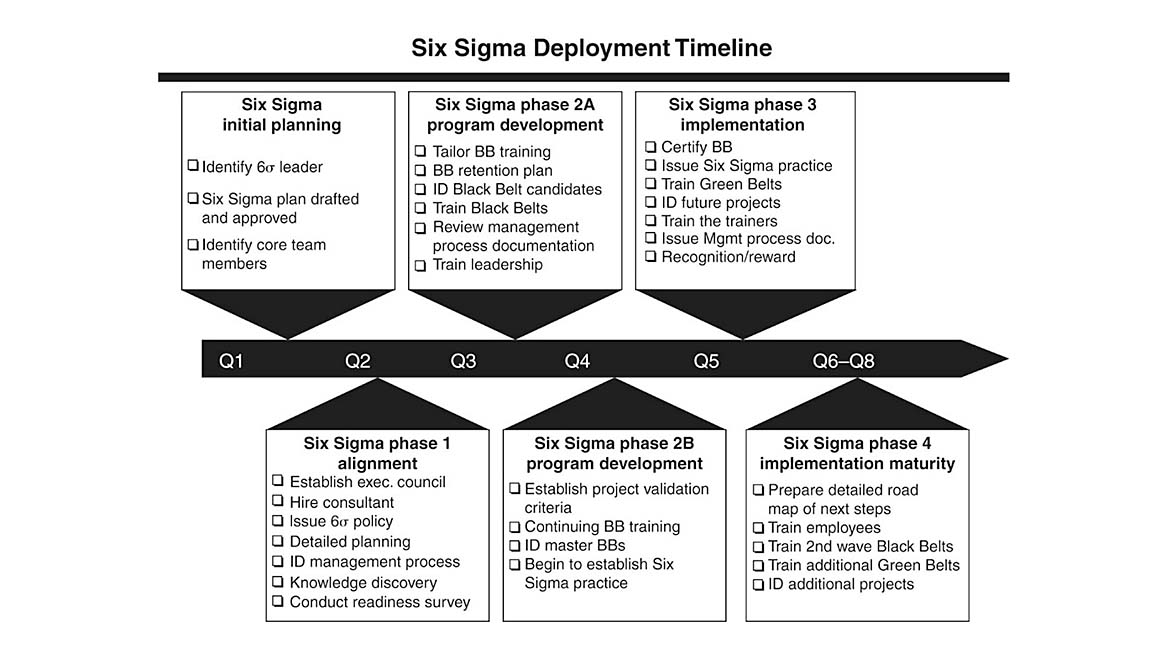
Figure 2: Lean Six Sigma Deployment Timeline (The Six Sigma Handbook: Sixth Edition, by Thomas Pyzdek and Paul Keller. McGraw-Hill (2024)).
Operational personnel participating in LSS project teams are trained as LSS Green Belts. An example Green Belt training outline is shown in Figure 3. Each of these topics is scoped for a 90-minute presentation, followed by a workshop. In addition to the three initial LSS overview topics, the course work is heavily focused on the project definition (four topics) and their role in team problem solving. The SPC (statistical process control) tools in the Measure Stage and the Lean tools of the Analyze stage are emphasized, since they will be heavily used not only during these DMAIC phases but also within their operational roles in the Control stage and beyond as process monitoring and maintenance tasks.
- Benefits & Comparisons.
How to Deploy Six Sigma
- Roles, responsibilities, resource allocation.
Six Sigma Projects
- Project Focus, Selection & DMAIC method.
DEFINE: Project Definition
- Project Charter, scoping, reporting.
DEFINE: Metrics & Deliverables
- CTC, CTQ, CTS Metrics, incl. Sigma, Cycle Efficiency, Velocity, OEE.
DEFINE: Project Scheduling
- Critical Path, PERT, GANNT.
DEFINE: Change Management / Teams
- Team Formation, Rules, Responsibilities, Consensus Tools.
MEASURE: Tools & Objectives
- Process & Metric Definition.
MEASURE: Process Baselines
- Control Chart requirement to measure baseline.
ANALYZE: Tools & Objectives
- Value-Stream Analysis, Level Loading, setup reduction.
ANALYZE: Regression Analysis
- Cause & Effect, Scatter, Linear models, DOE intro.
IMPROVE: Tools & Objectives
- Prioritization, lean improvement, failure mode mitigation.
CONTROL: Tools & Objectives
- Control Plans, maintaining improvement.
Figure 3: Green Belt Training Topics (www.qualityamerica.com).
LSS Black Belts are set up as full-time change agents, eventually working two to three cross-functional projects at a time at varying stages of DMAIC, spread across the organization. Their 200-hour training includes all the Green Belt topics plus advanced topics spread throughout the Measure, Analyze and Improve stages, including SPC implementation and analysis, experimental design, multivariate analysis, simulation and optimization. Although this expertise is often needed, it is more often not sufficient. The best Black Belts excel at team facilitation and communication. These skills, as well as their lack of daily operational responsibilities, provide the foundation to lead the team though the DMAIC cycle in the time scales discussed above.
Some organizations train experienced project managers as Green Belts and use them as LSS project team leaders. This can work if the team includes a Black Belt to oversee the analysis, and the Green Belt team leader has management support to commit the time needed and avoid excessive project duration.
Looking for a reprint of this article?
From high-res PDFs to custom plaques, order your copy today!