Automotive
Conveyance Systems Adapt to Meet Automotive’s Changing Demands
Electrification is reshaping assembly lines in real time.
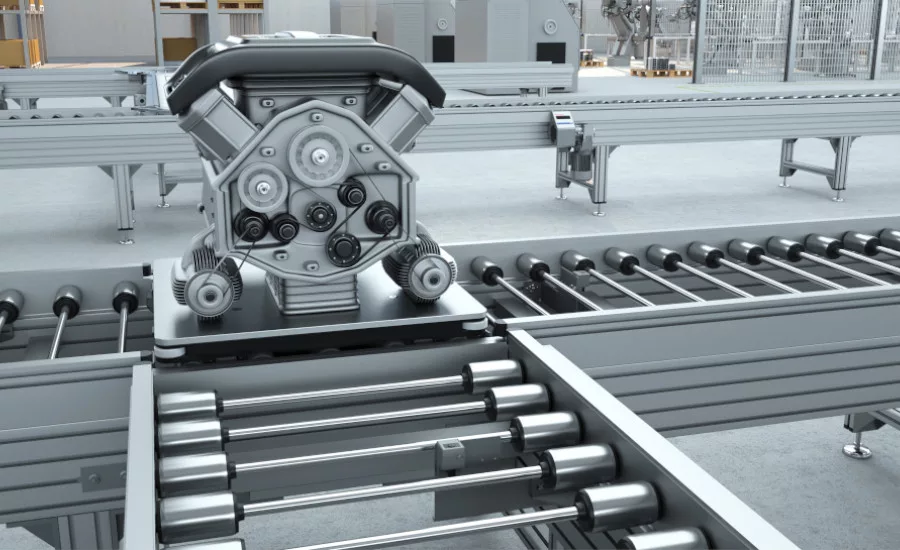
Conveyance has always been central to automotive production. Every vehicle component, from a small subassembly to a complete powertrain, depends on reliable movement through the factory. What is changing today is not conveyance’s role, but the demands placed on it. As automakers accelerate the shift to electric vehicles, adopt new lightweight materials, and push toward greater customization, conveyors are being asked to do more than simply move parts from station to station. They must handle wider payload ranges, support faster takt times, and integrate with increasingly digital, flexible production environments.
Matching Conveyance to the Task
Something that has been consistent with my experience in dealing with vehicle manufacturers is the need for matching the proper conveyance system to the job. A light-duty subassembly conveyance system will not cut it in heavy-duty drivetrain assembly, and vice versa. Manufacturers thus rely on conveyors with different loads, ranging from light systems to heavy-duty platforms that can handle transmissions, engines, or even whole battery modules.
For example, lighter systems are often found in electronics or interior assembly, where payloads are small, but precision is critical. Mid-range conveyors handle powertrain components such as engines or motors, while heavy-duty systems carry assemblies weighing several hundred kilograms. More recently, platforms designed to move loads in the tonnage range have become essential in EV production, where large battery modules must be moved safely and consistently.
Matching system design to the task is not just about capacity; it is also about ergonomics, line layout, and the interaction between workers and equipment. A conveyor that handles the weight but is difficult to load or unload can slow the process and increase operator strain. Manufacturers are therefore looking at conveyance holistically with equal parts payload, precision, and human factors.
High-Speed Conveyance Options
Traditional conveyor systems move at speeds of around 18 meters per minute. In many applications, this is sufficient. But in recent years, I’ve seen more manufacturers ask about higher-speed options to keep up with production demands.
That’s where the most advanced conveyance systems come in. These technologies can move parts up to 10 times faster than conventional conveyors, while maintaining a high degree of accuracy and repeatability. This allows assemblies to reach the next station almost immediately and ensures processes like pressing, sealing or welding happen within tighter tolerances.
Of course, speed is only one factor. Linear systems require more investment and infrastructure, so they are best suited for applications where throughput and accuracy gains outweigh the cost. In EV battery production, for instance, where a delay in one module can impact the takt time of an entire pack, the ability to move components rapidly and precisely can make a real difference. On the other hand, for simpler or lower-volume operations, a conventional conveyor often remains the best solution.
Supporting the Shift to Electrification
Electrification is reshaping assembly lines in real time. Conveyance systems that once carried engines or transmissions are now being asked to move battery packs and electric drivetrains. These loads can be both heavier and more delicate, requiring conveyors that combine high payload capacity with careful handling.
In recent projects, I’ve seen battery pack conveyance require a different approach than conventional engines. A pack may weigh upwards of 1,000 kilograms but also contain sensitive electronics and cooling systems. Conveyors need to move that weight smoothly, without jarring, and often with integrated positioning to support subsequent assembly or testing.
The industry is also struggling to meet diversified production. Vehicles today are producing internal combustion and electric vehicles. Machines able to handle more than one type of payload or reconfigure within a few minutes are becoming the norm. Instead of having a whole line dedicated to one product, manufacturers are producing flexible lines that can adapt as the product mix changes.
Digital Engineering and Simulation
Another trend I’ve witnessed is the growing use of digital tools to validate conveyance decisions before equipment is installed. Simulation software allows manufacturers to test how a proposed system will perform, confirm takt times, and anticipate bottlenecks.
In one case, a customer was evaluating whether to expand a mid-capacity line or invest in a higher-capacity platform to prepare for EV components. By simulating both scenarios, they were able to see where bottlenecks would occur and make a more confident decision before investing capital.
It reduces risk and helps ensure the chosen system will meet the needs of both today’s production requirements and tomorrow’s. Simulation further extends this capability, allowing automotive engineers to test and refine conveyance in a virtual environment before committing to physical layouts.
Workforce Considerations
Conveyance is also part of the workforce equation. In many plants, operators interact directly with these systems, whether by loading parts, inspecting assemblies, or managing takt times. Appropriate conveyance can reduce strain, improve ergonomics, and allow employees to focus on higher-value tasks rather than manually moving heavy assemblies.
The ongoing labor shortage in manufacturing makes this even more critical. Systems that improve operator efficiency and safety contribute not only to throughput but also to workforce sustainability. I’ve also seen how cultural acceptance plays a role. When teams understand how new conveyance systems support their work, rather than replace it, the transition is smoother, and productivity gains are realized more quickly.
Conveyance and Efficiency Over Time
Another area of focus is reducing energy use and material waste. Automakers are under pressure to improve efficiency across production, and conveyance systems are part of that equation.
Energy-efficient motors, modular platforms that can be reconfigured rather than discarded, and conveyors designed for longevity all play a role. In EV production especially, where sustainability is both a product goal and a manufacturing mandate, conveyance decisions increasingly factor in lifecycle impact.
Looking Ahead
Conveyors may not always attract the same attention as robotics or advanced automation, but they remain the backbone of automotive assembly. What’s changing is their role: from passive carriers to active enablers of speed, flexibility, and precision.
As the industry balances electrification, sustainability, and global competition, conveyance will continue to adapt. Whether through higher-capacity platforms, linear motor technology, or digital engineering, these systems will remain fundamental to building the vehicles of tomorrow.
For manufacturers, the key will be evaluating not only payload and speed but also integration with digital tools, ergonomics for operators and the flexibility to adapt as product mixes change.
Looking for a reprint of this article?
From high-res PDFs to custom plaques, order your copy today!