VIDEO PODCAST | Connected Frontline Workers
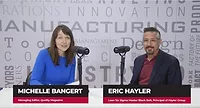
Michelle Bangert talks with Girish Gopalakrishnan, North America senior manager of continuous improvement at Case New Holland, about connected frontline workers at The Assembly Show in Chicago.
Michelle: So, can you tell our audience, how did you first become involved in quality?
Girish: Yeah, it's been a journey. I was just talking at the booth here about my certification journey, how I started out as a national engineer, and really understanding about how things work and how do you optimize the production, improve productivity, and improve safety.
And also, I kind of get into the quality realm of, okay, how do you improve the customer satisfaction, right? How do you design a product or design a process that can help the customer's needs?
That's when I got more involved. I had amassed a few certifications and coming from a background of, with a graduate degree in industrial engineering, I really wanted to get into the quality side of the business with continuous improvement.
I am master blackbelt certified. So, that kind of gave me a lot more ability in terms of tools, lean tools, Six Sigma tools, coaching, mentoring, and helping people grow as well, as part of this journey.
Michelle: I know you said your sessions went well. Could you tell us a little bit about those today?
Girish: At my first session I talked about how we, the connected frontline workforce, is a solution these days that can help propel industries and really get them what they need.
So, what do I mean by connected frontline workforce? It is it is a collection of digital technologies that can help our operators, our frontline workers, become more engaged where these technologies help track the processes in terms of finding anomalies, saying that, hey, there's something going wrong, and also working with the operators and understanding what can we do to fix the problem right away?
Because the more quickly we can fix the problem, it doesn't go further downstream and affect the customer. In this way, the autonomy is in the operator's hands, right? We empower them, we engage them. But, and using the cutting-edge technology, that we have here [at the show], a lot of the service providers here today, like tooling providers, they [know] how they can be integrated into the process, such that the operators can be more autonomous so they don't have to stop the line in order to fix the problem. But then they are trying to work with the process and then interact with the system and thereby improve the quality of the process.
Listen to the Full Podcast Here:
Looking for a reprint of this article?
From high-res PDFs to custom plaques, order your copy today!