Test & Inspection
Ergonomics, Accuracy, and Throughput: Why Quality Teams Are Turning to Cobots
By using cobots, throughput can be increased without forcing human inspectors to rush the inspection process.
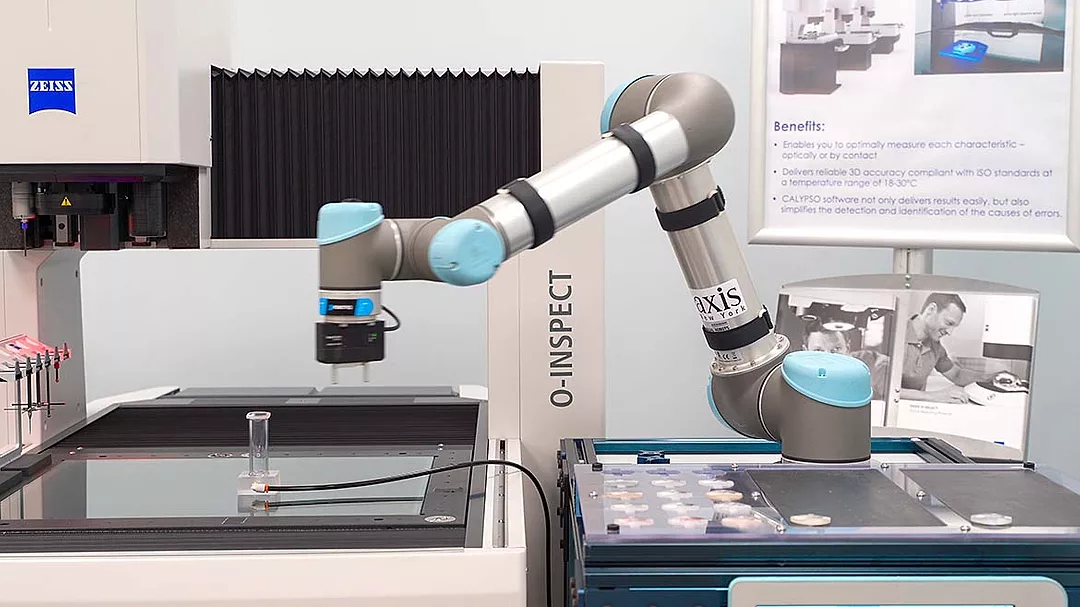
Easily redeployable and versatile workers, collaborative robots like this UR7e are often utilized for presenting and positioning parts for review by quality inspection machines and are able to tend these machines either with a worker nearby or completely lights out.

In this application, integrated by 3D Infotech, a technician is utilizing a UR7e holding a 3D scanner to automatically inspect the part on the workbench.

At BSH Hausgeräte, a MIRAI-controlled UR12e takes over the previously manual task of checking the metal pipes of refrigerators for leaks. The UR12e is driven by MIRAI which is a vision-based control system utilizing AI to allow industrial robots to deal with variance in position, shape or movement.

Thyssenkrupp Bilstein deployed UR10 cobots from Universal Robots on a range of tasks, including key inspection processes. The deployment not only helped the company achieve 100% parts inspection and enabled it grow without hiring extra staff – it also improved ergonomics and delivered ROI within 1-14 months. “Cobots are definitely a quicker return of investment than traditional robots,” says Aldo Albieri, Operations Manager, Thyssenkrupp Bilstein.
Any conversation about automation and quality has to start with an acknowledgment that robots inherently improve quality. Robots produce more consistent work than humans. They don’t get tired. They don’t drift off path. And they don’t accumulate errors as shifts progress.
As a natural consequence of the physical and mental load associated with many assembly and quality inspection tasks, humans make errors. By contrast, robots can repeat the same motion tens of thousands of times without a single mistake. In quality-sensitive applications, this consistency is key.
But not all robots are the same. Traditional automation with or without a robot requires guarding or fencing, typically has a larger footprint, is costly and complex to program and, crucially, is not built for collaboration with humans, but is designed to replace them.
By contrast, collaborative robots (‘cobots’) are industrial robots that have a smaller footprint, are easy to program and can—following a risk assessment—be deployed beside humans without fencing. Crucially, cobots are designed to empower humans in these workbench automation tasks and one of the major ways cobots do that is by improving ergonomics, including in assembly and quality inspection roles.
Moreover, in diverse industries from machining, automotive and aerospace through medical device, appliance and general manufacturing environments, improving ergonomics leads to improved quality outcomes downstream. And cobots are increasingly central to that shift, due to their flexibility, human-friendly size, and usability.
Small ergonomic wins deliver large quality impacts
Quality inspection often requires repetitive, focused work: placing parts into metrology equipment, positioning components under a vision system, or carrying out dozens of near-identical measurements using calibrated tools or a potentially heavy and expensive handheld scanner. Fatigue can creep in near the end of a shift, and even small lapses of concentration can impact measurement accuracy.
With the quality and inspection role facing labor shortages, it can be difficult for companies to take on extra work requiring inspection, especially with current staff already being under pressure and new quality roles being hard to fill.
This challenge drove thyssenkrupp Bilstein, a major suspension manufacturer based in Hamilton, Ohio, to integrate four cobots into the tending portion of its quality process. The cobots perform gage inspection and check the post-fill crimp and final parts assembly. “When we did the gage inspection before, we would check two parts every one or two hours to make sure we were still where we thought, but now we have 100 percent inspection,” says Doug McIe, manufacturing engineer at thyssenkrupp Bilstein.
One of the cobots is equipped with a camera and moves swiftly between inspection points to make sure that all components are in the right position and that the label is applied correctly and is readable.
“Every single part that comes is checked and if it fails, the robot actually rejects it in the process,” explains McIe. Automating this step reduced operator fatigue, created a more stable, predictable inspection flow, and enabled Bilstein to grow its business without having to find and train new staff.
Protecting expensive inspection equipment—and the people who use it
High-end 3D scanners can cost $20,000 or more. Traditionally, operators hold these scanners manually for extended periods while slowly moving around a part, building a 3D model point by point. The devices may seem easy to lift at first, but across an entire day can be exhausting. Arms fatigue. Grip strength varies. A brief lapse can lead to sub-optimal scans, inconsistent point clouds, or—in the worst case—dropping and damaging an extremely expensive and calibrated instrument.
Mounting handheld sensors on a cobot relieves the human worker from this physical and tedious task, ensuring a repeatable scanning path, and protecting expensive equipment from damage thanks to cobots’ built-in force-limiting features.
A Tier 1 automotive supplier that once relied on manual, high-precision 3D scanning over two shifts, decided to automate that process using a scanner mounted on a cobot arm. The deployment resulted in higher inspection throughput, more dimensions measured, and more live SPC reporting.
Meanwhile, there is a 12-axis cobot-based system that enables fast and accurate inspection in long reach positions that are difficult and unergonomic for humans.
No human wants—or needs—to hold a heavy scanner above shoulder height for four straight hours. From a quality standpoint, repeatability and path stability matter: the robot follows a consistent trajectory every time, which reduces noise in the scan data and supports higher measurement accuracy. Shifting that role to a cobot also means happier workers.
Tending metrology equipment: throughput without haste
In machining environments, particularly aerospace, defense, and medical device manufacturing, coordinate measuring machines (CMMs) and similar metrology systems must validate every part. With batches reaching into the hundreds, this means operators repeatedly loading and unloading equipment, referencing drawings, and verifying points one by one.
When a collaborative arm handles parts, performs pick-and-place or tends a machine, the variance that comes from human boredom and fatigue drops immediately. The cobot can execute the same motion, with the same timing, every cycle. This lowered variability means your quality technicians can be utilized for more important and value creating tasks in the organization.
One mid-sized manufacturer used a cobot-based system to automate the positioning, scanning, and measurement of high-mix components using a multi-robot cell. Two cobots equipped with vision systems can move through more than 100 inspection points in under 60 seconds—faster than a human could safely or accurately repeat. In tandem with cobots working on assembly and other tasks, the deployment helped the company grow its revenue by 230%.
“The collaborative nature of the UR robots allows us to put these expensive pieces of technology on the end of the arm and have that confidence that the robot isn’t going to run into something and damage the end-of-arm tool. That peace of mind that we get—I don’t even have words for it. It’s incredible,” says Michael Crowley, director of automation at 3D Infotech.
By using cobots, throughput can be increased without forcing human inspectors to rush the inspection process. Automating the physically demanding and boring elements of inspection removes that pressure—and the associated increased risk of error—entirely.
Making quality roles more sustainable—and easier to fill
Most quality departments have a small team supporting large production volumes. Skilled inspectors are difficult to hire and retain, and younger engineers are often deterred by the prospect of spending full shifts carrying calipers, gages, or heavy handheld devices.
When cobots load equipment, hold tools, or handle the repetitive parts of inspection processes, quality professionals can focus on interpreting results, handling exceptions, and improving processes. Freeing humans from repetitive manual work not only stabilizes quality output but makes the role more intellectually engaging.
Vision as part of the ergonomic equation
Cobots are rising in popularity to support vision-based inspection processes. Mounting cameras on cobots removes the need for operators to repeatedly reposition parts or for manufacturers to make dozens of fixtures or tooling for all the variants to be inspected. And while the cobot performs the camera positioning, the operator can manage exceptions, review data, or focus on higher-value analysis.
While production quality always makes a good start by incorporating automation, the real benefits for quality professionals are due to the ergonomic benefits, such as reduced physical and cognitive workload—and those benefits can only come from cobot-based solutions. And for managers, better ergonomics means better measurements and fewer defects making it to the customer. When company investments include high-value tools, such as handheld scanners, metrology systems, and calibrated instruments—all of which can now be mounted onto robot arms—cobots also protect the equipment itself.
Looking for a reprint of this article?
From high-res PDFs to custom plaques, order your copy today!