Vision & Sensors | Cobots
Collaborative Robots Emerge as Viable Automation Options for SMEs
Benefits and key steps for a successful system design and installation
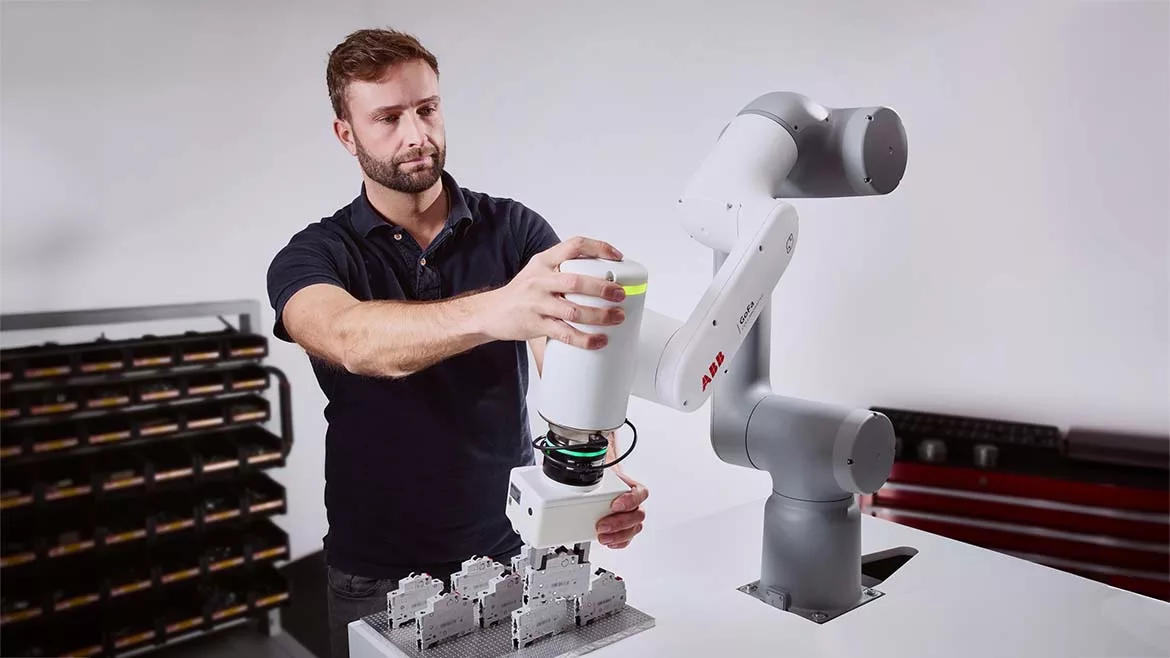
All Images Source: ABB Robotics
Collaborative robots (cobots) represent a significant milestone in robotic automation for their ability to work alongside human beings. Easy to install, program and operate, they offer safe performance with no need for cages or safety fences, helping to lower the barriers for small- and medium-sized enterprises (SMEs) to automating their operations.
Before cobots, industrial robot cells were big machines that needed to be kept behind secure safety fencing, requiring a time consuming process to interrupt production and enter a cell. In essence, industrial robots were most suited to larger companies that had the resources to hire dedicated robot programmers and operators. As time went on, people with these skills were hard to find, and if they left the company or were absent for any reason, production levels fell off for periods of time.
No robot can replace a person. But often, people are forced into robotic jobs – dull, dangerous, or repetitive tasks. The increasing capability, autonomy and intelligence of collaborative robots to handle such tasks can free employees up for more fulfilling work and contribute towards a happier, safer and healthier society.
Now, more than ever, businesses of all sizes need to embrace the flexibility afforded by robotics to efficiently adapt to low volume, high mix production cycles in the face of unprecedented supply chain backlogs and labor shortages.


What Makes a Robot Collaborative
For a robot to be considered collaborative, it must have the necessary safety functions which prevent injury to a human operator. This means factoring in the robot’s speed, the combined mass of the robot, its payload and the ability of the robot to quickly come to a halt. Built-in safety features, therefore, are the primary point of differentiation between collaborative robots and standard industrial robots.
Leading collaborative robots incorporate a range of features that allow it to be used directly alongside human workers without the space and expense associated with physical barriers or fences. Enabling a robot and human to continuously share the same workspace and cooperate on the same tasks, without jeopardizing speed and safety, allows for maximum flexibility and efficiency.

Flexibility and Ease-of-Use
Enabling people and cobot to safely share the same workspace creates maximum flexibility and efficiency. It means that the production line doesn’t have to stop for a worker to approach the robot for example to feed parts, or a person can work on one task and then hand a component over to the cobot to complete the next task. You can have the robot do simple or repetitive tasks, while the person does the value-add work that is hard for a robot to manage.
Smaller, lighter and inherently more portable than industrial robots, cobots are easy to install and move freely around a factory whenever and wherever they are needed. And with a compact footprint, cobots can be added to existing production lines without changing the entire process layout, especially to existing manual production lines, where larger automation cells are difficult to fit into tight spaces.
The newest collaborative robots are intuitive, easy to install, and operate, requiring little or no prior robotic programming knowledge or training. Lead-through programming, an even more simplistic programming method available with many of the newest cobots, allows users to program a robot by physically guiding to robot arm through the desired process.

Key planning steps to successfully installing collaborative robots
While collaborative robots are easier to operate than industrial robots, there are still important considerations that must be addressed in the planning stages, prior to identifying and installing the proper automation system for the desired application(s).
The following steps will help pave the way for a successful and productive collaborative robot system design and installation.
Make sure cobots are right for your application
Cobots are ideally suited for applications that require an operator to frequently interact with the robot, like in the case of high mix, low volume production runs. Though cobot reach and payload capacities have grown and are expected to continue to, there are still factors that would eliminate a cobot from consideration.
Traditional industrial robots are better suited for very complex operations or processes requiring high speeds to achieve the necessary throughput, handling heavy objects and working in extremely hazardous or dirty environments. Using cobots in these situations is likely unfeasible and should be avoided.
Proceed gradually, ensure employee buy-in
It is very helpful to make sure employees fully buy-in to the installation of robots. If employees are accepting of the solution and see it as making their jobs and lives easier, then the implementation is easy and safe. If the employees are fearful of the new technology or just change in general, then the implementation will be much more difficult, and potentially not as safe.
It is generally advisable for an organization to automate a fairly simple process, one potentially that could relieve a manual operator from handling an overly repetitive or dull task. This will allow the manual operator to be moved to a more fulfilling job, and will help employees see the benefits of bringing robots onto the scene.

Determine the scope of the system
Any organization adopting cobot automation must be careful to thoroughly define the structure and motion of the task that a newly installed cobot is to do on the production floor, especially if it is something that a human has traditionally done. People accomplish complicated tasks very easily, and when you automate these tasks it is very easy to miss when an operator re-orients a part, or looks to see what side of the part has a specific feature that allows proper positioning – or quality control.
Plan how the system fits into your production flow
Have a clear idea of what you want the automation solution to do, whether it is moving objects from one point to another or assembling parts of a product, etc. Plan how the system shall fit into your overall production flow, and define the intended use of the cobot and how it will work with your existing personnel.
Consider the installation environment
Consider the environment in which the system is going to be installed. The risks associated with a cobot application depend on whether it will be situated in a populated or a controlled area, on obstacles in the immediate environment, and on the periphery that is part of the system.
Identify the level of collaboration
Identify the level of collaboration required between the cobot and humans. A useful classification is according to the categories:
- Co-existence: Fenceless robot, no workplace sharing
- Intermittent Collaboration: Infrequent sharing of workspace
- Cooperation: Continuous sharing of workspace
Consult an expert
For more complex installations it is beneficial to consult a robotic systems integrator. System integrators are independent companies that work with you to understand your existing capabilities and processes; determine how automation can provide the maximum benefit to your efficiency, productivity and overall operations; and customize a system to your needs. Quality robotic integrators provide focused expertise in designing, implementing, operating and maintaining your robotics system to achieve the desired productivity.
System integrators will have access to advanced tools, like offline simulation and programming software, which allows very realistic simulations to be performed, using real robot programs and configuration files identical to those used on the shop floor.
In addition to helping identify the relative positioning of each robot based on their footprint, reach and payload, the software is able to select and position all other line components, such as conveyors and other fixtures needed to perform the various line processes. As a system simulation is developed, software can identify any potential bottlenecks and calculate accurate space requirements and cycle time metrics that the system concept would deliver if actually installed on the plant floor.
With software, companies are able design the optimal cell layout and verify its performance before integrating the robots in a particular operation.
Overall, hiring a robotic automation system integrator can help businesses leverage advanced technology effectively, improve operational efficiency, and achieve sustainable competitive advantages in their respective industries.

A list of qualified Robotic System Integrators can be found through either of these resources:
Looking for a reprint of this article?
From high-res PDFs to custom plaques, order your copy today!