Test & Inspection
Scaling Battery Production: The Growing Importance of Quality Assurance and Multi-Modal Inspection
How small, incremental advancements in process quality directly contribute to significant bottom-line benefits.
The global battery market is entering a phase of rapid industrial scaling, but growth alone does not guarantee efficiency. Valued at USD 181 billion in 2025 and expected to reach USD 432 billion by 2034, the sector is expanding at a compound annual growth rate (CAGR) of 10%.
While Asia Pacific is currently dominating the market with a 67% share in 2025, growth is not confined to Asia. A number of significant projects are under development worldwide. These include a USD 4.3 billion factory in the U.S., a collaboration between Tesla and LG Energy Solution that primarily focuses on stationary energy storage solutions. CATL, a Chinese giant, is also investing approximately USD 8.55 billion in a plant in Hungary, aiming for a substantial 100 GWh capacity.
However, as production volumes rise, quality assurance and yield optimization are becoming critical constraints that will ultimately determine profitability.
The economic impact of quality and efficiency becomes particularly clear at scale. In such a rapidly expanding and capital-intensive industry, maintaining stringent quality control and optimizing production efficiency are not just operational best practices, but critical drivers of profitability.
Take, for instance, a large-scale factory in Eastern Europe producing NMC battery cells. A seemingly minor 2% increase in production yield, elevating it from 94% to 96%, can drastically reduce material waste and rework. This subtle improvement translates into a substantial cost reduction of USD 1.2 per kilowatt-hour of batteries produced. For a facility operating at a target output of 20 GWh annually, this efficiency gain can lead to impressive annual savings of USD 240 million.
This demonstrates how small, incremental advancements in process quality directly contribute to significant bottom-line benefits, underscoring the indispensable role of meticulous inspection and quality assurance in battery manufacturing.
The Evolving Challenge of Battery Quality Assurance
Despite the immense economic incentives for robust quality, the manufacturing of lithium-ion batteries presents a formidable inspection challenge. EV batteries are difficult to produce at gigafactory scale and cells are very sensitive to minor production variations. Many anomalies that occur in production are minor and within acceptable tolerances, but some have potential implications for performance or safety and the battery industry has already witnessed highly visible safety issues.
The defects can occur at various stages, from initial material processing such as electrode production – one of the most cost-intensive steps in cell manufacturing – through cell assembly to final finishing processes like electrolyte filling and formation.
While advanced industrial X-ray and computed tomography (CT) systems play a critical role in quality control and failure analysis – detecting issues such as electrode defects, delamination, foreign particles, and tab anomalies – they are typically applied only in R&D, at the end of the production line, or in at-line inspections of samples per batch.
As a result, defects may pass through multiple costly process steps before being identified, if they are identified in the factory at all. This reliance on end-of-line and sample inspection increases the risk of undetected flaws, potentially leading to safety issues, performance losses, reduced lifetime, and costly recalls at gigafactory scale.
The Rise of Multi-Modal Battery Inspection
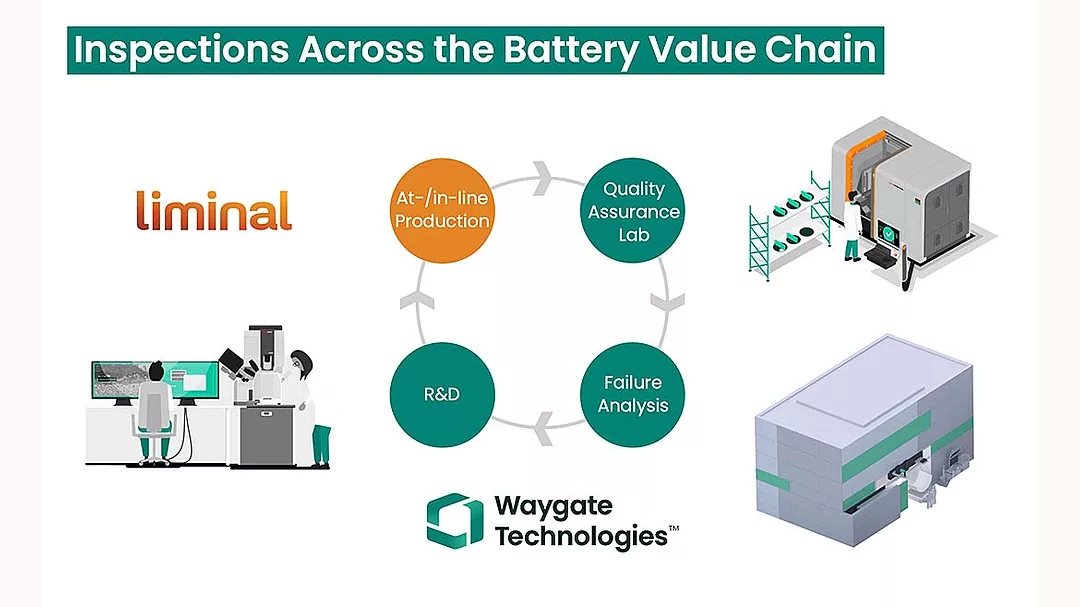
To overcome this inherent delay and enhance manufacturing efficiency, a pivotal hypothesis in the industry proposes a shift towards earlier, more integrated defect detection incorporating various nondestructive testing (NDT) methods. The core idea is to combine continuous, in-line ultrasonic (UT) scanning during the production process with comprehensive CT scanning in the research and development as well as materials evaluation phases, at the end of production, and during failure analysis. This strategy aims to identify anomalies significantly earlier in the manufacturing flow. The detailed data gleaned from such a combined approach empowers manufacturers to promptly update processes, leading to improved yield rates and overall product quality based on findings much earlier in the production cycle. This integration necessitates a robust digital platform for seamless data ingestion and analytics, transforming raw inspection data into actionable insights.
The implementation of this multi-modal inspection strategy involves collecting and comparing various data streams. In-line ultrasound can be employed at multiple insertion points along the production line for 100% inspection of cells and continuous process monitoring, effectively identifying outliers and potential risks related to process stability or drift. This real-time ultrasonic data acts as an early warning system. Concurrently, end-of-line CT data is utilized to validate the findings from the in-line scans, providing precise defect characterization and interpretation. By integrating this rich inspection data with process data, manufacturers gain the essential context and control needed for effective defect management. This comprehensive data triangulation ensures that observable defects are thoroughly characterized and complementary inspection methods continuously confirmed, ultimately driving continuous improvement and elevating battery quality.
Case Study: Waygate Technologies and Liminal Insights Strategic Partnership
A recent example of this shift toward multi-modal inspection is the partnership between Waygate Technologies, a Baker Hughes business, and Liminal Insights, which focuses on combining different inspection methods within a single workflow. The approach integrates industrial CT and radiography with AI-supported in-line ultrasound inspection to improve defect detection across the battery manufacturing process.
By linking in-line inspection with end-of-line analysis, the combined solution enables earlier identification of anomalies and provides more detailed insight into their root causes. Ultrasound systems can be deployed directly in production for continuous monitoring, while CT is used for deeper validation and structural analysis. This combination allows manufacturers to detect potential issues earlier in the process and reduce the risk of defective cells escaping the factory.
More broadly, such approaches illustrate how integrating complementary inspection technologies with data analytics can support more consistent quality control and more efficient production processes in large-scale battery manufacturing.
Proven Results and Future Validation
The efficacy of this multi-modal approach by Waygate and Liminal has been powerfully demonstrated through a joint proof-of-concept program conducted at the UK Battery Industrialisation Centre (UKBIC) in Coventry, UK, one of Europe's leading battery process development facilities. This program successfully tested over 400 battery cells using the combined ultrasound and CT workflow, building a comprehensive battery data science dataset. The results were compelling: the multi-modal strategy demonstrated over 10% cost savings compared to single-modality inspection and achieved a further 12% improvement in the defect capture rate.
As the global battery market continues to grow rapidly, driven by unprecedented demand, the widespread adoption and integration of advanced multimodal testing technologies is no longer an advantage, but is becoming an indispensable necessity for the industry. The capacity to detect defects earlier, prevent their propagation, and continuously optimize production processes through data-driven insights is absolutely essential. Achieving this level of comprehensive quality assurance is critical not only for safeguarding product quality and ensuring consumer safety but also for fully unlocking the economic potential of battery manufacturing, thereby paving the way for a more efficient and reliable energy future.
Looking for a reprint of this article?
From high-res PDFs to custom plaques, order your copy today!