Management
Building Excellence: The Global Surge of the ASQ Certified Construction Quality Manager (CCQM)
This rapid adoption underscores a global industry shift toward data-driven, systematic quality oversight from pre-contract phases through project turnover.

The American Society for Quality (ASQ) has witnessed a transformative year for the Certified Construction Quality Manager (CCQM) program. Launched in February 2025 to address the critical need for standardized quality management in complex-built environments, the certification has seen a staggering 70% growth rate in issuance over the past 12 months. Analysis of the data reveals two primary global hubs: North America and the Middle East, with the United States and Saudi Arabia collectively representing nearly 59% of all certifications. This rapid adoption underscores a global industry shift toward data-driven, systematic quality oversight from pre-contract phases through project turnover.
The New Standard for a Complex Industry
In an era where construction projects are growing in scale, complexity, and regulatory scrutiny, the “craft-based” approach to quality is no longer sufficient. Today’s construction professional must navigate a landscape of integrated project delivery, sustainable building practices, and intricate supply chains. The ASQ Certified Construction Quality Manager (CCQM) was developed to bridge this gap, providing a rigorous framework for professionals to validate their expertise in managing the quality lifecycle.
To earn the CCQM, candidates must demonstrate eight years of relevant on-the-job experience, including three years in a decision-making role. This high bar ensures that certification holders are not just theorists, but practitioners capable of managing contracts, quality planning, and risk management across diverse disciplines like civil, mechanical, and structural engineering.
Data Spotlight: A Year of Explosive Growth
The data from February 2025 to February 2026 paints a clear picture of a program gaining significant momentum (Fig 1). At the start of the period in February 2025, the program issued 41 certifications. By February 2026, this volume surged to 70 certifications per period, representing a 70% growth rate.
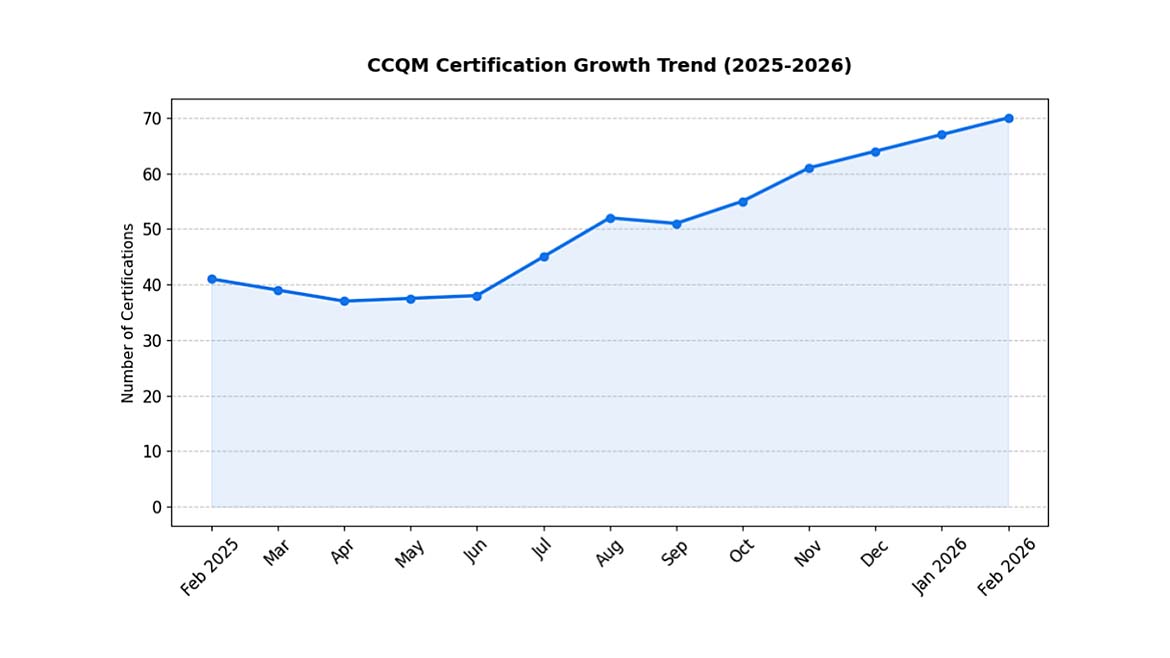
Image Credit: ASQ
A closer look at the “Certification Growth Trend” chart reveals a notable “Accelerated
Momentum” phase starting in August 2025. Since that surge, the volume has consistently stayed above 50 certifications per reporting period, eventually reaching its peak performance in February 2026. This trend suggests that the CCQM is moving from an “early adopter” phase into a mainstream industry requirement as firms recognize the competitive advantage of having certified leaders at the helm of their quality departments.
Geographic Hubs: A Tale of Two Regions
While the CCQM has a presence across eight global regions, the data reveals a high level of geographic concentration (Fig 2). The “Pareto Chart of Certifications by Country” highlights that the top five countries—the United States, Saudi Arabia, India, Canada, and Qatar—represent approximately 81.8% of all certifications.
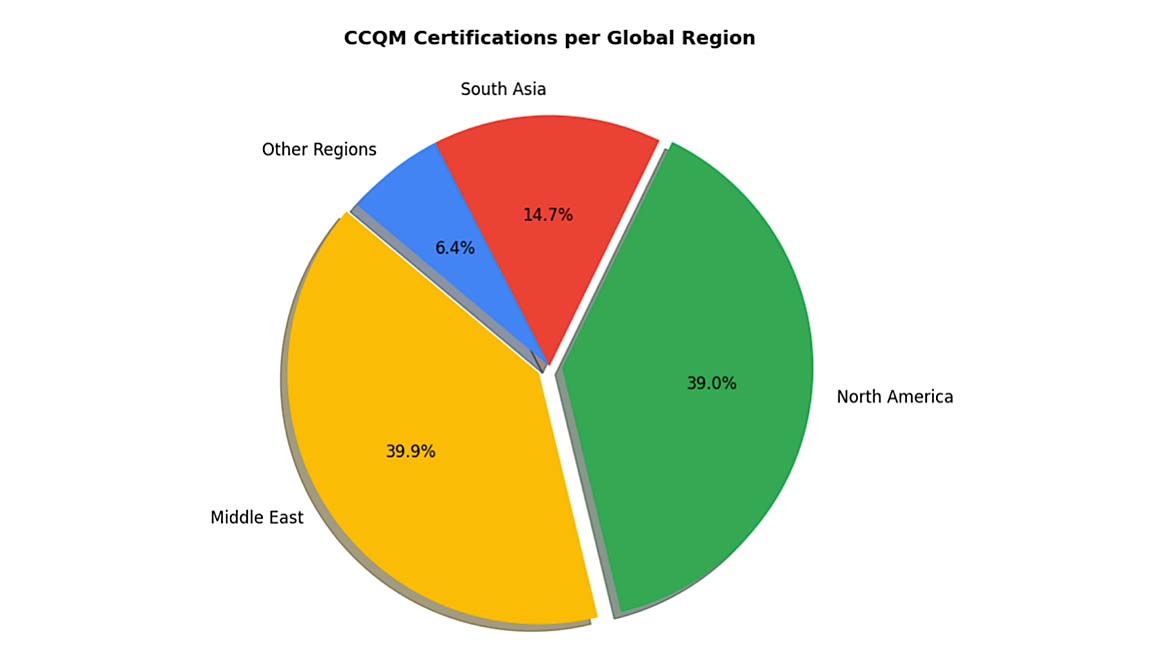
Image Credit: ASQ
- The North American Stronghold: With 135 total certifications, North America remains a dominant force. The United States leads the world with 112 certifications, while Canada follows with 20. This concentration likely reflects the region’s focus on aging infrastructure renewal and the implementation of new federal quality standards in large-scale public works.
- The Middle East Powerhouse: Closely following North America, the Middle East has emerged as a major regional hub with 138 certifications. Saudi Arabia is the primary driver here, holding 91 certifications—the second-highest total globally.
- The Riyadh Influence: Perhaps the most striking insight is the dominance of Riyadh. With 31 certification holders, Riyadh has the highest number of certified professionals of any city by a wide margin. This is nearly triple the number of the next closest city, Doha, which has 12. This surge is likely tied to massive infrastructure projects like Vision 2030, where standardized quality management is vital for the success of “Giga-projects.”
Beyond the Numbers: Extended Interpretation
The geographic data tells us more than just where people live; it tells us where the industry is professionalizing most rapidly. The emergence of India (43 certifications) as the third-largest market suggests that as South Asia undergoes a construction boom, there is a growing demand for internationally recognized quality credentials to attract foreign investment and ensure project durability. (Fig. 3)
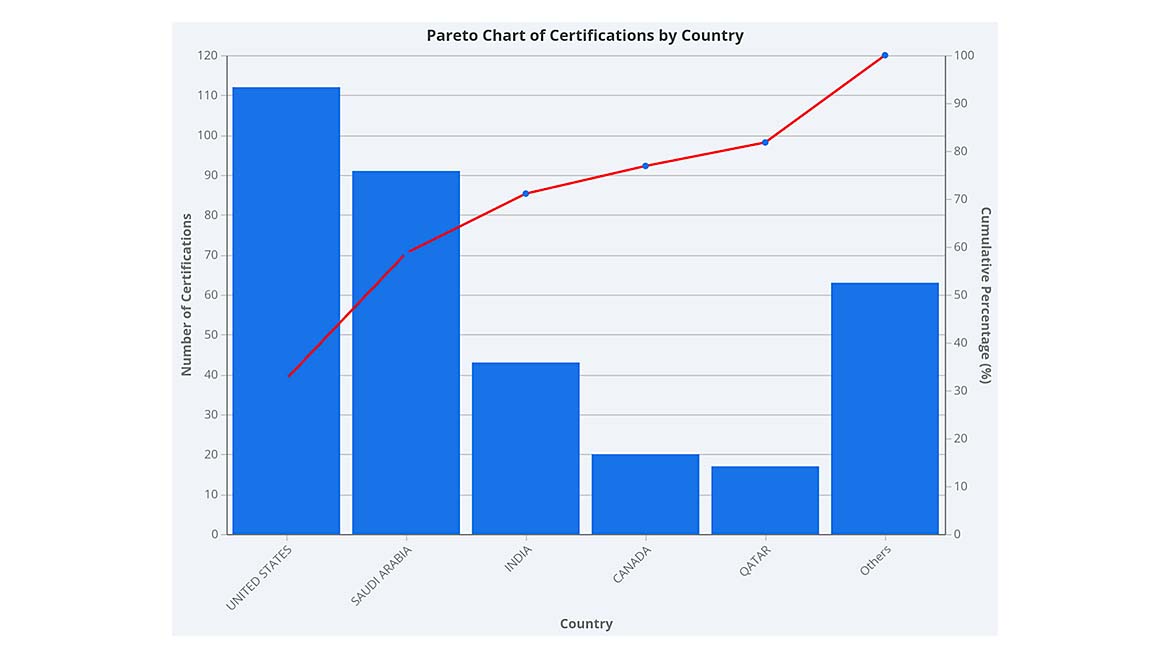
Image Credit: ASQ
Furthermore, the “August surge” in certifications corresponds with a broader industry trend toward “Quality 4.0”—the integration of digital tools and data analytics into the construction process. As firms adopt building information modeling (BIM) and automated inspection tools, they require managers who understand the fundamental Body of Knowledge (BoK) that the CCQM covers: from design phases to operations and maintenance.
Conclusion: The Road Ahead
The growth of the CCQM program is a testament to the construction industry’s commitment to excellence. With a 70% year-over-year increase in certifications and a growing footprint in eight global regions—including emerging bases in Africa, Europe, and Oceania—the CCQM is well on its way to becoming the global benchmark for construction quality management.
Future Opportunities:
- Regional Expansion: While the Middle East and North America lead, there is significant room for growth in Europe (five certifications), South East Asia (nine certifications) and South America (one certification), where sophisticated infrastructure markets could benefit from standardized quality frameworks.
- Career Advancement: For the individual professional, the trend is clear. Certification holders are increasingly positioned for senior leadership roles, with some industry surveys suggesting certified managers can earn significantly more than their non-certified peers.
As we look toward 2027 and beyond, the CCQM will continue to serve as a cornerstone for those dedicated to driving not just quality, but the sustainability and safety of the world's most critical infrastructure.
Looking for a reprint of this article?
From high-res PDFs to custom plaques, order your copy today!