Nondestructive testing has never been more essential to public safety, infrastructure reliability, and industrial quality, yet the profession faces a mounting workforce challenge.
We all have likes and dislikes. When I was young, I liked to wear sneakers and play; what kid didn’t? Sunday mornings were the worst; not only did attending church cut into playtime, but I had to dress up and wear shoes.
Today’s planning tools enhance the ability to tailor inspections to asset-specific conditions, but they do not eliminate the necessity of engineering judgement.
Modern nondestructive testing (NDT) is undergoing measurable change across multiple stages of the inspection cycle, to include planning, data acquisition, analysis, and personnel training and qualification.
In assessing how digital learning might be introduced responsibly, BINDT is also informed by regulatory guidance from adjacent safety-critical sectors.
The British Institute of Non-Destructive Testing (BINDT) Burns Supper Seminar, held in January, provided a timely forum for industry discussion on professional development, competence assurance, and the evolving demands placed on technical training systems.
Bennie Caldwell is the director of quality at Bullen Ultrasonics. He oversees the full spectrum of quality operations, including quality engineering, CMM programing, calibration, and final inspection. He also recently wrote an article for Quality.
The idea of the ‘dark factory’ has gained new attention as advances in robotics and AI accelerate. Stories range from fully automated automotive plants that operate around the clock and lights-out facilities in China, to experiments with humanoid robots on production lines, often framed as early signs of factories that no longer require people on the shop floor.
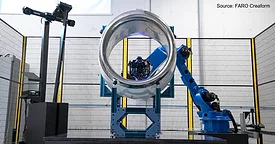
FARO Creafom, a business of AMETEK, Inc. and global provider of 3D scanning and portable CMM solutions, announced the next evolution in automated quality control for at-line inspection in mass production: the CUBE-R M Series.