Quality Magazine logo
search
cart
facebook twitter linkedin youtube
  • Sign In
  • Create Account
  • Sign Out
  • My Account
Quality Magazine logo
  • NEWS
  • PRODUCTS
    • FEATURED PRODUCTS
    • SUBMIT YOUR PRODUCT
  • CHANNELS
    • AUTOMATION
    • MANAGEMENT
    • MEASUREMENT
    • NDT
    • QUALITY 101
    • SOFTWARE
    • TEST & INSPECTION
    • VISION & SENSORS
  • MARKETS
    • AEROSPACE
    • AUTOMOTIVE
    • ENERGY
    • GREEN MANUFACTURING
    • MEDICAL
  • MEDIA
    • A WORD ON QUALITY PUZZLE
    • EBOOK
    • PODCASTS
    • VIDEOS
    • WEBINARS
  • EVENTS
    • EVENT CALENDAR
    • IMTS
  • DIRECTORIES
    • BUYERS GUIDE >
      • Supplier Insights
    • NDT SOURCEBOOK
    • VISION & SENSORS
    • TAKE A TOUR
  • INFOCENTERS
    • Digital Quality Management Systems
    • NEXT GENERATION SPC & QUALITY ANALYTICS
  • AWARDS
    • ROOKIE OF THE YEAR
    • PLANT OF THE YEAR
    • PROFESSIONAL OF THE YEAR
  • MORE
    • Expert Columns
    • NEWSLETTERS
    • QUALITY STORE
    • INDUSTRY LINKS
    • SPONSOR INSIGHTS
  • EMAG
    • eMAGAZINE
    • ARCHIVES
    • CONTACT
    • ADVERTISE
  • SIGN UP!
Automation

Robotics

The ‘Dark Factory’ Myth

Why Human-in-the-Loop Manufacturing Still Drives Progress
By Erik Nieves
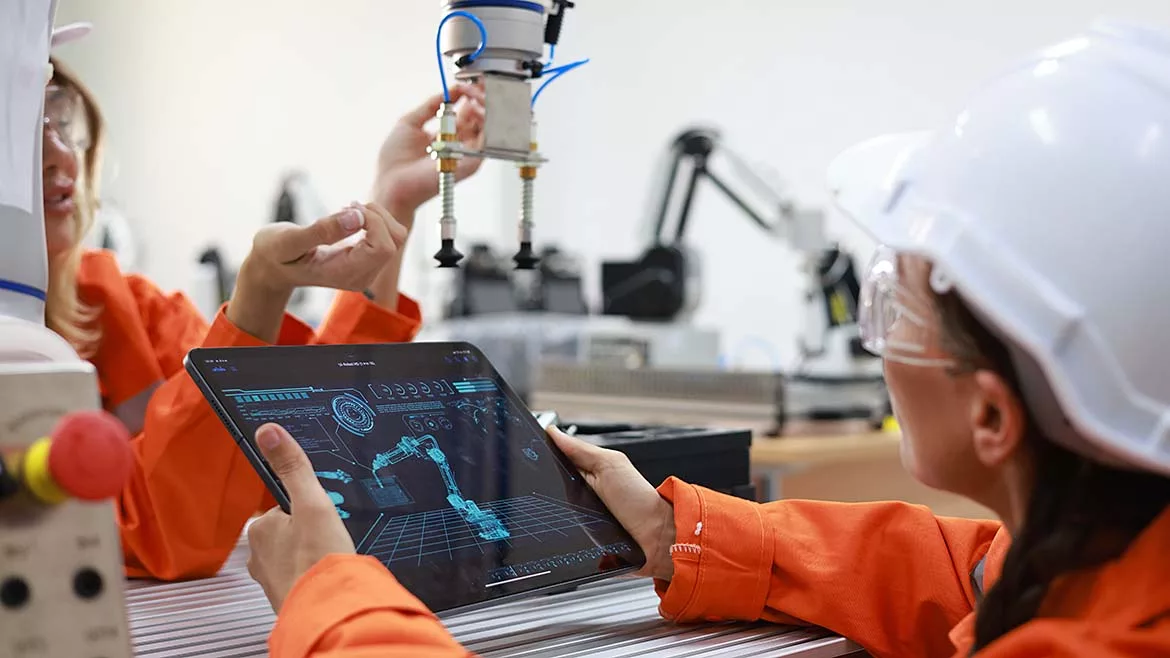
This image depicts a high-tech industrial robotics laboratory featuring workers interacting with robotic arms.
Image credit: onuma Inthapong / E+ (Royalty-free).
March 6, 2026

The idea of the ‘dark factory’ has gained new attention as advances in robotics and AI accelerate. Stories range from fully automated automotive plants that operate around the clock and lights-out facilities in China, to experiments with humanoid robots on production lines, often framed as early signs of factories that no longer require people on the shop floor.

These headlines often oversimplify complex realities. While it is true that robots are becoming more capable and machines are handling more tasks than ever before, there is also a lot of hype about tools that are sometimes described as “GPT for robots.”

The general idea behind this is that AI could soon control machines in ways that remove humans from the manufacturing loop entirely. But, observers and industry analysts agree that manufacturing progress still depends on humans working with machines. The future will not be a fully lights-out, human-free operation.

It’s important to ground the discussion in how manufacturing systems actually operate today, where technology adds value and where human expertise remains central.

What is a ‘Dark Factory’?

A dark factory refers to a production facility designed to operate without human workers on the factory floor. The term implies that robots handle all assembly, inspection and material movement, eliminating the need for lighting, breaks or shift changes.

Analysts expect that by 2030, there could be at least one fully automated automotive assembly plant operating in either China or the U.S. This plant would be capable of producing vehicles with no humans directly involved, relying entirely on robotics and automation systems.

This projection has contributed to the growing hype around autonomous manufacturing and the belief that human labor may soon be unnecessary in production environments. But, the same reporting also highlights how limited and specialized such facilities would be, even if they did become operational.

Behind the Rapid Advancement of Automation

Manufacturing has made steady gains in robotics, sensors and automation over the last several decades. Today’s robots are faster, more precise and more flexible than earlier generations. Vision systems and sensors allow machines to identify defects, guide motion and verify quality at high speed.

Some manufacturers are already operating highly automated facilities where robots perform most assembly tasks, particularly in areas like welding, painting and material handling. Those advances in manufacturing innovation allow manufacturers to improve consistency, increase throughput and reduce exposure to hazardous tasks. In controlled environments with stable product designs, automation can deliver strong returns.

At the same time, these systems are not self-directing. They require extensive programming, calibration and oversight. When production conditions change, humans are still responsible for adapting the system.

The Limitations of Fully Autonomous Manufacturing

Even in the most automated automotive plants, humans remain essential. There are many tasks that are still difficult to automate reliably, such as those involving variability, fine manipulation and judgement. Examples include installing flexible components, responding to unexpected defects and adjusting processes during launch phases.

Fully autonomous factories are also expensive and complex to design. They work best when producing high volumes of highly standardized products. Many manufacturers operate mixed-model lines, frequent product refreshes or customized builds — all of which increase reliance on human adaptability.

As a result, most manufacturers are not pursuing full lights-out operations across their networks. Instead, they are selectively applying robotics where it adds the most value, while keeping people involved in supervision, quality control and continuous improvement.

Human-in-the-Loop is the Real Model

The human-in-the-loop approach reflects how modern manufacturing actually works. In this model, robotics and automation systems handle repetitive and physically demanding tasks, while humans remain responsible for interpreting data, making decisions and redesigning processes.

Even as robotics capabilities expand, people are still needed to manage expectations, troubleshoot issues and improve workflows.

Robots execute predefined actions. People decide whether those actions are producing the desired outcome. Engineers analyze performance data, identify root causes of defects and determine when automation strategies should change. This collaboration is what enables manufacturing systems to evolve rather than simply reset.

Human-in-the-loop manufacturing also supports safer operations. When humans oversee automated systems, they can intervene when conditions deviate from expectations. This reduces risk and protects both equipment and output quality.

Implications for Manufacturing Strategy

For manufacturers evaluating automation roadmaps, robotics and autonomous systems should be viewed as tools that enhance human capabilities, not replacements for them. The most effective operations strategy should balance automation with skilled human oversight.

This balance allows manufacturers to deploy robotics where they are most helpful while preserving flexibility. People provide the creativity and judgement needed to redesign processes, launch new products, and respond to unexpected disruptions.

Moving beyond the Dark Factory Myth

The Dark Factory remains a compelling idea, but it does not reflect how manufacturing excellence is achieved today. Fully autonomous plants may exist in limited cases, but they are not the dominant or most practical model for most.

READ MORE

  • Why 2026 Will Bring a Reckoning for Warehouse Robotics  
  • Exploring the Persistent Dominance of Human-Centered Automation in Robotics 
  • PODCAST | Trends in Robotics for the New Year 
KEYWORDS: Artificial Intelligence (AI) manufacturing metrology quality robotics

Share This Story

Looking for a reprint of this article?
From high-res PDFs to custom plaques, order your copy today!

Erik Nieves is the CEO and co-founder of Plus One Robotics

Recommended Content

JOIN TODAY
to unlock your recommendations.

Already have an account? Sign In

  • 2024 Quality Rookie of the Year Justin Wise 1440x750px banner with "Quality Rookie of the Year" logo inset

    Meet the 2024 Quality Rookie of the Year: Justin Wise

    Justin Wise is an exceptional individual who has been...
    Aerospace
    By: Michelle Bangert
  • Man with umbrella and coat stands outside while it rains at night looking at a building.

    Nondestructive Testing: Is there an ethics problem?

    I was a whistleblower who exposed fraudulent activities...
    NDT
    By: Dale Norwood
  • Unraveling Deflategate: Football stadium with closeup of football on field

    Unraveling the Tom Brady Deflategate

    The Deflategate scandal erupted following the 2014 AFC...
    Measurement
    By: Greg Cenker and Henry Zumbrun
Manage My Account
  • eMagazine Subscriptions
  • Newsletters
  • Online Registration
  • Subscription Customer Service
  • Manage My Preferences

More Videos

Sponsored Content

Sponsored Content is a special paid section where industry companies provide high quality, objective, non-commercial content around topics of interest to the Quality audience. All Sponsored Content is supplied by the advertising company and any opinions expressed in this article are those of the author and not necessarily reflect the views of Quality or its parent company, BNP Media. Interested in participating in our Sponsored Content section? Contact your local rep!

close
  • Key Takeaways for Quality Leaders
    Sponsored byComplianceQuest

    Key Takeaways for Quality Leaders from the 2026 Gartner Magic Quadrant™ for QMS

  • This image shows a person seated next to a Bobcat T66 compact track loader.
    Sponsored byPolyWorks by InnovMetric

    Supercharging Digital Gauging at Bobcat North America

  • Dorsey Calibration Lab photo by Tom LaBarbera Picture this Studios
    Sponsored byDorsey Metrology International

    Ensuring Product Quality in a Competitive Manufacturing Landscape

Popular Stories

This image shows a person seated next to a Bobcat T66 compact track loader.

Supercharging Digital Gauging at Bobcat North America

a professional in the aviation field performing maintenance, repair, and overhaul (MRO) work

Manufacturing Retention: Strategies for Improving Company Culture, Engagement and Skill Development

Dorsey Calibration Lab photo by Tom LaBarbera Picture this Studios

Ensuring Product Quality in a Competitive Manufacturing Landscape

2026 Quality Professional of the Year!

Events

June 22, 2026

Automate 2026

Automate is North America's largest robotics and automation event — and the best place to take your ideas from insight to impact.
 
Our show floor features the world’s leading automation solutions, from AI and robotics to motion control, vision systems, and more. Plus, our educational conference is second to none, led by the brightest minds in automation today.
 
Ready to transform the way you work? Take the next step at Automate.
July 14, 2026

Quality Leaders Forum: Better Communication, Better Quality Data

The Quality Leaders Forum is a quarterly, editor-moderated fireside chat series hosted by Quality Magazine, featuring candid conversations with senior manufacturing and operations executives shaping enterprise-level quality.

View All Submit An Event

Products

Lean Manufacturing and Service Fundamentals, Applications, and Case Studies

Lean Manufacturing and Service Fundamentals, Applications, and Case Studies

See More Products
Quality Podcast Channel Custom Content

Related Articles

  • QM 0222 CLMN Face of Quality Jim Smith 1170x658

    Failure is a Myth

    See More
  • Through Heat or Dirt and Dark of Night ...

    See More
  • This image shows a manufacturing employee inspecting a MEMS glass wafer, which is a component used in medical equipment like ventilators. Bullen-p1FT-Bullen---Bullen-inspection-of-ultrasonically-machined-CVD-Silicon-Carbide.jpg

    Quality as the Connective Tissue: Reframing the Role of Quality on the Factory Floor

    See More

Related Products

See More Products
  • Incorporating Lean: From the Factory to Front Office DVD

  • Getting Factory Automation Right (The First Time)

  • Optimizing Factory Performance: Cost-Effective Ways to Achieve Significant and Sustainable Improvement

See More Products

Related Directories

  • Factory Systems

    Factory Systems is a software solutions company elevating manufacturers in the collection and analysis of production and quality data. Our systems collect data off a factory floor from any input and import it into a database where your data can be used to generate reports, charts, on-boards and more.
×

Stay in the know with Quality’s comprehensive coverage of
the manufacturing and metrology industries.

Newsletters | Website | eMagazine

JOIN TODAY!
  • RESOURCES
    • Advertise
    • Contact Us
    • Directories
    • Manufacturing Division
    • Store
    • Want More
  • SIGN UP TODAY
    • Create Account
    • eMagazine
    • Newsletters
    • Customer Service
    • Manage Preferences
  • SERVICES
    • Marketing Services
    • Market Research
    • Reprints
    • List Rental
    • Survey/Respondent Access
  • STAY CONNECTED
    • LinkedIn
    • Facebook
    • YouTube
    • X (Twitter)
  • PRIVACY
    • PRIVACY POLICY
    • TERMS & CONDITIONS
    • DO NOT SELL MY PERSONAL INFORMATION
    • PRIVACY REQUEST
    • ACCESSIBILITY

Copyright ©2026. All Rights Reserved BNP Media, Inc. and BNP Media II, LLC.

Design, CMS, Hosting & Web Development :: ePublishing