Battery manufacturing quality in the automotive industry is becoming increasingly important with the growing popularity of electric and hybrid-electric vehicles.
As a technology, automated inspection has transformed the manufacturing industry, In addition, automated inspection is used in life sciences and pharmaceuticals, where its applications can range from reducing the probability of cross-contamination to identifying abnormalities in cells.
Lighting represents a crucial consideration when designing and specifying a system, as it is fundamental to image quality. Understanding how lighting impacts the rest of the system lays the foundation for system success.
Camera sensors and new machine vision applications tend to drive parallel advances in optics, and optics suppliers must continually evolve as machine vision technologies progress.
CLHS specification 1.2 recently introduced the 25 Gbps speed along with the QSFP28, SFP28, and MPO connectors. The committee has proof of concept to achieve 50 Gbps using the same IP core, ensuring an easy transition to future speeds.
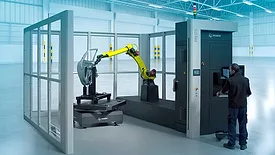
Automated quality control systems improve the manufacturing process efficiency and effectiveness while simultaneously reducing the potential for human error and boosting the final product’s overall quality — and robotics and sensors play a critical role.
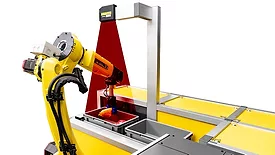
Since the beginning of modern industrial robots in the early 1980s, robots have been guided by machine vision. Originally there were only a few robots with vision, but today it is over 5,000 robots annually in the North American market and significantly more globally.
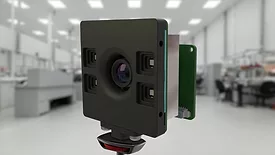
FRAMOS announced the launch of a new development kit for vision system engineers who are working to develop Time-of-Flight devices for industrial and robotics applications.