In his article for Computerworld, Paul Glen recounts that when most executives have told him that their operations require more accountability what they are really saying is that they need someone to blame.
As we consider the possibility that products can be manufactured anywhere in the world, we must also think about the specifics of the standard we use to describe the product requirements.
GD&T is widely considered to be an essential tool for communicating design intent and ensuring parts meet the desired form, fit, function and assembly.
The central concept behind model-based definition (MBD) is that the digital model contains all of the detailed information necessary for all aspects of the product life cycle.
In mass-production industries, it has been realized that Product Design (PD) departments and Manufacturing Engineering (ME) departments under the same organization show quite different interests in the same product line.
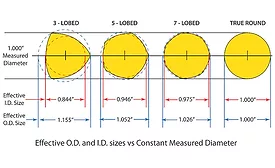
While John Goodman and Arnold Schwarzenegger are both 6’2”, few would argue that they have similar body shapes. What this says, simply, is that measuring size does not necessarily say anything about shape.
What is GD&T? GD&T, namely “Geometric Dimensioning & Tolerancing,” is a symbolic language with which to 1) research, 2) refine and 3) ultimately “encode” the functions of each feature of a machine part by specifying permissible limits of imperfection.